
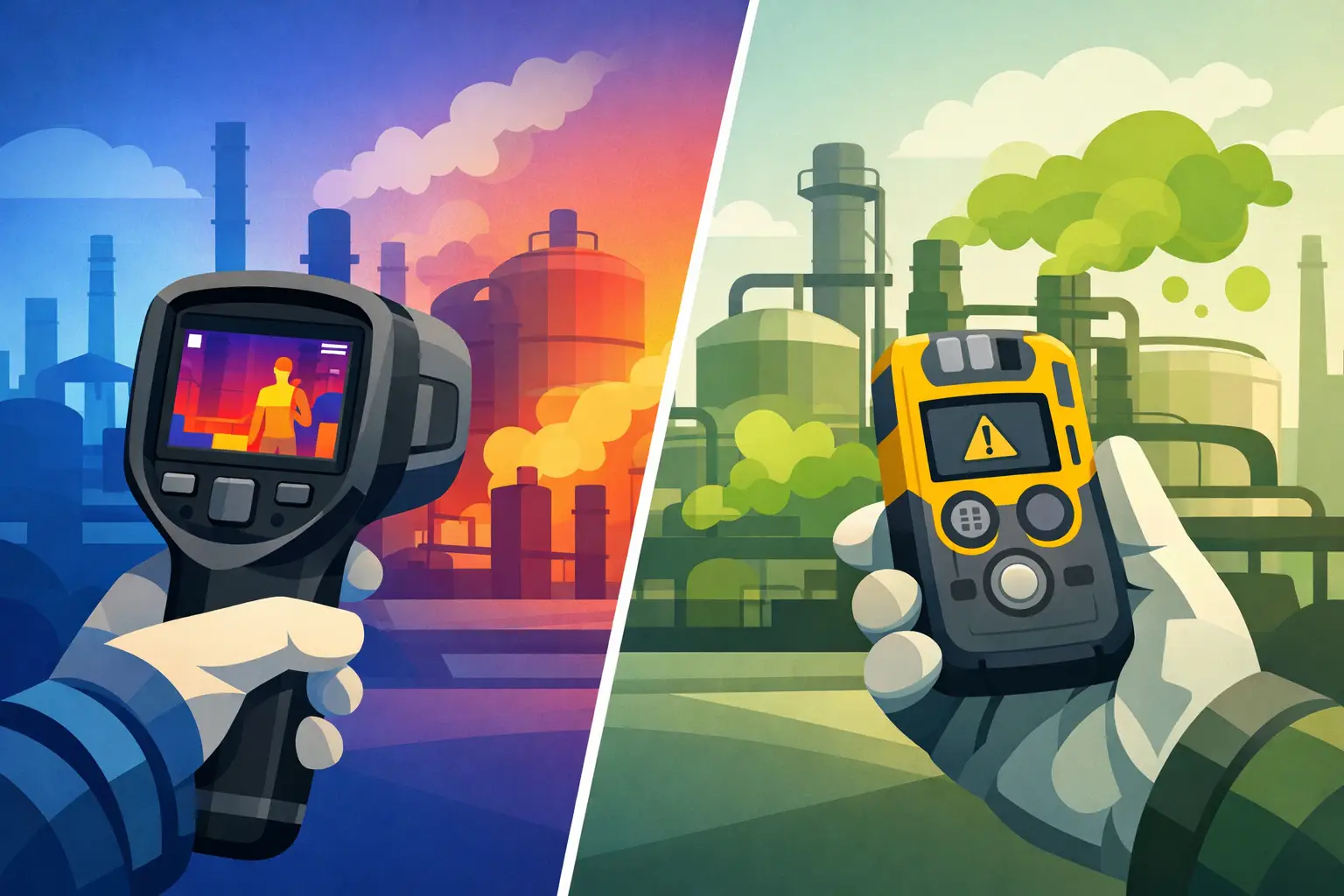
A hydrocarbon release rarely occurs where teams have the clearest line of sight. It can begin high on a pipe rack, around a compressor seal, beneath a loading arm, or along an offshore process module exposed to wind and salt. The decision between thermal cameras versus gas detectors determines whether an operation receives an alarm at one point, visual confirmation across an area, or the layered coverage needed to protect people, production, and assets.
For refinery, chemical, power, marine, and oil and gas operators, this is not a simple technology choice. A fixed gas detector and a gas-imaging thermal camera solve different parts of the same risk. Specifying one as a substitute for the other can create blind spots, slow investigations, or add equipment that does not perform in the real operating environment.
Thermal Cameras Versus Gas Detectors: The Core Difference
A fixed gas detector measures the presence of a specific gas or gas group at its installation point. Depending on the sensing technology, it can provide an alarm when concentration reaches a configured threshold. These detectors are central to emergency shutdown logic, hazardous-area monitoring, ventilation control, and personnel safety strategies.
A gas-imaging thermal camera, often called an optical gas imaging camera, detects certain gas emissions by viewing how the gas absorbs infrared energy in a selected spectral band. Rather than reporting only that gas has reached one sensor, the camera can show a moving plume and its apparent release location across a monitored scene. This makes it a powerful surveillance and investigation tool for valve banks, flare systems, tank farms, compressor areas, manifolds, marine fuel systems, and perimeter process zones.
The distinction matters: not every thermal camera is a gas detection camera. A standard thermal surveillance camera is designed to show heat contrast between objects. It may identify a hot motor, an overheating electrical connection, or a person in low light, but it will not reliably visualize methane or volatile organic compound emissions. Gas detection requires a camera with the correct cooled sensor and optical filtering for the target gas.
Where Fixed Gas Detectors Deliver the Strongest Value
Point gas detectors are the right choice when an operation needs a dependable alarm at a known accumulation point. They are particularly effective in enclosed or semi-enclosed spaces where gas behavior is understood, such as turbine enclosures, compressor buildings, pump rooms, engine rooms, battery spaces, and ventilation ducts.
Their major advantage is direct concentration monitoring. A properly selected and positioned detector can trigger alarms and automated responses according to a documented safety philosophy. For toxic gases such as hydrogen sulfide, carbon monoxide, chlorine, or ammonia, this concentration-based response is essential. A camera may help identify the origin of a release, but it does not replace the need to measure personnel exposure risk.
Gas detectors also support established control-system integration. They can report fault status, alarm levels, calibration conditions, and live readings to a central platform. In a critical facility, that predictable signal path is often non-negotiable.
However, point detectors have a physical limitation: they only detect gas that reaches them. Wind direction, ventilation patterns, gas density, structural obstructions, and release pressure can carry a plume away from the detector. Expanding coverage means adding more detectors, more cable runs, more junction boxes, and more maintenance points.
Where Gas-Imaging Thermal Cameras Take the Lead
A properly specified optical gas imaging camera gives operators scene-wide visibility. Instead of waiting for a plume to reach a point sensor, a control room can observe a suspected release near its source. This is valuable in large, open, congested, or difficult-to-access areas where installing dense detector coverage is expensive or impractical.
For methane and hydrocarbon monitoring, the camera’s greatest operational benefit is localization. An alarm or inspection finding can become a visual event: operators can identify whether the release is coming from a flange, valve stem, drain, tank vent, loading connection, or a nearby process component. This shortens the time between detection, verification, isolation, and repair planning.
Cameras also create a usable evidentiary record. Recorded video can support incident review, maintenance prioritization, contractor accountability, and leak-repair verification. Remote access allows security teams, engineers, and operations management to review conditions without immediately sending personnel into a potentially hazardous zone.
At offshore facilities and marine terminals, this capability is especially valuable. Elevated structures, restricted access, corrosive conditions, and changing weather make conventional inspection more difficult. A fixed, hazardous-area-rated gas-imaging camera can maintain coverage of selected high-risk assets while reducing unnecessary exposure for technicians.
The Limits of Thermal Gas Imaging
Gas-imaging cameras are high-value detection assets, but they are not universal gas monitors. Their effectiveness depends on the target gas, sensor configuration, viewing angle, distance, background temperature contrast, humidity, wind, weather, and the size and movement of the release.
A camera must be selected for the gases the facility needs to identify. Methane, sulfur hexafluoride, certain refrigerants, and volatile organic compounds have different infrared absorption characteristics. A camera configured for one application may not be appropriate for another. Procurement teams should require a clear statement of detectable gases and expected performance conditions rather than accepting a generic claim of “gas detection.”
Cameras are also not normally used to provide a precise concentration reading at a worker’s breathing zone. They show visual evidence of a plume under suitable conditions, not a substitute for toxic gas concentration monitoring or a personal protection program. If the hazard analysis requires alarm thresholds in parts per million or percentage of lower explosive limit, fixed detection remains necessary.
Optics require a clean field of view. Salt spray, dirt, steam, ice, process residue, vibration, and physical obstructions can degrade performance. Marine and industrial deployments need appropriate housings, environmental protection, stable mounting, cleaning access, and planned maintenance. Buying the camera without engineering the installation is a false economy.
Selecting the Right System for Each Risk Zone
The most effective strategy is usually a layered design, not an either-or decision. Use fixed gas detectors where the consequence of gas accumulation requires immediate concentration-based alarm and automated action. Use optical gas imaging cameras where wide-area observation, early leak localization, remote verification, and recording deliver better operational control.
For example, a compressor enclosure may need fixed combustible and toxic gas detectors connected to shutdown logic. A gas-imaging camera can monitor the external compressor train, associated pipework, and vent points, helping teams locate fugitive emissions before they become a larger release. The detector protects the enclosed hazard; the camera extends situational awareness around it.
At a tank farm, fixed detectors may be concentrated around loading bays, pump skids, and enclosed control points. Cameras can oversee tank vents, transfer lines, manifold areas, and high-level pipe routes where gas movement is unpredictable. On a vessel, detector coverage remains essential in engine rooms and enclosed machinery spaces, while camera coverage can strengthen oversight of fuel handling areas and exposed deck equipment.
Procurement Questions That Prevent Costly Gaps
Before selecting equipment, define the gas hazard, expected release scenarios, area classification, required response time, and integration path. A low price does not compensate for a detector installed outside the likely plume path or a camera unable to visualize the gas of concern.
Ask suppliers to confirm the target gases, detection principle, hazardous-area approvals, operating temperature range, ingress protection, corrosion resistance, network requirements, recording options, alarm interfaces, and maintenance needs. For cameras, evaluate lens selection and field of view against the actual site layout. A wide scene is not automatically better if the target components are too distant to assess.
Network design deserves the same attention as sensor selection. Industrial cameras require reliable power, bandwidth, recording capacity, cybersecurity controls, and alarm integration. Offshore and remote sites may need hardened network infrastructure and resilient communications to preserve live viewing and video evidence during a process event.
Acceptance testing should reflect real conditions. Verify detector response and alarm logic. For camera systems, test representative viewing distances, likely release positions, expected weather conditions, and control-room workflows. The objective is not simply to prove that equipment powers on. It is to prove that operators can recognize, confirm, escalate, and act on a credible leak event.
Build Detection Around the Decision You Need to Make
Choose fixed gas detectors when the immediate question is, “Has gas concentration reached an unsafe level here?” Choose gas-imaging thermal cameras when the question is, “Where is the release, how is it moving, and what equipment is involved?” In critical industrial environments, the strongest answer is often both: concentration alarms for protection and visual intelligence for faster, more confident response.
A well-engineered detection plan turns surveillance equipment from a box on a specification sheet into a practical advantage. It gives control rooms clearer evidence, maintenance teams better repair targets, and operations leaders a stronger basis for protecting uptime, people, and high-value infrastructure.
🛡️ Secure Your Home or Business Today
Protect your home, office, shop, or business with reliable CCTV security cameras. Explore our range of CCTV cameras and find the right security solution for your needs.
Explore CCTV Cameras ✉️ Email Us


 Singapore :
+65-6708-9302
Singapore :
+65-6708-9302