
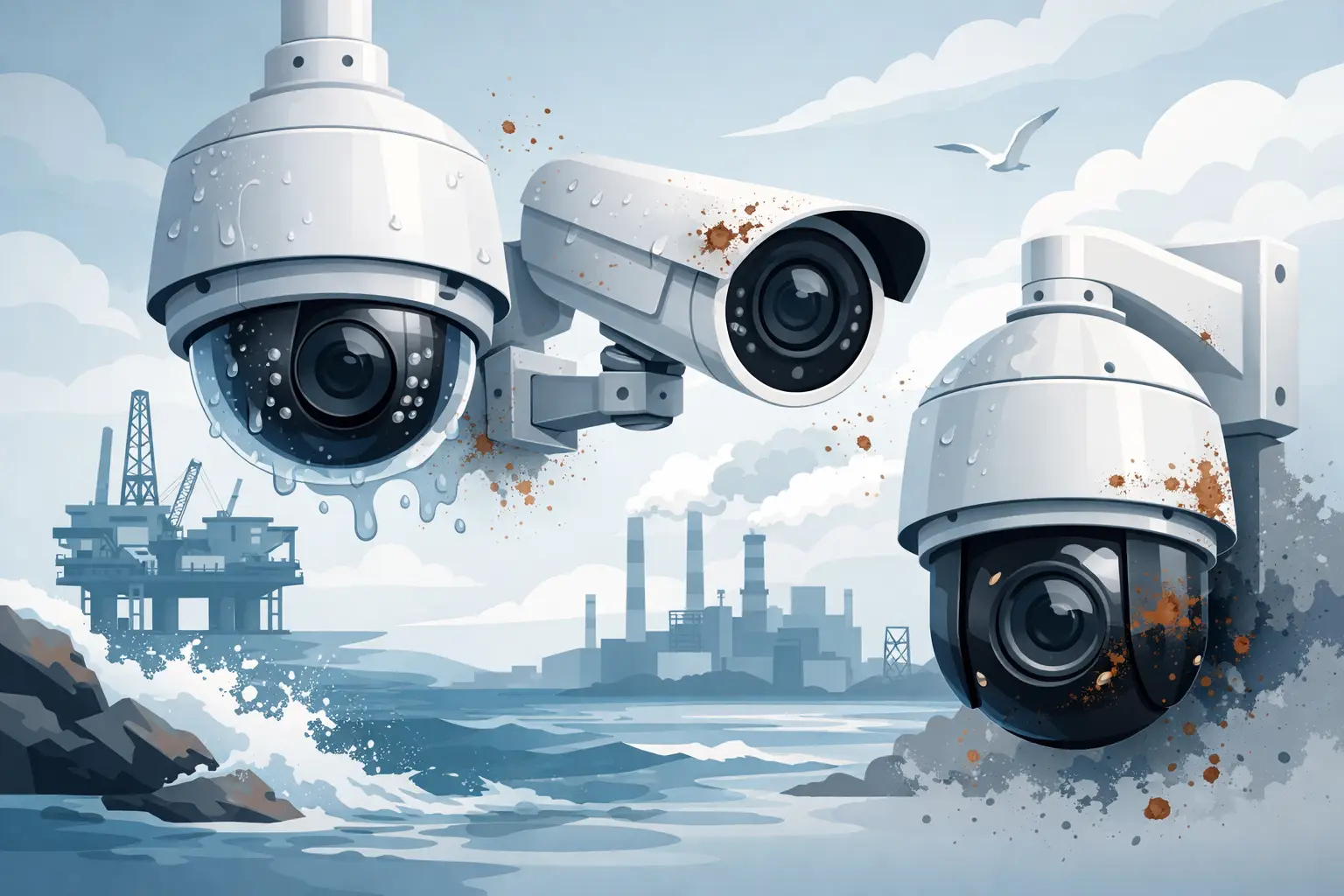
Salt spray destroys weak hardware fast. On a vessel deck, offshore platform, refinery perimeter, or chemical loading area, a standard camera can start failing long before the site team expects it. That is exactly why anti corrosion security cameras matter. They are built for locations where moisture, chemicals, salt, and airborne contaminants turn ordinary surveillance equipment into a maintenance problem.
For industrial operators, this is not a cosmetic issue. Corrosion affects image stability, enclosure seals, connectors, mounting points, and long-term network reliability. When surveillance goes down in a hazardous or remote area, the cost is not just replacement hardware. It can mean downtime, extra labor, delayed inspections, reduced situational awareness, and gaps in incident records. Buyers in marine, oil and gas, energy, and heavy process industries need systems engineered for the environment first, then specified for coverage and analytics.
Why anti corrosion security cameras are different
A camera rated for indoor commercial use and a camera designed for corrosive industrial service may look similar on a spec sheet at first glance. The difference shows up in the housing materials, surface treatment, sealing design, fasteners, brackets, cable glands, and testing standards.
Anti corrosion security cameras are typically built with stainless steel housings, marine-grade alloys, or specialized protective coatings designed to resist oxidation and chemical attack. In harsh coastal and offshore environments, 316L stainless steel is often preferred because it performs better than painted aluminum or lower-grade metals when exposed to salt-laden air. In chemical plants, material compatibility becomes even more specific because certain compounds can attack coatings, rubber seals, or metals differently.
The real value is service life. A lower-cost camera can appear attractive during procurement, but if it needs early replacement, repeated cleaning, or frequent seal and bracket work, the total cost climbs quickly. Industrial buyers know the cheapest unit on day one is rarely the cheapest unit over three to five years.
Where anti corrosion security cameras deliver the most value
Marine operators are among the clearest use cases. Cameras installed on open decks, mast structures, loading arms, dock perimeters, and port infrastructure face constant exposure to wind-driven salt, humidity, vibration, and temperature shifts. Even a good imaging module will underperform if the enclosure and fittings degrade.
In offshore oil and gas, the challenge expands. Equipment may be mounted near flare areas, process zones, helidecks, and platform edges where corrosive conditions combine with hazardous area requirements. Here, buyers often need more than corrosion resistance alone. They may also require explosion-proof or ATEX and IECEx-compliant camera assemblies, depending on the installation zone and local compliance framework.
Refineries and chemical plants have a different risk profile. Corrosion can come from airborne chemicals, washdown routines, steam, and process residue. Cameras in these settings must maintain visibility, seal integrity, and stable network performance even when the environment is aggressive and maintenance windows are tight.
Power stations and nuclear facilities also benefit from corrosion-resistant surveillance, especially in cooling, coastal, and external process areas. The demand is straightforward – stable imaging, dependable uptime, and fewer failures in places where access control and visual verification are critical.
What buyers should look for in anti corrosion security cameras
The first point is housing material. Stainless steel, especially marine-grade variants, usually outperforms general-purpose housings in corrosive settings. That said, material choice still depends on the site. Some installations benefit from specialized coatings or composite protections when specific chemical exposure is known.
The second point is ingress protection. A corrosion-resistant housing means little if water or dust can penetrate seals over time. Industrial buyers should look closely at IP ratings, gasket quality, gland design, and how the camera handles washdown or heavy weather. A strong IP rating is not the whole story, but it is a critical baseline.
The third point is temperature and mechanical durability. Harsh sites do not only corrode equipment. They also expose it to vibration, impact, heat, cold, and pressure changes. A camera deployed on a ship, terminal, or drilling facility needs stable performance across those variables, not just corrosion resistance in isolation.
Optics also matter. If the application involves perimeter coverage, berth monitoring, flare observation, or process oversight, lens selection, low-light performance, infrared support, and image stabilization can be as important as enclosure strength. A camera that survives but fails to deliver useful footage is still the wrong purchase.
Then there is connectivity. Network cameras for industrial use should be chosen with the broader system in mind – recording, playback, remote access, bandwidth conditions, and integration with existing video management or control infrastructure. In remote or offshore operations, the practical question is simple: can the camera deliver reliable video under real site conditions, not ideal lab conditions?
Corrosion resistance is not the same as hazardous area compliance
This is where some buying decisions go wrong. A corrosion-resistant camera may be excellent for marine exposure, but that does not automatically mean it is suitable for hazardous gas or dust zones. If the site includes classified areas, the camera may need certified explosion-proof construction in addition to anti-corrosion protection.
For procurement teams, that means the selection process should begin with the environment profile. Is the main issue saltwater exposure, chemical washdown, explosive atmosphere, temperature variation, or a combination of all four? The right answer often leads to a more specialized product, but it also prevents expensive specification errors.
This is especially relevant in oil terminals, offshore platforms, refineries, and gas processing sites. Choosing a camera based on corrosion resistance alone can leave a compliance gap. Choosing only on hazardous-area certification can leave a durability gap. The strongest specification handles both.
The cost question: higher upfront, lower lifecycle risk
Industrial buyers are measured on budget, but they are also measured on uptime and asset protection. Anti corrosion security cameras usually carry a higher upfront cost than standard commercial models. That is expected. The materials, testing, sealing, and environment-specific engineering are more advanced.
What matters is the lifecycle outcome. Fewer replacements, fewer service visits, lower failure rates, and more stable recording performance can make a corrosion-resistant system the smarter financial decision. This is even more obvious when cameras are installed in hard-to-reach areas such as offshore structures, tank farms, berth towers, and elevated process zones where access costs are significant.
There is a trade-off, though. Not every site needs the highest-spec housing on every camera. Covered areas, internal control spaces, and lower-exposure locations may be well served by other industrial-grade options. A commercially focused buying strategy does not overspecify the whole site. It matches the camera class to the exposure level.
How to specify the right system for your site
The best results come from defining the operating environment before comparing image features. Start with the installation location, expected contaminants, weather exposure, hazardous classification, cleaning regime, and maintenance access. After that, determine the viewing task – perimeter detection, process monitoring, loading observation, access control, or incident recording.
Once those basics are clear, the camera specification becomes more practical. Buyers can assess housing material, mounting hardware, lens type, night performance, network compatibility, and recording requirements with much better accuracy. This avoids the common mistake of buying by resolution alone.
It is also worth asking how the full system will be supported over time. Spare parts availability, installation guidance, and application matching are part of the purchase value. A dependable supplier should be able to explain why one housing, certification level, or imaging format fits a berth, deck, terminal, or refinery unit better than another.
For industrial clients that need serious field performance, Revlight Security focuses on this kind of environment-led surveillance selection. That approach matters because the camera is only one part of the result. The real objective is dependable security coverage where corrosion, weather, and process conditions are constantly working against standard equipment.
Anti corrosion security cameras and long-term site security
A failed camera in a corrosive location is rarely an isolated equipment issue. It can reduce perimeter visibility, weaken incident investigation, and create blind spots around operations that carry real safety and financial consequences. In sectors where assets are exposed, regulated, and costly to access, dependable surveillance infrastructure is a practical business decision.
The strongest camera choice is not the one with the longest feature list. It is the one built for the atmosphere, the duty cycle, and the operational risk of the site. If your environment includes salt, chemical exposure, constant moisture, or harsh weather, anti corrosion security cameras are not a premium extra. They are the standard your site should be built around.
When surveillance hardware matches the environment, your team spends less time dealing with failures and more time protecting the operation.
🛡️ Secure Your Home or Business Today
Protect your home, office, shop, or business with reliable CCTV security cameras. Explore our range of CCTV cameras and find the right security solution for your needs.
Explore CCTV Cameras ✉️ Email Us

 Singapore :
+65-6708-9302
Singapore :
+65-6708-9302