
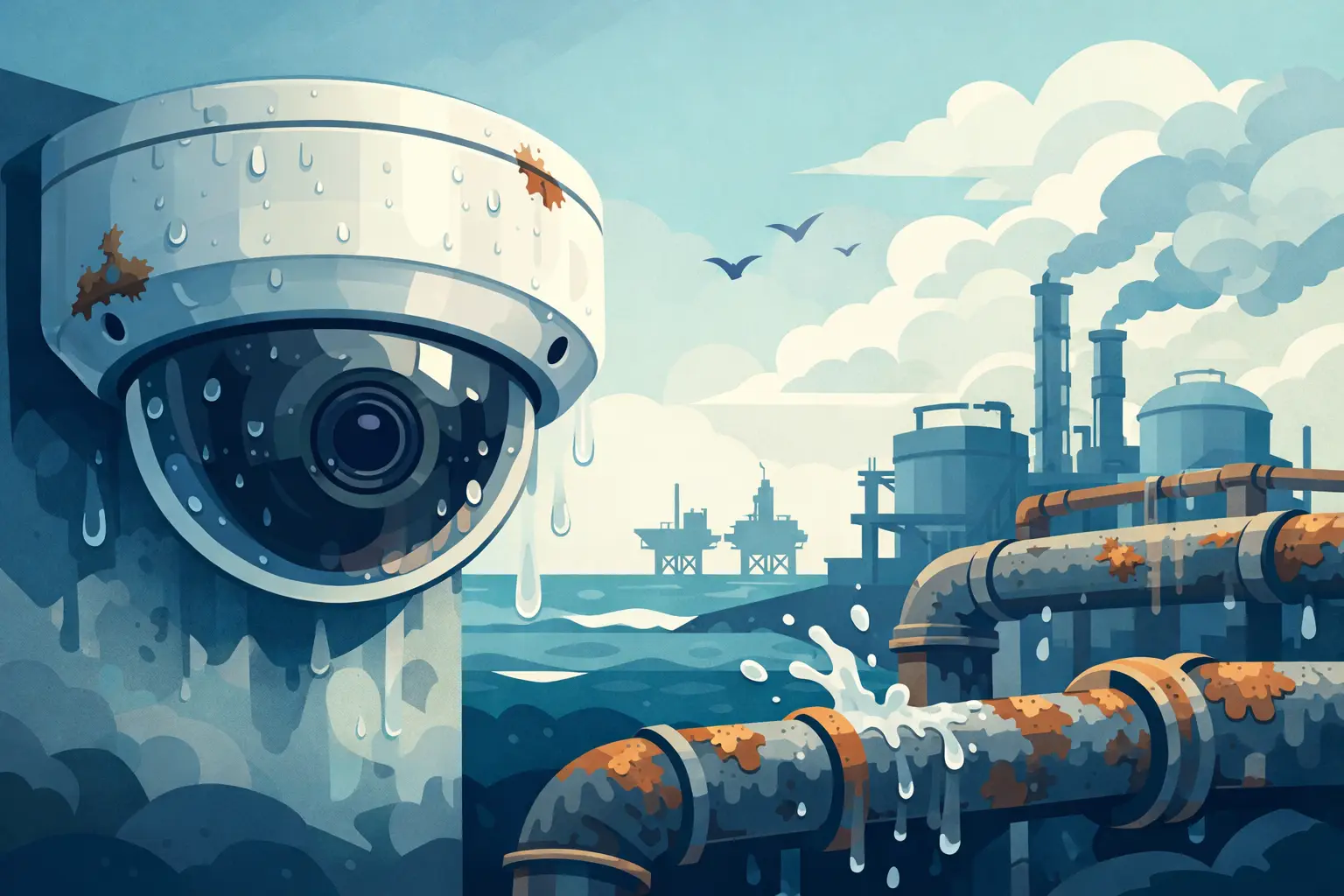
A standard dome that performs well in a warehouse can fail fast on a tanker deck, near a desalination skid, or above a chemical process line. Dome cameras for corrosive environments are built for exactly those conditions, where salt spray, aggressive vapors, humidity, and washdown cycles can destroy housings, cloud domes, and compromise seals long before the imaging system reaches its expected service life.
For procurement teams and operations leaders, this is not a minor specification issue. A failed camera in a corrosive zone creates blind spots, service calls, permit delays, and replacement costs that quickly outweigh the price difference between commercial-grade hardware and industrial surveillance equipment designed for marine, offshore, refinery, and power environments. The right unit protects uptime as much as it protects the site.
What makes corrosive environments so demanding
Corrosion rarely attacks just one part of a camera. It starts at exposed fasteners, cable glands, mounting brackets, and housing joints, then works inward. In marine settings, salt-laden air accelerates oxidation even when the camera is not directly exposed to seawater. In refineries and chemical plants, airborne contaminants, process vapors, and cleaning chemicals can degrade metals, seals, and external finishes much faster than many buyers expect.
The dome bubble itself is also vulnerable. If the material is not suited to the environment, it can haze, craze, or discolor. Once that happens, image quality drops even if the sensor and optics are still working correctly. That means identification performance suffers first, often before the camera is classified as failed.
Temperature cycling makes the problem worse. Equipment exposed to heat during operation and cooler ambient conditions overnight expands and contracts repeatedly. Over time, that movement can weaken seals and invite moisture ingress. Add vibration from engines, pumps, or rotating equipment, and low-grade housings quickly show their limits.
How dome cameras for corrosive environments are engineered differently
Not every industrial camera marketed as rugged is suitable for corrosive exposure. The difference is usually in materials, sealing, and long-term environmental resistance rather than headline resolution alone.
Housing material is one of the first checkpoints. For offshore, marine, and chemical applications, 316L stainless steel is a common requirement because it offers far better corrosion resistance than painted aluminum or lower-grade stainless. In highly aggressive washdown or chemical settings, specialist coatings and non-metallic components may also be part of the solution, but the full assembly matters more than any single material claim.
The sealing system is equally important. A camera body may look solid, but if the gaskets, O-rings, cable entries, and pressure points are poorly specified, moisture and contaminants will find a path inside. Buyers should expect clear ingress protection ratings and should ask how those ratings are maintained once the camera is mounted, wired, and exposed to service conditions.
Then there is the issue of the dome itself. Optical clarity must hold up over time, not only on day one. A corrosion-resistant camera with a low-grade bubble can still become a maintenance problem if the viewing surface degrades under UV exposure, chemical mist, or abrasive cleaning. This is one reason serious industrial operators look beyond brochure claims and evaluate the complete build quality.
Ratings matter, but only when they match the site
The most common buying mistake is treating ratings as a box-ticking exercise. IP66, IP67, or higher can be useful, but ingress protection alone does not confirm resistance to salt, chemicals, or sustained washdown. IK ratings matter where impact resistance is needed, especially on exposed decks or in areas with tools and moving equipment. Hazardous area certifications may also be mandatory in refineries, tank farms, gas processing sites, and certain energy facilities.
That is why site matching matters more than generic rugged claims. A camera overlooking a berth on a marine terminal faces different risks than a unit mounted in a chlorine area, an offshore topside module, or a food-grade washdown zone. The environment determines the correct housing material, the correct certification path, and the likely maintenance interval.
For buyers managing mixed assets, standardization sounds attractive, but a single model is not always the best commercial decision. It often makes more sense to standardize by environment class rather than trying to use one camera everywhere.
Where dome form factors work best
Dome cameras are often chosen because they combine compact installation, directional discretion, and a protected lens area. In industrial sites, that can be a strong advantage in corridors, process buildings, accommodation areas, control access points, loading stations, and covered marine spaces where operators want a lower profile than a full PTZ housing.
They are also useful where tamper resistance matters. A properly designed dome can reduce exposed edges and help protect the imaging core from casual interference. In areas with regular personnel movement, this can be more practical than larger exposed camera formats.
That said, the dome form factor is not automatically the best fit for every corrosive application. If long-range viewing, heavy marine exposure, or extreme washdown is involved, a specialized stainless housing or a dedicated PTZ system may be the better investment. This is where application design should lead the product choice, not aesthetics.
What buyers should ask before specifying dome cameras for corrosive environments
Commercial buyers should push beyond resolution, zoom, and price. The first question is what the camera body, bracket, and fasteners are actually made of. Marketing language can be vague, and mixed-metal assemblies can introduce avoidable corrosion issues even when the main housing looks suitable.
The next question is how the camera handles cable entry and mounting. Weakness often appears at junctions, not in the housing shell itself. A well-specified camera can still underperform if glands, connectors, or adaptors are not chosen for the same environment. This is especially relevant in retrofit projects where legacy mounts or conduit systems are reused.
Cleaning and maintenance should also be discussed early. If the site uses frequent washdown, chemical cleaning, or high-pressure surface treatment nearby, the camera needs to tolerate that routine. Procurement teams should ask what cleaning agents are acceptable and whether the viewing dome can be serviced or replaced without disturbing the full installation.
Finally, buyers should look at total operating cost. A cheaper camera that needs replacement every 12 to 18 months is rarely the low-cost option in offshore and industrial settings. Labor access, permits, vessel schedules, shutdown coordination, and lost coverage can make each replacement disproportionately expensive.
Installation details that affect service life
Even top-of-the-line offers can fail early if installation standards are poor. Mounting location is critical. Where possible, the camera should be positioned to reduce direct exposure to standing spray, concentrated chemical discharge, and unnecessary mechanical vibration. A small design adjustment at the start can add meaningful service life.
Bracket selection also matters. If the camera housing is corrosion resistant but the mount is not, the overall system is compromised. The same applies to fixings, conduit accessories, and junction boxes. Serious industrial surveillance systems must be specified as a complete assembly, not as isolated components.
Commissioning should include more than image setup. Seal checks, gland integrity, torque verification, and environmental review are part of a professional deployment. For operations teams, that discipline translates into fewer faults and better recording continuity.
Why the right supplier makes a commercial difference
In corrosive environments, product supply is only one part of the job. Buyers need support that matches real site conditions, certification requirements, and integration goals. A supplier that understands offshore platforms, refineries, marine fleets, and power infrastructure can help prevent overbuying in one zone and under-specifying in another.
This is where engineering-backed surveillance supply creates measurable value. The best service provider is not simply the one with the longest product list. It is the one that can align camera type, housing grade, network requirements, recording expectations, and maintenance realities into a system that works under pressure.
Revlight Security operates in exactly that space, supplying specialized surveillance and detection equipment for industrial sectors where failure is expensive and environmental exposure is relentless. For buyers comparing options, that kind of category focus is often the difference between a camera that looks suitable on paper and one that keeps delivering in the field.
If you are specifying surveillance for salt-heavy, chemical, or washdown conditions, treat corrosion resistance as a primary performance requirement, not a secondary feature. The right dome camera should protect the image, the network, and the maintenance budget at the same time.
🛡️ Secure Your Home or Business Today
Protect your home, office, shop, or business with reliable CCTV security cameras. Explore our range of CCTV cameras and find the right security solution for your needs.
Explore CCTV Cameras ✉️ Email Us



 Singapore :
+65-6708-9302
Singapore :
+65-6708-9302