
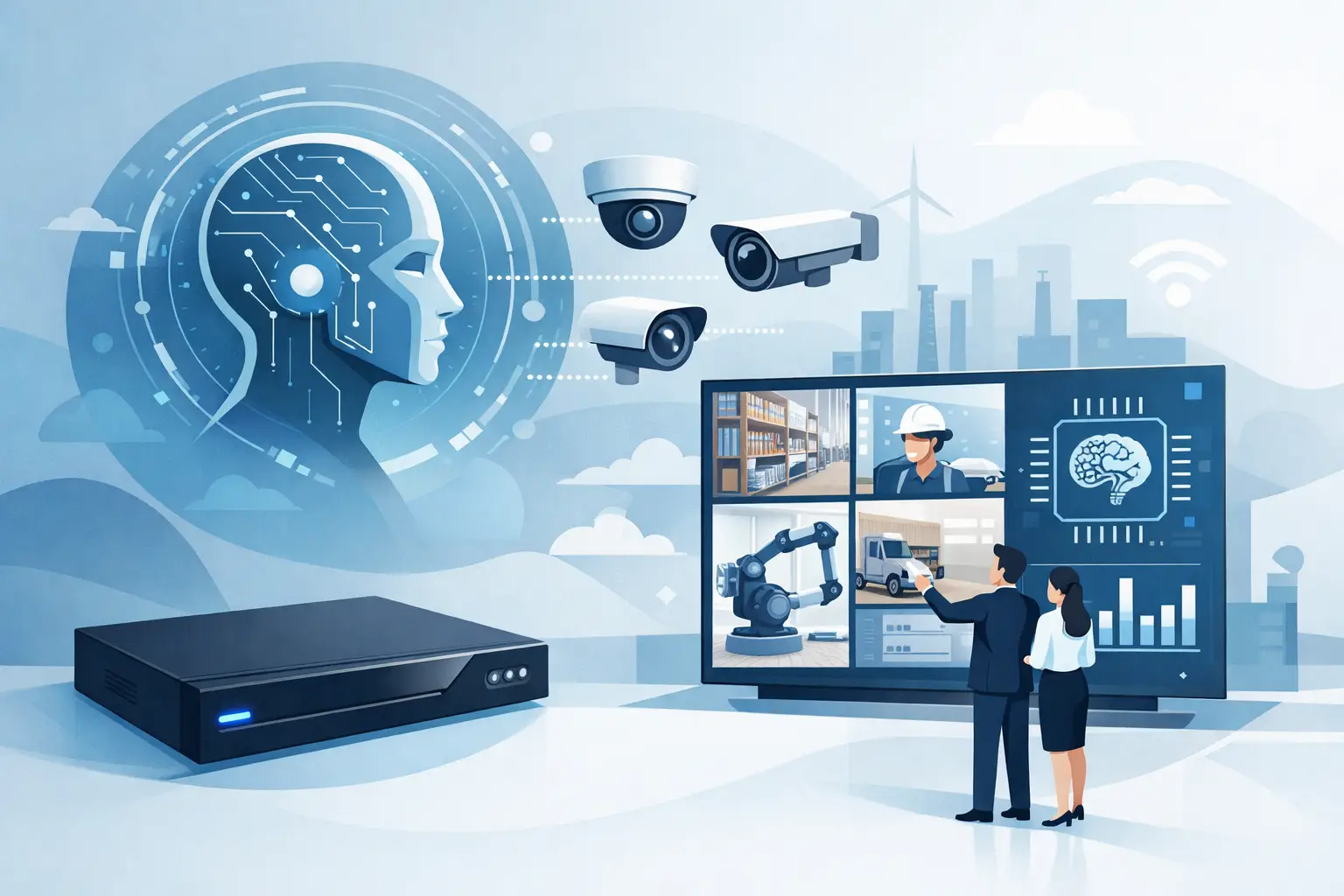
A refinery perimeter, offshore deck, turbine hall, or marine loading area can generate thousands of video events before a security team has reviewed a single one. The best AI NVR for industry is not simply the recorder with the longest feature list. It is the system that turns high-value video into actionable alarms while continuing to record reliably through harsh conditions, network interruptions, and round-the-clock operations.
For industrial buyers, AI video recording must support operational security, not create another dashboard that requires constant attention. The right platform reduces nuisance alarms, protects evidentiary footage, and gives control room teams faster visibility when a person enters a restricted zone, a vehicle approaches a gate, or a process-area incident requires immediate review.
What an Industrial AI NVR Must Deliver
An AI network video recorder combines video storage with analytics that identify defined objects, behaviors, or conditions. Traditional motion detection reacts to pixel changes. Rain, exhaust vapor, waves, moving shadows, insects, and vibrating equipment can all trigger it. AI analytics are designed to distinguish people and vehicles from irrelevant motion, making alerts more useful in demanding industrial environments.
That distinction matters at sites where teams cannot afford alarm fatigue. A security operator monitoring a tank farm should receive an alert for a person crossing a virtual perimeter, not every time heat shimmer moves across the image. On a vessel or offshore platform, analytics can help identify people in exclusion areas while filtering the continuous movement of water and machinery.
A top-of-the-line industrial NVR should also provide dependable continuous recording, event recording, rapid playback, remote access, user permissions, and camera health monitoring. AI does not replace these fundamentals. It adds value only when the recorder can preserve footage, retrieve it quickly, and make it available to authorized personnel when an incident occurs.
How to Choose the Best AI NVR for Industry
Start with the operational risk, not the camera count. A 16-channel unit may be sufficient for a remote pump station, while a refinery, power plant, port terminal, or large vessel fleet may require high-density recording servers, distributed architecture, or multiple recorders managed from one platform. Buying capacity without defining priorities often leads to underpowered analytics or expensive storage shortages later.
Match analytics to actual site events
Specify the events your team needs to detect. Common requirements include perimeter intrusion, line crossing, loitering, people counting, vehicle detection, object left or removed, crowding, and license plate capture at controlled entry points. Each use case has different camera placement, lighting, image-quality, and processing requirements.
Do not assume every AI feature will perform equally well in every location. License plate recognition, for example, depends on vehicle speed, camera angle, illumination, plate format, and a clean view of the approach lane. PPE detection can be valuable in controlled areas, but its accuracy depends heavily on camera distance, helmet color, body orientation, and whether workers are partially obscured by equipment.
For oil, gas, chemical, marine, and power operations, prioritizing a smaller number of high-confidence rules is usually the better commercial decision. A recorder configured around critical gates, fenced perimeters, access corridors, loading zones, and exclusion areas delivers more value than a broad deployment of poorly tuned alerts.
Confirm where the AI processing occurs
Analytics may run at the camera, inside the NVR, on a dedicated server, or through a hybrid arrangement. Edge AI cameras reduce the processing burden on the recorder and can limit bandwidth by sending metadata and event clips. An NVR with built-in AI can apply analytics to compatible standard IP cameras, which may simplify upgrades where cameras are already installed.
Neither approach is automatically best. Edge processing can be effective for remote marine assets and low-bandwidth sites, while server-based processing may offer more centralized control across a large facility. Confirm the number of simultaneous AI channels the NVR can support at your required resolution and frame rate. A recorder advertised as AI-capable may only analyze a limited number of streams at full performance.
Calculate storage from evidence requirements
Industrial recording capacity should be calculated, not guessed. Storage demand is shaped by camera quantity, resolution, frame rate, compression method, scene activity, retention period, continuous versus event recording, and redundancy requirements. High-resolution cameras at busy gates or process areas can consume storage quickly, particularly when recordings must be retained for investigation, compliance, or insurance purposes.
H.265 compression can reduce storage demand, but it does not eliminate the need for proper design. Motion-heavy scenes, nighttime noise, rain, vapor, and complex industrial backgrounds can increase bit rates. Ask for realistic storage estimates based on the actual camera scenes and the required number of retention days.
The recorder should support enterprise-grade surveillance drives, drive health monitoring, RAID where appropriate, and clear replacement procedures. For critical installations, consider failover recording, redundant power supplies, and local edge storage in cameras. If a network path fails, the objective is not merely to maintain live view. It is to prevent a gap in the evidentiary record.
Build for unstable networks and remote access
Offshore platforms, ships, remote energy sites, and large industrial compounds often operate with constrained or variable connectivity. The NVR should continue recording locally when WAN connectivity drops, then allow authorized remote users to retrieve footage when the link is restored. Sub-stream viewing, bandwidth controls, and event-based exports help operations teams review what matters without saturating a limited connection.
Remote access must be secure and practical. Look for role-based user permissions, audit logs, encrypted communications, strong password policies, multi-factor authentication where supported, and controlled firmware management. A recorder connected to an operational network without proper segmentation and access control can become a security liability.
Verify environmental and integration requirements
The NVR itself is commonly installed in a control room, communications cabinet, or conditioned equipment space, but the system must still be selected for the site reality. Power quality, cabinet ventilation, ambient temperature, vibration, salt air exposure, dust, and rack space all affect reliability. Marine and offshore deployments may need protected enclosures, corrosion-conscious installation practices, and carefully designed power backup.
Integration is equally important. Confirm compatibility with the existing camera estate, video management platform, access control system, alarm panels, network switches, and monitoring center workflows. Open interoperability can protect your investment, but compatibility should be validated through an approved device list and a site-specific test. “Works with ONVIF” is not a complete acceptance criterion for advanced analytics, metadata search, audio, or alarm inputs.
Questions Procurement Teams Should Ask Before Ordering
A serious supplier should be able to answer practical questions before equipment is purchased. Ask how many cameras can record simultaneously at the stated resolution, how many channels can run each AI rule, what storage retention is expected under real scene conditions, and whether the unit supports RAID or recorder failover. Confirm the maximum incoming bandwidth, outgoing remote-viewing bandwidth, supported drive capacity, warranty terms, and firmware support process.
Also ask who owns configuration responsibility. AI performance is not delivered by hardware alone. Camera aiming, scene calibration, tripwire placement, alarm schedules, object-size filters, and operator escalation procedures determine whether the system reduces risk or creates noise. Commissioning should include test events in daylight, darkness, adverse weather, and normal operating conditions.
Avoid the Lowest-Cost Recorder Trap
The cheapest recorder may appear attractive when a project is measured only by channel count and hard-drive capacity. That comparison misses the operational cost of false alarms, slow incident searches, unsupported firmware, failed drives, and unclear responsibility after commissioning. A lower-cost NVR can be appropriate for a low-risk site, but it is rarely the right basis for protecting critical infrastructure.
The stronger purchasing decision is to define a performance specification: required retention, required AI events, camera compatibility, cybersecurity controls, remote-access limits, redundancy, and environmental conditions. Then evaluate equipment against those outcomes. This approach produces clearer bids and helps prevent expensive changes after installation.
For critical industrial surveillance, the right AI NVR is a working part of the security operation, not a box of storage in a rack. Revlight Security can help buyers align recorder capacity, intelligent detection, network design, and site conditions so the final system delivers dependable footage and alarms when the operation needs them most.
🛡️ Secure Your Home or Business Today
Protect your home, office, shop, or business with reliable CCTV security cameras. Explore our range of CCTV cameras and find the right security solution for your needs.
Explore CCTV Cameras ✉️ Email Us



 Singapore :
+65-6708-9302
Singapore :
+65-6708-9302