
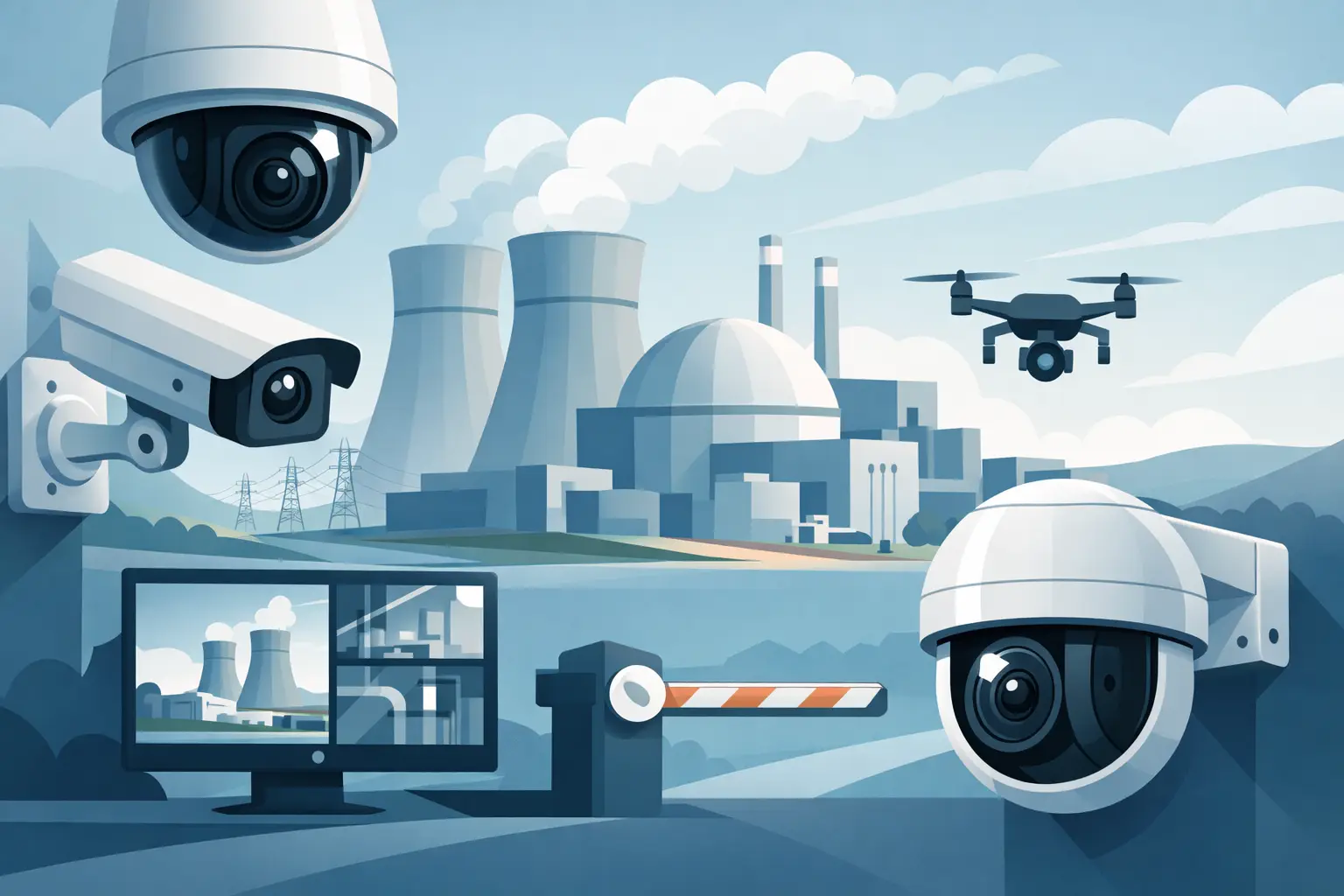
A standard commercial security camera fails fast in a nuclear environment. Heat, radiation, vibration, corrosive washdowns, steam, and strict compliance requirements change the buying criteria completely. When teams ask about the best cameras for nuclear plants, they are really asking which systems will keep delivering clear video, reliable alarms, and stable remote access when conditions are far from ordinary.
That is the right question to ask, because in nuclear facilities, camera performance is tied directly to safety, operational visibility, outage planning, and incident response. A lower-cost unit that works well in a warehouse can become an expensive liability once image sensors degrade, housings corrode, or network hardware drops out under plant conditions. Procurement decisions need to be based on environment, inspection goals, lifecycle cost, and system integration, not headline specs alone.
What makes the best cameras for nuclear plants different
Nuclear plants demand more than surveillance. In many areas, cameras support routine monitoring, perimeter protection, process observation, equipment inspection, and operator decision-making. That means image quality matters, but survivability matters just as much.
Radiation tolerance is one of the first dividing lines. Not every zone in a nuclear plant exposes equipment to the same levels, so the correct specification depends on where the camera will be installed and how long it is expected to remain in service. A camera suitable for turbine halls, access points, or administrative perimeters may not last in containment-adjacent areas or inspection zones with elevated exposure. In those locations, radiation-hardened components, shielding, and purpose-built housings become essential.
Environmental sealing is another non-negotiable factor. Nuclear sites often combine indoor and outdoor coverage, washdown procedures, humidity swings, airborne contaminants, and temperature extremes. Cameras need housings rated for dust and water ingress, along with materials that resist corrosion over time. Stainless steel construction is often the better long-term investment where chemical exposure or aggressive cleaning is part of normal operations.
Then there is system continuity. Nuclear operators do not buy cameras just to record footage. They need dependable live viewing, playback, event verification, and remote access from control rooms and authorized off-site locations. That puts equal importance on network stability, power design, recording architecture, and compatibility with existing video management platforms.
The camera types that matter most
Fixed network cameras are often the backbone of a nuclear deployment. They are well suited to corridors, access control points, loading zones, spent equipment routes, and perimeter fencing. Their value comes from predictable coverage and straightforward maintenance. When the field of view is stable and the scene is known, a fixed camera usually gives better consistency than a moving unit.
PTZ cameras have a different role. They are ideal for wide-area situational awareness, fence line monitoring, cooling infrastructure, turbine buildings, and response support. A PTZ allows operators to investigate motion alarms, verify personnel activity, and zoom in on process areas without deploying staff. The trade-off is that PTZ coverage depends on where the camera is pointed at the time. In critical areas, PTZ should complement fixed coverage, not replace it.
Thermal cameras are often underused in industrial planning, but they can be a major asset in nuclear facilities. They detect heat signatures rather than relying on visible light, which makes them effective for perimeter protection at night, identifying abnormal equipment temperatures, and monitoring areas with poor visibility. Thermal imaging is not always the right choice for reading labels or identifying fine visual detail, but it is excellent for early detection and condition awareness.
Explosion-proof and hazardous-area cameras may also be required in support zones where flammable gases, vapors, or combustible dust are present. Not every nuclear site needs them in core operational areas, but many broader energy facilities include adjacent environments where hazardous-area certification is a purchasing requirement. If your plant includes fuel handling, chemical treatment, or combined industrial processes, this category deserves close attention.
Specialist inspection cameras also have a place, especially for remote observation of confined, high-risk, or difficult-to-access assets. The key is to specify these by task rather than trying to make one product cover every requirement.
How to choose the best cameras for nuclear plants
The strongest buying decisions start with zone-by-zone assessment. One plant can require several camera classes across the same site. Perimeter roads, reactor-adjacent spaces, control access points, cooling systems, and maintenance workshops all place different demands on optics, housing, and network design.
Start with the operating environment. Ask what the camera will face every day, not only during ideal conditions. Radiation level, ambient temperature, washdown frequency, humidity, corrosion risk, vibration, and hazardous-area classification should all shape the shortlist. A camera with impressive resolution is not the best option if it cannot maintain performance in that environment.
Next, define the surveillance purpose clearly. If the camera is there to detect perimeter intrusion, thermal analytics and long-range visibility may matter more than ultra-high pixel count. If it is being used to monitor valve positions, access doors, or procedural compliance, image clarity and stable close-up coverage may take priority. If it supports incident review, recording retention and playback reliability become central.
Integration should be treated as a cost issue as well as a technical one. The best camera is rarely the one with the longest feature sheet. It is the one that works cleanly with your VMS, storage, analytics, control room workflows, and cybersecurity requirements. Nuclear operators cannot afford to introduce weak points into an already controlled infrastructure. ONVIF compatibility, secure remote access, segmented networking, and managed recording policies should be part of procurement from day one.
Key features worth paying for
Low-light performance is a high-value feature because many industrial zones are unevenly lit, especially outdoors and during outages. Good low-light imaging reduces the need for excessive added lighting and improves event verification.
Optical zoom is worth the investment for large compounds and elevated mounting positions. Digital zoom has its uses in playback, but for live operational viewing across long distances, true optical zoom delivers far better results.
Heated and cooled housings can be critical depending on climate and plant conditions. Electronics degrade faster when thermal management is poor, and image quality can suffer when housings fog or overheat.
Redundant power options and network resilience also deserve attention. PoE simplifies deployment, but critical views may justify backup power paths or hardened switching infrastructure. In nuclear operations, uptime is not just a convenience metric.
Cybersecurity features are now part of physical security buying. Secure authentication, user permissions, encrypted transmission, and disciplined firmware support should be expected. Cameras are network endpoints, and that makes them part of your risk surface.
Common mistakes that raise total cost
One of the most expensive mistakes is buying to a generic industrial spec instead of a plant-specific one. “Industrial grade” is too broad to be meaningful on its own. A camera that performs well in a warehouse, port, or standard power station may still fail early in nuclear service.
Another common issue is overconcentrating on camera price while underestimating installation and replacement costs. In high-security or difficult-access areas, labor, permitting, downtime, and safety controls can outweigh the hardware cost very quickly. Paying more upfront for a longer-lasting unit often produces better value.
There is also a tendency to overspec resolution and underspec optics, housing, or network performance. More megapixels do not automatically mean better usable video. Lens quality, scene lighting, compression settings, and recording design all affect what operators can actually see.
A practical buying approach for nuclear operators
For most plants, the right approach is not finding one winner but building a matched system. Fixed cameras handle constant oversight, PTZ units manage active assessment, thermal cameras cover low-visibility and early-warning tasks, and radiation-tolerant or specialized housings protect investment in higher-risk areas. That combination gives better coverage and better lifecycle economics than forcing one camera type into every role.
Commercially, the best results come from working with a supplier that understands critical infrastructure deployments, not just catalog sales. You need support on mounting, housing selection, transmission options, recording architecture, and environmental fit. That is where specialist surveillance suppliers add value beyond product availability. Revlight Security serves industrial buyers who need dependable performance in demanding sectors, with top-of-the-line offers built around real operating conditions rather than generic retail claims.
If you are comparing options now, focus less on which camera looks strongest on paper and more on which system will still be delivering clear evidence, stable uptime, and manageable maintenance three to five years from now. That is usually where the best cameras for nuclear plants prove their value.
🛡️ Secure Your Home or Business Today
Protect your home, office, shop, or business with reliable CCTV security cameras. Explore our range of CCTV cameras and find the right security solution for your needs.
Explore CCTV Cameras ✉️ Email Us


 Singapore :
+65-6708-9302
Singapore :
+65-6708-9302