
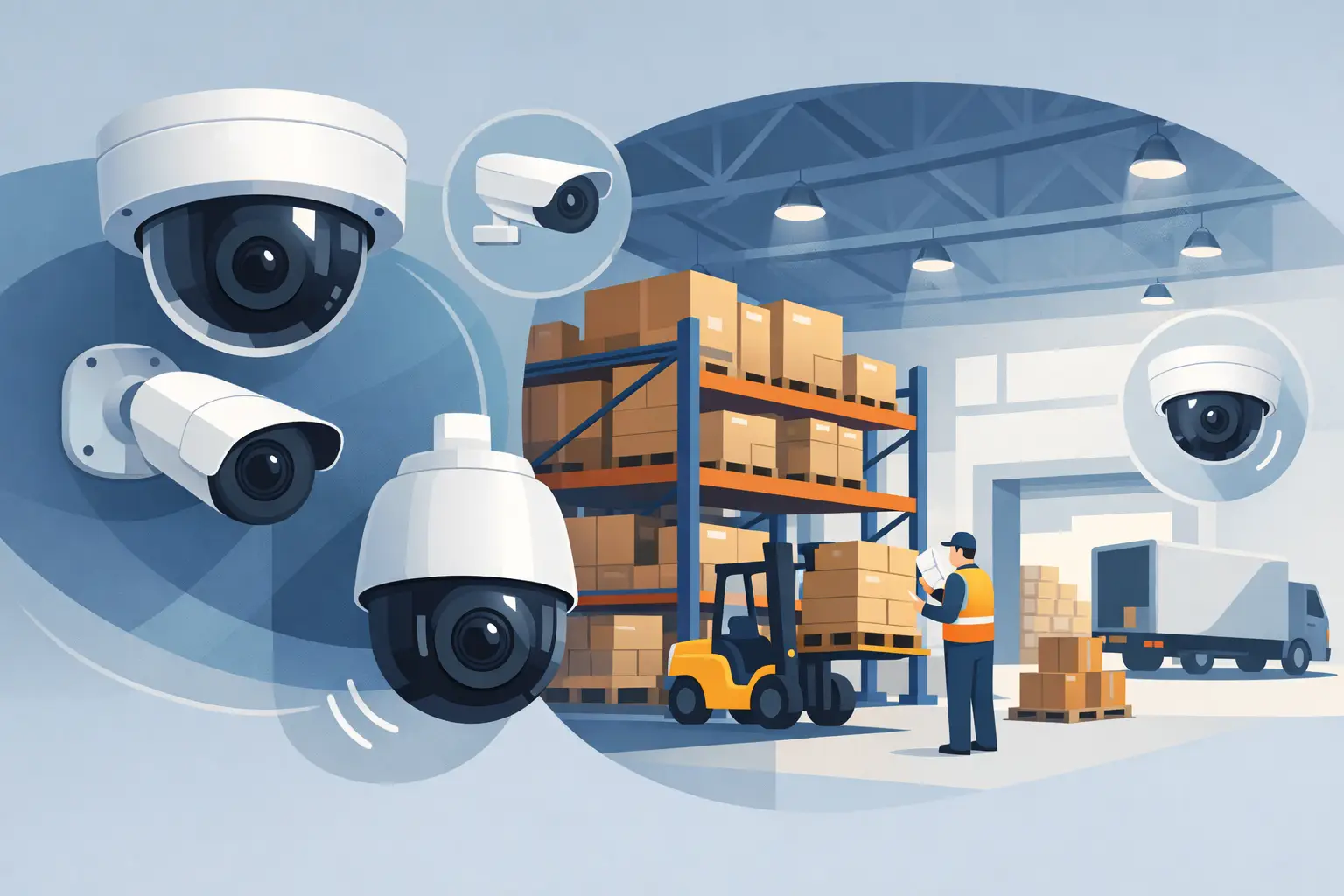
A 200,000-square-foot warehouse with six dock doors does not need the same camera count as a high-value parts facility with twelve loading bays, narrow aisles, and 24/7 traffic. That is why the real answer to how many cameras does a warehouse need starts with risk, layout, and operational pressure – not a generic camera-per-square-foot rule.
For industrial buyers, getting this number wrong has a direct cost. Too few cameras leave blind spots at dock doors, yard gates, cage storage, and shipping lanes. Too many cameras inflate hardware, storage, network, and maintenance costs without adding meaningful coverage. The right system is built around what you must see clearly, what you must record reliably, and how quickly your team needs to retrieve footage when an incident happens.
How many cameras does a warehouse need in real terms?
Most warehouses land somewhere between 8 and 40 cameras. Small single-unit warehouses with limited access points may only need 8 to 12 well-placed units. Mid-size distribution sites often require 16 to 24. Large, high-throughput, or high-risk industrial facilities can easily move beyond 30, especially when exterior perimeter coverage, yard activity, hazardous zones, and remote monitoring are part of the brief.
The number rises fast when the site has multiple dock doors, cross-docking operations, outdoor storage, restricted inventory zones, or compliance-driven recording requirements. It also rises when image detail matters. A camera used for general situational awareness covers more area than one expected to capture faces, badges, forklift interactions, pallet labels, or vehicle plates.
That is the first commercial point buyers should keep in view: coverage and identification are not the same thing. If the goal is simply to know whether movement occurred in an aisle, one camera may cover a broad area. If the goal is to confirm who removed a pallet or whether a loading error happened at a specific bay, the design must be tighter.
The factors that decide camera count
The warehouse footprint matters, but it is only one part of the calculation. Access points usually drive the base count first. Every personnel entrance, vehicle gate, dock door, and emergency exit should be assessed as a likely event location. These are the points where shrinkage, unauthorized entry, safety incidents, and chain-of-custody disputes most often begin.
Interior workflow comes next. Warehouses with long, uninterrupted aisles can often be covered efficiently with fewer, strategically mounted cameras. Facilities with shelving breaks, mezzanines, racking shadows, packing benches, conveyor merges, or enclosed inventory cages need more. Visual obstruction is one of the most common reasons warehouse systems underperform.
Operating model also changes the count. A low-traffic storage warehouse may need broad overview coverage and limited forensic detail. A fast-moving logistics site with constant forklift activity, staged outbound goods, and contractor access needs more overlap, more angles, and stronger recording continuity. In industrial environments, security design has to account for safety, process control, and incident review at the same time.
Environmental demands can affect placement as well. Dust, humidity, extreme temperatures, corrosive atmospheres, and washdown zones may require specialized housings or ruggedized hardware. That does not always increase the number of cameras, but it often changes where they can be installed and what each unit can realistically see.
A practical way to estimate warehouse camera needs
Start with the perimeter and work inward. Most warehouses should cover the main entrance, every dock door lane, rear service access, vehicle gates, and parking or yard transition zones. A facility with one front entrance, one rear exit, and six dock doors is already at a meaningful count before interior coverage begins.
Inside, focus first on the highest-consequence areas. That usually means receiving, shipping, high-value inventory, returns processing, packing stations, and any restricted or regulated storage. Then assess aisle visibility. Some aisles can be grouped under overview cameras, but high-value or high-theft categories often justify individual aisle coverage.
Finally, consider blind spot reduction. Corners, rack ends, staging zones, and intersections where forklifts cross pedestrian routes should not be treated as secondary. These are exactly the locations where footage becomes valuable after a claim, injury review, or stock discrepancy.
As a rough planning framework, a small warehouse under 20,000 square feet may operate effectively with 8 to 12 cameras if the layout is simple. A mid-size site from 20,000 to 100,000 square feet may require 12 to 24 depending on dock count and aisle complexity. Larger facilities above 100,000 square feet often need 20 to 40 or more, particularly if exterior yards, fuel areas, fence lines, or multiple operational zones are included.
Where warehouses usually need cameras most
Dock doors deserve special attention because they concentrate movement, handoff risk, and dispute exposure. One camera aimed broadly across multiple doors may look efficient on paper, but it often fails when you need detail on a missed scan, damaged load, or unauthorized removal. In many cases, one camera for every one to two dock positions is a stronger standard, depending on height, lens selection, and required image detail.
Receiving and shipping areas also benefit from layered coverage. An overview camera shows flow and timing, while tighter views capture package condition, personnel activity, and load movement. The same logic applies to inventory cages and controlled materials storage. Broad visibility is useful, but if you cannot identify actions clearly, the footage may not support an investigation.
Exterior areas are often underestimated. Yard entrances, trailer parking, fencing, and outdoor storage compounds can generate as much risk as the interior. For industrial operators, this is even more relevant where vehicles, contractors, and third-party logistics traffic move continuously across the site.
Why one-size-fits-all formulas fail
Buyers often ask for a simple ratio such as one camera per 5,000 square feet. That sounds convenient, but it is not an engineering-grade approach. Two warehouses of the same size can require very different systems based on rack height, SKU value, throughput, and operational hours.
A low-density storage building with clear sightlines might need fewer units than a smaller facility handling regulated chemicals, high-value components, or sensitive process equipment. A warehouse attached to a refinery, marine terminal, or energy site may also need integrated surveillance around restricted zones, utility corridors, and external transfer points. In those environments, camera count is tied to risk exposure and operational continuity, not just floor area.
This is where serious buyers gain by treating surveillance as infrastructure rather than an accessory. The camera count must align with network capacity, recording duration, playback performance, and remote access expectations. Adding more cameras is easy. Building a system that operators can actually use under pressure is the real standard.
Budget, storage, and the cost of getting it wrong
More cameras increase coverage, but they also increase storage demand, bandwidth use, installation complexity, and future service requirements. That does not mean fewer cameras are better. It means each device should have a clear job.
For example, if your operation needs 30-day retention with high-resolution recording across 24 cameras, storage planning becomes a serious procurement issue. If your team needs remote review from corporate security, marine operations, or regional management, network design matters just as much as camera placement. Buyers should also factor in low-light performance, analytics, and environmental protection, because weak hardware in a demanding warehouse is a false economy.
The strongest commercial result comes from balancing three things: enough cameras to remove critical blind spots, enough image quality to support decisions, and enough system capacity to keep footage accessible when it matters. That is where top-of-the-line offers earn their value.
How to know your warehouse has enough cameras
A warehouse has enough cameras when every critical event path is covered without forcing operators to guess. You should be able to review who entered, what moved, when it moved, and where it went at the major risk points across the facility. If repeated incidents still happen in unseen areas, or if footage shows motion but not actionable detail, the system is underbuilt.
A properly designed deployment should also support daily operations, not just investigations. Managers should be able to verify dock activity, monitor traffic flow, review loading performance, and check alarm events without wasting time cycling through poorly placed views. That is the difference between a basic camera installation and the ultimate in security surveillance systems.
For industrial and warehouse buyers, the best answer to how many cameras does a warehouse need is this: enough to cover every critical access point, operational choke point, and high-value zone with usable detail, and no more than the site truly requires. If you start with risk, workflow, and environment instead of square footage alone, you will buy a system that protects the operation and pays its way every day.
🛡️ Secure Your Home or Business Today
Protect your home, office, shop, or business with reliable CCTV security cameras. Explore our range of CCTV cameras and find the right security solution for your needs.
Explore CCTV Cameras ✉️ Email Us



 Singapore :
+65-6708-9302
Singapore :
+65-6708-9302