
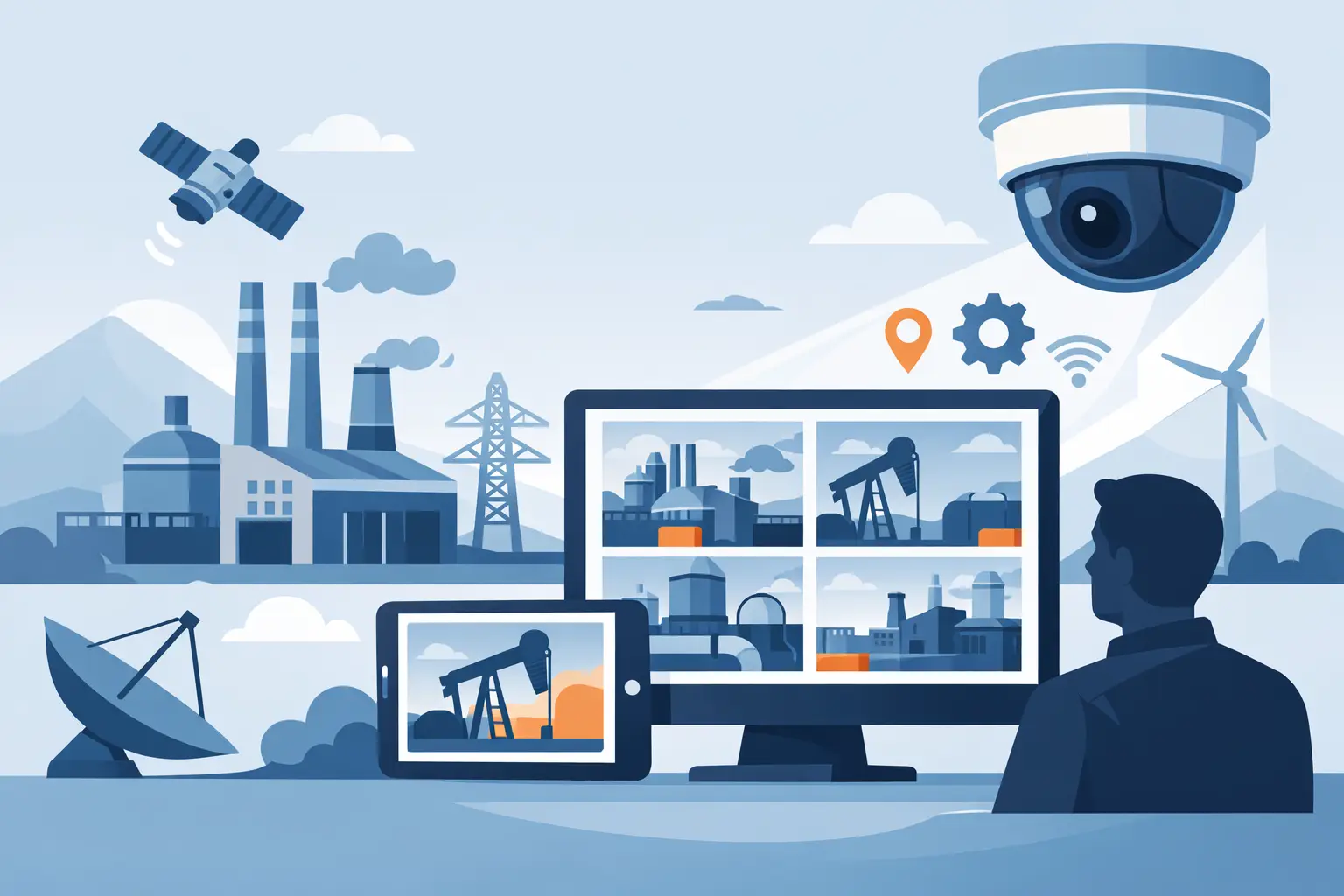
A failed pump on an offshore platform at 2:10 a.m. does not wait for daylight. Neither does a perimeter breach at a refinery tank farm or a gas leak moving across a restricted process area. That is why an industrial remote surveillance guide matters to operations leaders – it helps you choose systems that deliver visibility when the site is hazardous, remote, or too expensive to monitor with people alone.
Industrial surveillance is not the same as standard commercial CCTV. In oil and gas, marine, energy, and heavy processing environments, the camera is only one part of the job. The real requirement is dependable remote awareness across harsh conditions, wide perimeters, unstable weather, corrosive atmospheres, low-light zones, offshore structures, and safety-critical assets. If the system cannot keep transmitting, recording, and supporting decisions under those conditions, it is not fit for industrial use.
What an industrial remote surveillance guide should cover
A useful industrial remote surveillance guide starts with operational outcomes, not just hardware specs. Buyers usually begin by asking how many cameras they need, what resolution to select, or how much storage to budget. Those details matter, but the better starting point is risk. What exactly are you trying to detect, verify, record, and respond to?
At a refinery, remote surveillance may be centered on perimeter security, flare monitoring, leak detection support, and control of vehicle movements. On a vessel, the priority may shift toward deck visibility, machinery spaces, cargo areas, and communications stability between ship and shore. At a power station or chemical plant, you may need continuous oversight of critical infrastructure, restricted zones, and maintenance activities without placing personnel in unnecessary danger.
That is why system design should be tied to site conditions, compliance pressure, staffing levels, and response procedures. A low-cost setup can look attractive during purchasing, then fail under salt exposure, vibration, bandwidth limitations, or poor integration with existing networks. In industrial environments, replacement costs and downtime usually outweigh the savings of a cheaper first purchase.
Start with the environment, not the camera count
Industrial sites punish weak equipment. Heat, moisture, explosive atmospheres, corrosive spray, dust, vibration, and long cable runs all change what is practical. A warehouse camera package that performs well in a clean indoor setting may be the wrong answer for a drilling platform or coastal terminal.
This is where buyers need to focus on environment-specific durability. Housing ratings, temperature tolerance, ingress protection, marine-grade resistance, and compatibility with hazardous-area requirements are not optional details. They directly affect service life and maintenance frequency. If access to the equipment requires permits, shutdown coordination, rope access, or vessel scheduling, reliability has a clear financial value.
There is also the issue of placement. More cameras do not always mean better coverage. In many industrial sites, a smaller number of properly positioned units with the right optics, low-light capability, and remote control options will outperform a larger installation of generic fixed views. Blind spots at access gates, loading points, flare stacks, offshore legs, gangways, and remote fence lines are where costly gaps tend to appear.
Why transmission matters as much as image quality
A high-definition image has limited value if it arrives late, drops out, or cannot be accessed by the people making decisions. Remote surveillance depends on stable transmission across the full path – camera, network, control room, and off-site access point.
This is especially relevant in marine and offshore operations, where distance, motion, and weather can interfere with communications. Industrial WiFi, network bridges, and hardened transmission infrastructure often make the difference between a workable system and a frustrating one. If your team needs real-time monitoring during docking, transfer operations, perimeter alerts, or equipment faults, network resilience becomes part of the security design rather than a separate IT issue.
The core functions buyers should prioritize
The strongest systems do four things well. They provide clear live viewing, dependable recording, fast playback, and secure remote access. Those functions sound basic, but they are where many industrial installations either prove their value or create friction.
Live viewing supports incident verification and operational awareness. Recording protects the evidence trail and helps with internal reviews, claims, and compliance reporting. Playback needs to be quick and practical, because no operations manager wants to lose time searching for footage around a specific event. Remote access extends visibility to decision-makers who are not physically on site, whether that is a superintendent onshore, a marine operator in another port, or a director managing multiple facilities.
The right system should also scale sensibly. Some sites need a compact deployment with a limited camera count and straightforward recording. Others need a larger architecture with broader coverage, multiple user permissions, remote diagnostics, and integration into wider facility systems. There is no universal ideal setup. The correct design depends on how the site runs and how quickly teams need to act when conditions change.
Detection is where surveillance becomes more valuable
For industrial buyers, surveillance increasingly overlaps with detection. Video alone may confirm an event, but detection technologies can identify developing risk earlier. In oil, gas, and chemical environments, that distinction matters.
Gas and methane detection cameras, for example, add a layer of operational intelligence that standard visual monitoring cannot provide. They help teams identify leaks, verify suspected release points, and improve situational awareness around sensitive infrastructure. That has implications for safety, environmental exposure, downtime, and response coordination.
Underwater surveillance is another specialized case. Offshore platforms, marine operators, and energy facilities often need visibility below the surface for inspections, asset checks, and security monitoring around submerged structures. Standard camera assumptions do not apply here. Water clarity, depth, pressure resistance, lighting, and mounting conditions all influence performance. Buyers should treat underwater systems as a dedicated category rather than an accessory add-on.
It depends on who uses the system every day
A procurement team may focus on capital cost, warranty terms, and supplier reliability. Operations managers often focus on uptime, access, and ease of review. Engineers may care most about integration, power requirements, network demands, and maintenance. Ship captains and offshore supervisors want systems that work without creating extra complexity during live operations.
A good buying process accounts for all of those views. If the interface is difficult, the playback is slow, or the network burden is too high, the system may be technically capable but commercially inefficient. The best-performing surveillance installations are usually the ones that balance image quality, durability, user access, and supportability instead of chasing a single headline spec.
Common mistakes in industrial remote surveillance projects
One of the most common mistakes is underestimating the site. Buyers sometimes specify around ideal conditions rather than real operating conditions. Another is treating surveillance as a standalone purchase rather than part of a larger monitoring and response framework.
There is also a tendency to over-prioritize initial price. That can lead to equipment with weaker housings, limited remote access, poor low-light performance, or short service life in aggressive environments. In industrial settings, service interruptions are expensive. Maintenance visits are expensive. Losing coverage at the wrong time is more expensive still.
A further mistake is failing to plan for growth. A facility may start with perimeter monitoring and later need process-area visibility, remote supervisory access, added recording days, or integration with marine communications and site networking. If the original system cannot expand efficiently, the second phase becomes more disruptive and more costly than it should be.
Choosing a supplier, not just a product
For industrial sectors, supplier strength matters almost as much as equipment quality. Serious buyers should look for engineering-backed guidance, category depth, and clear understanding of oil and gas, marine, and energy use cases. A general surveillance reseller may offer broad choice, but that is not the same as having the right answer for an offshore platform, refinery, vessel, or power facility.
This is where specialist providers stand apart. The right partner helps define what the site actually needs, where remote access will matter most, how recording and playback should be structured, and what network architecture will support the system over time. That reduces specification risk and helps buyers avoid mismatched products that look acceptable on paper but perform poorly in the field.
Revlight Security operates in that specialist space, supplying industrial surveillance and detection equipment designed for hard-use environments where performance, reliability, and remote visibility directly affect operations.
Industrial remote surveillance guide for better buying decisions
If you are building an industrial remote surveillance guide into your purchasing process, keep the decision grounded in outcomes. Ask what must be seen, what must be detected, who needs access, how footage will be used, and what conditions the system must survive. Then test every product decision against those requirements.
The best industrial surveillance systems do more than record incidents. They reduce uncertainty, support faster decisions, improve site awareness, and help protect people, assets, and uptime across difficult environments. When the equipment is matched correctly to the site, remote surveillance stops being a checkbox purchase and becomes part of how the operation runs better every day.
The right system pays for itself quietly – in fewer blind spots, faster verification, stronger control, and less time spent worrying about what is happening when no one is standing there to see it.
🛡️ Secure Your Home or Business Today
Protect your home, office, shop, or business with reliable CCTV security cameras. Explore our range of CCTV cameras and find the right security solution for your needs.
Explore CCTV Cameras ✉️ Email Us

 Singapore :
+65-6708-9302
Singapore :
+65-6708-9302