
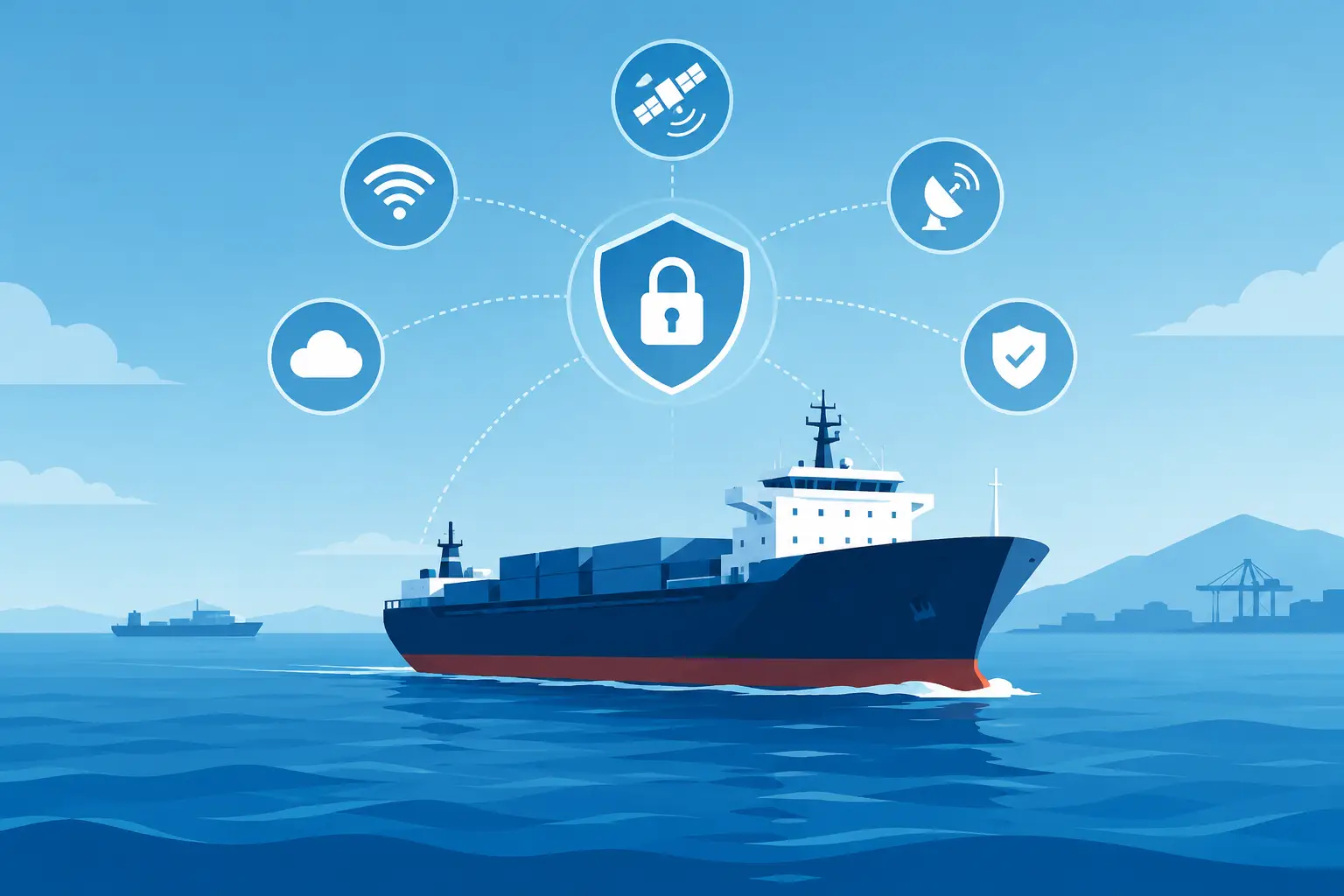
A vessel can have the best surveillance hardware on board and still leave its operator exposed if the network cannot deliver video, alarms, and system health data when it matters. Smart ship connectivity trends are changing that equation. For fleet owners, ship managers, captains, and engineering teams, connectivity is no longer limited to crew internet access or routine reporting. It is now a core operational layer for security, maintenance, compliance, and faster decision-making.
Smart Ship Connectivity Trends Are Becoming Operational Infrastructure
Modern vessels generate more data than older communications plans were designed to handle. Fixed surveillance cameras, thermal monitoring, access control, machinery sensors, fuel systems, navigation equipment, and safety alarms all require reliable routes to the people responsible for acting on them. A shipboard network must prioritize those routes rather than treating every device and user as equal.
The commercial driver is clear. When an operations center can review a verified alarm, inspect a restricted deck area, or receive a network fault notice without waiting for the vessel to reach port, it can reduce uncertainty and shorten response time. That does not mean every video feed should be transmitted continuously over a satellite connection. Bandwidth remains expensive, availability can vary by route and weather, and operational traffic must always take priority over convenience traffic.
The better model is intelligent distribution. Record high-resolution footage locally, transmit alarms and selected live views when required, and give authorized shore teams secure access to playback and device status. This approach supports investigation and oversight without creating unnecessary satellite costs.
Hybrid Networks Are Replacing Single-Connection Dependence
The most capable marine communications designs do not rely on one path. They combine satellite services with coastal cellular coverage, port WiFi, and vessel-to-vessel or local wireless links where practical. The goal is not to chase the highest advertised speed. The goal is to maintain the right level of availability for the vessel’s operating profile.
A tanker on a long ocean passage has different connectivity requirements from a harbor tug, offshore support vessel, cruise vessel, or workboat serving an energy installation. Coastal operators may gain substantial value from managed LTE or 5G connections, while ocean-going fleets must engineer around satellite capacity and latency. For offshore assets, dedicated links between the vessel and platform infrastructure may also be part of the design.
Network Failover Must Be Planned, Not Assumed
Automatic failover is a major purchasing requirement, but it needs careful configuration. A backup link that activates only after a lengthy interruption may be unacceptable for security alerts or critical remote support. Conversely, moving large data transfers to premium satellite service during every short disruption can produce avoidable charges.
Operators should define which traffic receives priority on each available connection. Alarm notifications, remote access to approved surveillance views, cybersecurity monitoring, and critical equipment telemetry should be at the top of the queue. Software updates, large archive transfers, and nonessential crew traffic can wait for a lower-cost connection or a port call.
This is where marine-grade routers, managed switches, and traffic policies become commercially valuable. The equipment is not merely connecting devices. It is enforcing operational priorities under changing conditions.
Edge Recording Makes Video Practical at Sea
High-definition surveillance is essential around gangways, engine room access points, cargo areas, restricted decks, and offshore transfer operations. Yet live streaming every channel to shore is rarely the most efficient or dependable plan. Local network video recording remains the foundation of a serious maritime surveillance system.
With edge recording and onboard storage, the vessel keeps continuous footage available even when the external connection is limited or unavailable. Operators on shore can receive motion, intrusion, line-crossing, temperature, or equipment health alerts, then pull live footage or recorded clips relevant to the event. The result is a more controlled use of bandwidth and a stronger evidence trail.
The quality of this design depends on more than storage capacity. Cameras, recorders, network cabinets, power protection, and wireless access points must be selected for vibration, salt exposure, humidity, temperature variation, and the vessel’s available power environment. A low-cost component that fails during a critical voyage creates a far greater cost than its purchase price suggested.
Remote Access Needs Clear Authority Controls
Remote visibility is valuable only when access is controlled. A captain may need full operational visibility, while a shore security manager may need access to selected cameras and incident playback. A maintenance contractor may need to diagnose a device fault but should not have broad access to security footage or vessel systems.
Role-based permissions, multi-factor authentication, encrypted remote sessions, and audit logs should be standard expectations. Just as important, accounts must be reviewed when crew assignments, vendors, or management contracts change. Many security problems begin with access that was legitimate months earlier but was never removed.
Cybersecurity Is Now Part of Physical Vessel Security
As surveillance and detection devices become networked, physical security and cybersecurity are no longer separate procurement categories. An improperly segmented camera network can become a route into wider vessel systems. A weak wireless password can expose a management interface. An unsupported recorder or router may carry known vulnerabilities that are easy to exploit.
The answer is not to avoid connected security systems. The answer is to deploy them with appropriate separation and management. Surveillance, crew welfare internet, business applications, and operational technology should not share unrestricted network access. Segmentation limits the reach of a compromised device and makes network activity easier to monitor.
Procurement teams should also ask suppliers direct questions: How are firmware updates delivered? Can device credentials be changed and managed centrally? Is remote support logged? What encryption is used? Can the system operate safely if shore connectivity is lost? These questions identify whether a proposed solution is designed for industrial and marine duty or adapted from a basic commercial installation.
Data Prioritization Will Define the Next Phase of Smart Ships
The next stage of connectivity is not simply more bandwidth. It is better judgment about what data needs immediate attention. A smart vessel should distinguish between a routine status update and an event that requires escalation. It should send the alarm, the relevant footage, the device location, and enough context for a shore team to act without searching across multiple systems.
This is particularly valuable for marine operators working around offshore platforms, terminals, and high-value cargo. Underwater inspection systems, perimeter surveillance, gas detection equipment, and onboard monitoring can all produce useful information, but only if that information reaches the right people in a usable form. Integration should serve the operating team, not create another dashboard that must be watched continuously.
Artificial intelligence can help filter events, identify unusual activity, and reduce false alarms. However, it should be evaluated realistically. Detection accuracy depends on camera placement, lighting, sea state, weather, training data, and the specific scenario being monitored. Automated alerts should strengthen human decision-making, not replace operational judgment.
Buying Connectivity by Vessel Risk Profile
There is no single best package for every fleet. The right specification depends on voyage pattern, threat exposure, number of users, camera count, regulatory obligations, available technical support, and the cost of losing visibility. A vessel operating near congested ports may prioritize cellular coverage and access control. An offshore construction vessel may need higher-capacity satellite communications, segmented networks, and reliable support for multiple surveillance zones.
Before approving equipment, buyers should map the full chain from field device to shore response. That includes the camera or detector, power source, cable or wireless path, switch, router, recording platform, external connection, user permissions, and support process. A weakness at any point can limit the value of the entire installation.
Revlight Security helps marine and industrial buyers assess this chain with security infrastructure built for demanding environments. The objective is practical: dependable surveillance, controlled remote access, and network performance that supports operations instead of adding another point of failure.
The strongest investment is not the one with the longest feature list. It is the system that still delivers a clear alarm, usable evidence, and authorized access when the vessel is offshore, the connection is constrained, and the decision cannot wait until the next port call.
🛡️ Secure Your Home or Business Today
Protect your home, office, shop, or business with reliable CCTV security cameras. Explore our range of CCTV cameras and find the right security solution for your needs.
Explore CCTV Cameras ✉️ Email Us

 Singapore :
+65-6708-9302