
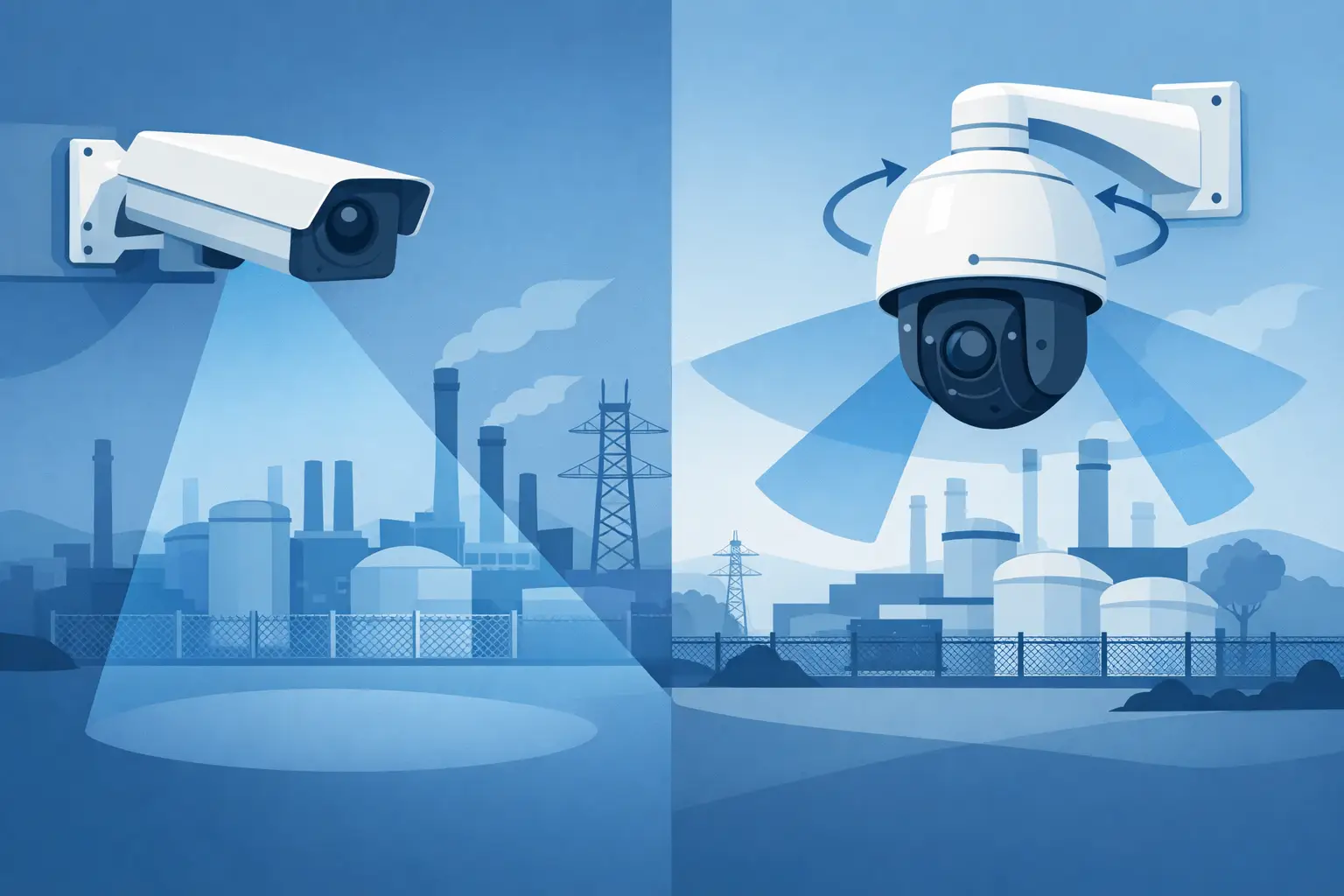
A camera that can follow a vessel alongside a berth or inspect a flare stack from the control room is compelling. But when specifying fixed versus pan tilt zoom surveillance for an offshore platform, refinery, terminal, or power facility, movement is not automatically better coverage. The correct choice depends on what must be seen continuously, what requires operator investigation, and what failure or incident carries the greatest cost.
For most industrial sites, the strongest security design is not a site-wide choice between fixed cameras and PTZ units. It is a deliberate combination: fixed cameras protect critical views around the clock, while pan tilt zoom cameras give operators the reach to investigate, verify, and direct a response.
Fixed Versus Pan Tilt Zoom: The Core Difference
A fixed camera watches one defined scene continuously. Once correctly positioned and commissioned, it records the same area at all times: a gate lane, pump skid, loading arm, tank perimeter, machinery access point, or marine gangway. This makes fixed surveillance the dependable foundation for incident review, process-area monitoring, and perimeter coverage.
A pan tilt zoom, commonly called a PTZ camera, moves horizontally and vertically and uses optical zoom to inspect distant details. An operator can track a vehicle, read activity around a berth, investigate an alarm location, or examine an elevated structure without placing personnel in a hazardous area.
The difference has major operational consequences. A fixed camera preserves evidence for its assigned view even when no one is watching. A PTZ records only where it is facing. If it is tracking activity at one end of a jetty, it is not covering the opposite end. Preset patrol tours improve situational awareness, but they do not create continuous coverage of every scene.
Where Fixed Cameras Deliver the Best Value
Fixed cameras are the right first investment where continuous visibility matters more than close-up investigation. They are generally less complex to install, simpler to maintain, and easier to scale across a large site. They also provide a predictable image for video analytics, including intrusion detection, line-crossing alerts, occupancy monitoring, and object classification.
At a refinery or chemical facility, fixed cameras should protect critical operating zones such as access gates, control-building entrances, compressor areas, loading racks, fence lines, and emergency assembly points. On marine vessels and offshore installations, they are highly effective for gangways, engine-room entrances, deck access, crane work zones, stern areas, and machinery spaces.
A fixed camera also avoids a common control-room problem: two operators cannot independently use one PTZ camera at the same time. When multiple people need dependable visibility into a high-risk area, fixed views prevent control conflicts and preserve a clear record.
For hazardous-area and environmentally demanding applications, the camera housing matters as much as the imaging specification. Salt spray, vibration, dust, high heat, washdown procedures, and corrosive atmospheres can quickly expose weak equipment choices. Industrial-grade fixed units with suitable environmental protection, corrosion-resistant materials, stable mounting, and correct hazardous-location approval provide lower lifecycle risk than consumer-grade equipment adapted for industrial use.
When PTZ Cameras Earn Their Cost
PTZ cameras earn their place when one camera must inspect a broad or changing area and an operator needs detail on demand. Their strongest applications are wide perimeters, vessel approaches, tank farms, berths, large yards, flare systems, remote substations, and offshore deck operations.
Optical zoom is the key capability. It allows a control room to investigate a suspicious person, vehicle movement, mooring operation, or alarm point at a distance without sacrificing image clarity in the way digital enlargement does. For security teams managing large facilities with limited personnel, this can reduce unnecessary dispatches and support faster decisions.
PTZ units are particularly valuable when integrated with alarms and video management software. A radar, access-control event, fence alarm, gas detection event, or analytics alert can command the camera to move to a preset location. Operators receive a closer view of the alarm source rather than searching manually across a large scene.
However, PTZ performance depends on commissioning and operational discipline. Presets must be accurate, patrol patterns must support real site risks, and operators need clear procedures for alarm verification. A poorly positioned PTZ with excessive zoom expectations can become an expensive camera that spends most of its time looking at empty space.
Coverage Design: Start With the Risk, Not the Camera
The procurement question should not be, “How many PTZ cameras can this budget buy?” It should be, “Which views must never be lost?” That distinction prevents expensive gaps in coverage.
Begin with a site risk map that identifies people, process assets, access routes, restricted areas, and incident escalation points. Consider the exact evidence needed after an event. A fixed camera may prove who entered a control room or whether a valve station was accessed. A PTZ may help an operator assess a developing incident from a safe location.
For a tank farm, fixed cameras can continuously cover gates, access roads, pump houses, and key perimeter zones. A PTZ placed on an elevated mast can then inspect activity between tanks, follow a vehicle, or verify an alarm. At a marine terminal, fixed cameras should maintain uninterrupted views of vessel boarding and cargo-transfer areas, while PTZ coverage supports berth-wide observation and vessel approach monitoring.
This layered approach avoids using one moving camera as a substitute for several essential fixed views. It also gives the operations team both the broad context and the close detail needed to make confident decisions.
Image Quality, Network Load, and Recording Requirements
High-resolution fixed cameras can capture broad scenes with useful forensic detail, but resolution alone does not solve a poor design. Lens selection, mounting height, lighting conditions, target distance, and the required identification level all determine whether footage is operationally useful.
PTZ cameras need enough optical zoom for the farthest priority target, not simply the highest zoom figure available. More zoom narrows the field of view and amplifies vibration, especially on marine structures, towers, and exposed masts. In these locations, stable mounting and camera stabilization features can be as valuable as additional zoom range.
Both formats require realistic network and storage planning. Continuous recording from multiple fixed cameras can create significant bandwidth and retention requirements. PTZ streams can be less predictable because motion, zoom, weather, and scene complexity affect video compression. Specify recording duration, frame rate, resolution, and event-based recording rules before selecting network switches, storage capacity, and wireless links.
For remote offshore and marine operations, network resilience is essential. A camera system should remain manageable across variable connectivity, with prioritized traffic, protected network architecture, and remote health monitoring. A camera that cannot be accessed or maintained when needed does not deliver security value.
Maintenance and Lifecycle Cost in Harsh Environments
The purchase price is only one part of the decision. PTZ cameras contain motors, gears, moving assemblies, and more complex control components. In corrosive, high-wind, high-vibration, or extreme-temperature environments, these parts require careful specification and planned inspection.
Fixed cameras have fewer mechanical failure points, which often makes them the lower-maintenance option for large deployments. Yet they still need routine lens cleaning, housing inspection, mounting checks, and verification of image quality. A salt-covered lens or misaligned fixed view can silently undermine an otherwise well-designed system.
For PTZ units installed offshore, on port structures, or near process areas, evaluate corrosion protection, heater and blower options, wiper or washer capability where appropriate, operating temperature range, ingress protection, and hazardous-area certification. Selecting equipment designed for the actual environment protects uptime and reduces replacement costs.
The Practical Specification Decision
Choose fixed cameras when the scene requires continuous evidence, consistent analytics, lower maintenance, and permanent coverage. Choose PTZ cameras when operators need active investigation, long-range optical detail, flexible observation, and alarm-directed response.
For most critical industrial facilities, specify both. Build the system around fixed cameras at every non-negotiable view, then position PTZ units where their movement and zoom can add real operational value. Revlight Security helps industrial operators match surveillance infrastructure to the risks, conditions, and response requirements that define each site.
The most effective camera system is the one that gives your team a reliable view before an incident, clear detail during it, and defensible evidence afterward.
🛡️ Secure Your Home or Business Today
Protect your home, office, shop, or business with reliable CCTV security cameras. Explore our range of CCTV cameras and find the right security solution for your needs.
Explore CCTV Cameras ✉️ Email Us


 Singapore :
+65-6708-9302
Singapore :
+65-6708-9302