

A refinery control room can receive hundreds of motion alerts in a single shift. Most are routine activity: authorized personnel, vehicle movements, changing light, steam, or wildlife near a perimeter. The operational risk is not a lack of video. It is the delay created when teams must sort meaningful events from background activity. That is why AI video analytics trends now matter to industrial security buyers: they are changing video from a passive record into a source of prioritized operational intelligence.
For oil and gas sites, marine assets, power stations, chemical facilities, and other high-consequence environments, the right analytics deployment can reduce nuisance alarms, shorten incident response, and give supervisors a clearer view of what requires attention. The wrong deployment can create a costly stream of unreliable alerts. Selection still comes down to camera position, environmental conditions, network capacity, integration requirements, and the real decisions operators need to make.
AI Video Analytics Trends That Matter on Industrial Sites
The most valuable trend is a move away from basic pixel-change motion detection toward object-aware detection. Rather than alerting whenever something moves in a scene, modern analytics can distinguish people, vehicles, vessels, and selected site-specific objects. That distinction is commercially significant. A security team can create different rules for a person entering a restricted zone, a vehicle stopping near critical infrastructure, or a vessel approaching an exclusion area.
This does not mean every deployment should pursue the most complex analytic package available. A simple line-crossing rule at a well-designed perimeter may deliver more value than an elaborate model applied to poor video coverage. The best systems begin with a defined risk: unauthorized access, unsafe access to a process area, delayed vessel approach awareness, perimeter intrusion, or an unverified alarm that is consuming operator time.
A second major shift is AI-assisted alarm verification. When an alarm reaches a security operations center or remote monitoring team, analytics can identify the object type, mark its position in the image, and present a short event clip. This helps operators make a decision faster than reviewing lengthy recordings or cycling through multiple live views. It is especially useful at remote installations where a limited team must supervise a large area.
For industrial buyers, verified alerts are often the strongest business case. Fewer false dispatches protect security budgets, reduce unnecessary callouts, and allow personnel to focus on genuine operational and safety concerns. Analytics should support human judgment, not replace it. Critical decisions still require trained operators, clear escalation procedures, and recorded evidence.
Thermal, Optical, and Gas Detection Are Becoming More Coordinated
Industrial video analytics is no longer limited to visible-light surveillance. More projects are combining thermal imaging, optical cameras, and specialized gas detection equipment into a coordinated detection strategy. Each technology sees a different part of the risk picture.
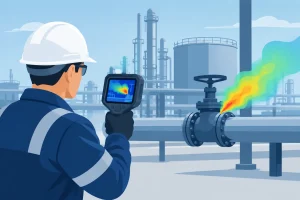
Thermal imaging can identify heat signatures in darkness, haze, or challenging low-light conditions where visible-light images lose detail. Optical video provides identification context, such as clothing, vehicle markings, activity, and exact location. Gas detection cameras can help visualize certain hydrocarbon leaks under suitable conditions. When these systems are designed to work together, the result is stronger event verification and more useful incident evidence.
The trend is not simply to add more sensors. It is to connect events intelligently. For example, an elevated thermal reading near a process area can trigger a higher-priority visual view for operator review. A gas detection event can call up the relevant zone, preserve pre-event and post-event footage, and notify the appropriate team. This approach improves situational awareness without forcing staff to manually search across separate systems.
Environmental conditions remain decisive. Offshore salt exposure, refinery heat, vibration, marine weather, dust, glare, fog, and hazardous-area requirements all affect equipment selection and analytic reliability. Buyers should demand performance validation for the actual deployment environment, not rely on generic laboratory demonstrations.
Edge Analytics Reduces Delay and Network Load
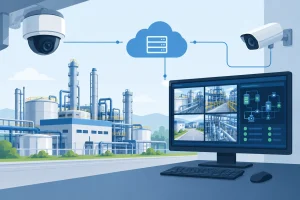
Sending every high-resolution stream to a central server is expensive and, in remote locations, often impractical. Edge analytics is gaining ground because it processes selected video data at or near the camera. Instead of transmitting continuous footage for analysis, the system can send event metadata, alarms, and requested clips.
This can reduce bandwidth use on offshore platforms, marine vessels, pipeline facilities, and distributed energy sites. It also improves response time because an event can be assessed locally rather than waiting for a distant system to process the stream. For sites with intermittent connectivity, edge capability can keep detection operating while communications are constrained.
There is a trade-off. Edge devices need sufficient processing power, disciplined firmware management, and a cybersecurity plan. Centralized analytics may still be the better choice when a facility has dependable high-capacity connectivity, a large control room operation, and a need to apply one consistent analytic model across many cameras. Hybrid architecture is increasingly common: immediate detection at the edge, with centralized management, storage, reporting, and cross-site review.
AI Video Analytics Trends Are Moving Into Operations
Security is still the core application, but operations teams are increasingly evaluating analytics for workflow visibility. Vehicle dwell time, gate activity, vessel movements, queue monitoring, restricted-area occupancy, and equipment traffic patterns can all provide useful management data when the camera coverage is designed for the task.
This is not a reason to turn every surveillance system into an operations platform. The question is whether the data will drive a repeatable decision. If fleet managers need to know when a loading lane remains blocked beyond a defined threshold, an analytic alert can be practical. If a site only collects movement data because it is available, it may create reporting work without delivering measurable value.
For marine operators, analytics can strengthen watchkeeping support around access points, gangways, deck zones, and vessel approaches. For refineries and chemical sites, it can add another layer of awareness around controlled areas and perimeter boundaries. These are targeted applications with clear thresholds, ownership, and response procedures.
Cybersecurity and Privacy Are Procurement Requirements
As AI functions become more connected, cybersecurity has become part of camera selection rather than a separate IT discussion. Cameras, recorders, network switches, storage platforms, and remote-access tools all require lifecycle controls. A capable analytic system is not a dependable security asset if it introduces unmanaged devices or weak remote access into a critical network.
Procurement teams should examine how equipment is updated, how credentials are protected, whether user access can be controlled by role, and how audit records are maintained. Network segmentation, encrypted communications, and secure remote management should be specified early. Retrofitting these requirements after installation is slower and more expensive.
Privacy also needs practical treatment. Analytics that detect people or monitor work areas must align with local regulations, labor requirements, site policy, and the legitimate purpose of the system. Clear retention rules, access controls, signage where required, and disciplined use of recorded footage help protect both the organization and its workforce.
What Buyers Should Specify Before Purchasing
The strongest AI surveillance projects are designed from the threat outward, not from a list of features inward. Before requesting proposals, define the areas to protect, the events that should trigger action, expected operating conditions, required response time, and who will own the alarm workflow.
Ask suppliers to demonstrate analytics using conditions similar to the site. Daylight performance is not enough for a perimeter that faces headlights, rain, fog, reflections, or active process emissions. Request clarity on minimum target size, detection range, camera mounting height, lighting assumptions, calibration needs, and expected false-alarm performance. If a supplier cannot explain the limits of an analytic rule, the deployment risk is being transferred to the buyer.
Integration should also be specific. Determine whether events need to appear in an existing video management system, trigger access control actions, create alarms in a control room, or be available through secure remote viewing. The ability to record, search, play back, and export event evidence remains essential. AI should make video easier to use after an incident, not only more impressive during a demonstration.
Revlight Security approaches industrial surveillance as an engineered security infrastructure decision, with specialist camera, detection, marine network, and remote-access solutions selected for demanding operating conditions. The priority is dependable coverage and usable detection, not feature overload.
The best next step is to identify one high-value risk area and define what a successful alert looks like. Test the camera coverage, analytic rule, network path, and operator response as one system. When every part of that chain performs under real site conditions, AI video analytics becomes a practical security investment rather than another source of alarms.
🛡️ Secure Your Home or Business Today
Protect your home, office, shop, or business with reliable CCTV security cameras. Explore our range of CCTV cameras and find the right security solution for your needs.
Explore CCTV Cameras ✉️ Email Us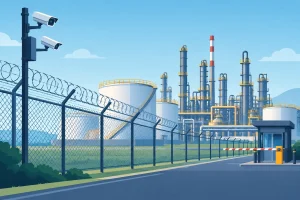

 Singapore :
+65-6708-9302
Singapore :
+65-6708-9302