
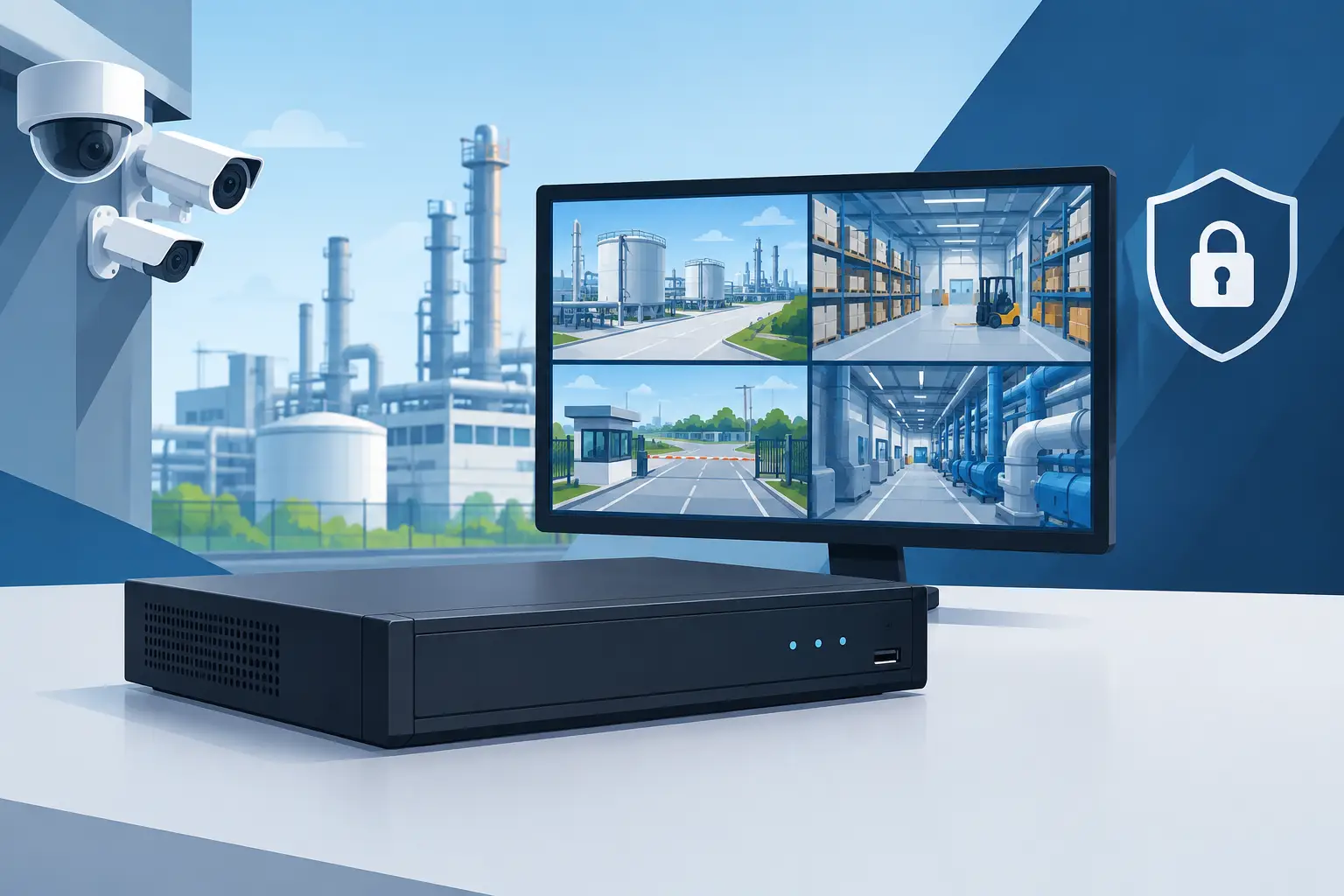
A recorder failure at an offshore platform, refinery gate, or power station is not a minor IT issue. It can erase the evidence needed after an intrusion, process upset, safety incident, or environmental event. This industrial NVR review focuses on what separates a consumer-grade recorder from a system built to protect critical operations: recording continuity, usable video retention, network tolerance, cybersecurity, and maintainable remote access.
For procurement teams, the lowest initial price is rarely the lowest operating cost. A recorder that drops channels under load, cannot retain footage for the required period, or forces technicians to travel offshore for a simple recovery can quickly become the expensive option. The right NVR supports the cameras, workflows, and risk profile of the facility without adding unnecessary complexity.
What an Industrial NVR Must Deliver
An industrial network video recorder is the command point for IP video. It receives camera streams, records footage, manages live and recorded viewing, and gives authorized personnel a way to search incidents from a control room or approved remote location. In industrial environments, however, those basic functions must continue under conditions that office systems are not designed to handle.
Network paths may run across long distances, fiber backbones, marine WiFi links, satellite connections, or segmented operational networks. Cameras may monitor perimeter fences, loading arms, engine spaces, substations, flare stacks, tank farms, jetties, and hazardous process areas. The video system must cope with low-light scenes, high-motion events, high-resolution streams, and variable bandwidth without sacrificing evidence quality.
A serious NVR selection also considers the physical installation. Rack-mounted equipment, stable power, controlled cooling, and service access are common requirements. For exposed or space-constrained locations, the recorder may need a protected cabinet, suitable power conditioning, and a clear plan for replacing drives or network components without interrupting security coverage.
Industrial NVR Review: The Criteria That Matter
A useful industrial NVR review should not stop at channel count. A 32-channel unit may be suitable for one site and completely inadequate for another if stream bit rates, retention targets, analytics, and remote viewing demand more processing or storage. The specification has to match the actual camera schedule and operating conditions.
Recording Continuity and Camera Compatibility
Start with the recorder’s proven recording throughput, not simply its stated number of channels. A system recording a small number of low-resolution streams has a very different workload from one handling high-resolution fixed cameras, thermal imaging, low-light surveillance, or multiple streams from a large perimeter.
Confirm that the NVR supports the camera protocols and stream formats planned for the project. Open interoperability is valuable when a facility has mixed camera estates, but compatibility should be validated before purchase. A supplier should be able to state the expected performance with the proposed camera models, recording settings, frame rates, and analytics enabled.
Look for continuous recording with event-based markers, pre-event capture, and post-event capture. Continuous footage provides context before and after an alarm. Event tagging helps security teams find a relevant incident quickly rather than searching through hours of video manually. Both functions matter at sites where response teams must act on facts, not assumptions.
Storage Is an Engineering Decision
Retention is often miscalculated. The number of days requested by a security policy is only one input. Storage demand depends on camera count, resolution, frames per second, codec, scene activity, recording mode, and whether cameras use variable bit rate. A busy loading terminal at night can consume far more storage than a quiet internal corridor.
The practical question is not how many hard drive bays a recorder has. It is whether the installed storage will retain evidential footage for the required duration at the selected quality settings. Build in headroom for camera additions, seasonal changes in scene activity, and periods when an incident requires protected footage to remain available beyond the normal overwrite cycle.
Drive health monitoring, fault alerts, and a clear replacement procedure should be part of the purchase decision. Redundant storage can reduce the impact of a single drive failure, but it does not replace backup procedures or health checks. Critical footage may also need export workflows that preserve timestamps, audit details, and playback integrity.
Network Performance and Remote Access
Industrial sites often have limited or expensive bandwidth between locations. Sending every high-quality stream to a central recorder may not be the best architecture. Local recording at an offshore asset, vessel, or remote substation can protect video during a communications interruption, while selected lower-bandwidth streams remain available to a central security team.
Remote viewing should be designed around user roles and available connectivity. A ship superintendent may need incident playback and health status, while an operator needs live views of a gate or process area. Give each group the access it needs without exposing the whole video estate. Sub-stream viewing, adaptive stream selection, and sensible camera layouts reduce network load while keeping operators informed.
Do not treat marine WiFi, satellite links, and operational network paths as interchangeable. Each has different latency, capacity, availability, and security considerations. The NVR architecture should reflect those constraints from the start.
Cybersecurity Cannot Be an Add-On
An NVR is a networked computer with access to sensitive video and, in many designs, a route toward other network assets. Default passwords, unmanaged user accounts, open services, and delayed firmware updates create avoidable exposure.
Specify unique credentials, role-based access, audit logs, encrypted management where supported, and a controlled update process. Network segmentation is equally valuable. Security video should have an approved route for authorized viewing and administration, not unrestricted access across business and operational networks.
Cybersecurity also improves accountability. When an exported clip is questioned after an incident, audit records can show who accessed footage, when it was exported, and which account performed the action. That level of control matters for investigations, compliance reviews, and contractor-managed sites.
Choose the Right Architecture for the Site
A single central NVR can make sense for a compact refinery, plant, or port facility with reliable fiber and a staffed security room. It centralizes administration and can simplify incident review. The trade-off is that a network outage between a camera zone and the recorder may leave a coverage gap unless edge recording or secondary paths are in place.
Distributed recording is often stronger for offshore platforms, vessels, remote pipelines, and multi-site energy operations. Local NVRs maintain recording close to the cameras, with central monitoring used for oversight and selected playback. This approach can reduce long-haul bandwidth demand and improve resilience, though it requires disciplined device management across several locations.
For high-consequence areas, consider how the recorder supports cameras beyond standard visible-light coverage. Thermal monitoring, low-light surveillance, and specialized detection solutions can provide earlier warning around perimeters, process equipment, marine approaches, and gas-risk zones. The NVR must have enough processing, network capacity, and storage to record those streams at settings that preserve their operational value.
Deployment Details That Prevent Expensive Problems
Before approving a purchase order, ask for a complete camera and recording design rather than a recorder quote in isolation. The design should state each camera’s resolution, codec, expected bit rate, recording schedule, retention target, switch capacity, uplink capacity, and power arrangement. This turns a generic specification into an accountable system design.
Environmental planning is just as practical. Recording appliances generate heat, and hard drives have operating limits. A cabinet in a hot electrical room, engine space, or unconditioned enclosure needs proper thermal planning. Stable power, surge protection, UPS runtime, grounding, and orderly shutdown behavior deserve the same attention as video specifications.
Commissioning should include more than confirming that images appear on a monitor. Test every camera at the intended recording settings, simulate a network interruption, confirm remote access permissions, verify footage retrieval, and review alerts for drive or camera failure. A system that has not been tested under expected fault conditions is not ready to carry critical evidence.
Questions to Put to Your NVR Supplier
Use these questions to separate a basic recorder sale from a site-ready surveillance proposal:
- What is the proven incoming recording bandwidth at our required camera settings?
- How many retention days will the proposed drives provide, with assumptions shown?
- What happens to recording if the uplink, a drive, or primary power fails?
- Which camera models, stream formats, and specialized imaging devices have been validated?
- How are user permissions, audit trails, firmware updates, and network segregation handled?
- What support is available when a remote marine or industrial installation needs recovery?
Revlight Security approaches NVR selection as part of the full surveillance infrastructure, including the network path, camera environment, retention obligation, and operational response requirement. That is the level of planning serious facilities need.
A capable industrial NVR does more than store video. It gives operations teams dependable evidence when conditions are difficult and decisions are time-sensitive. Specify the recorder against the risk, test it against real failure scenarios, and buy the system that will still perform when access to the site is limited and the footage matters most.
🛡️ Secure Your Home or Business Today
Protect your home, office, shop, or business with reliable CCTV security cameras. Explore our range of CCTV cameras and find the right security solution for your needs.
Explore CCTV Cameras ✉️ Email Us



 Singapore :
+65-6708-9302
Singapore :
+65-6708-9302