
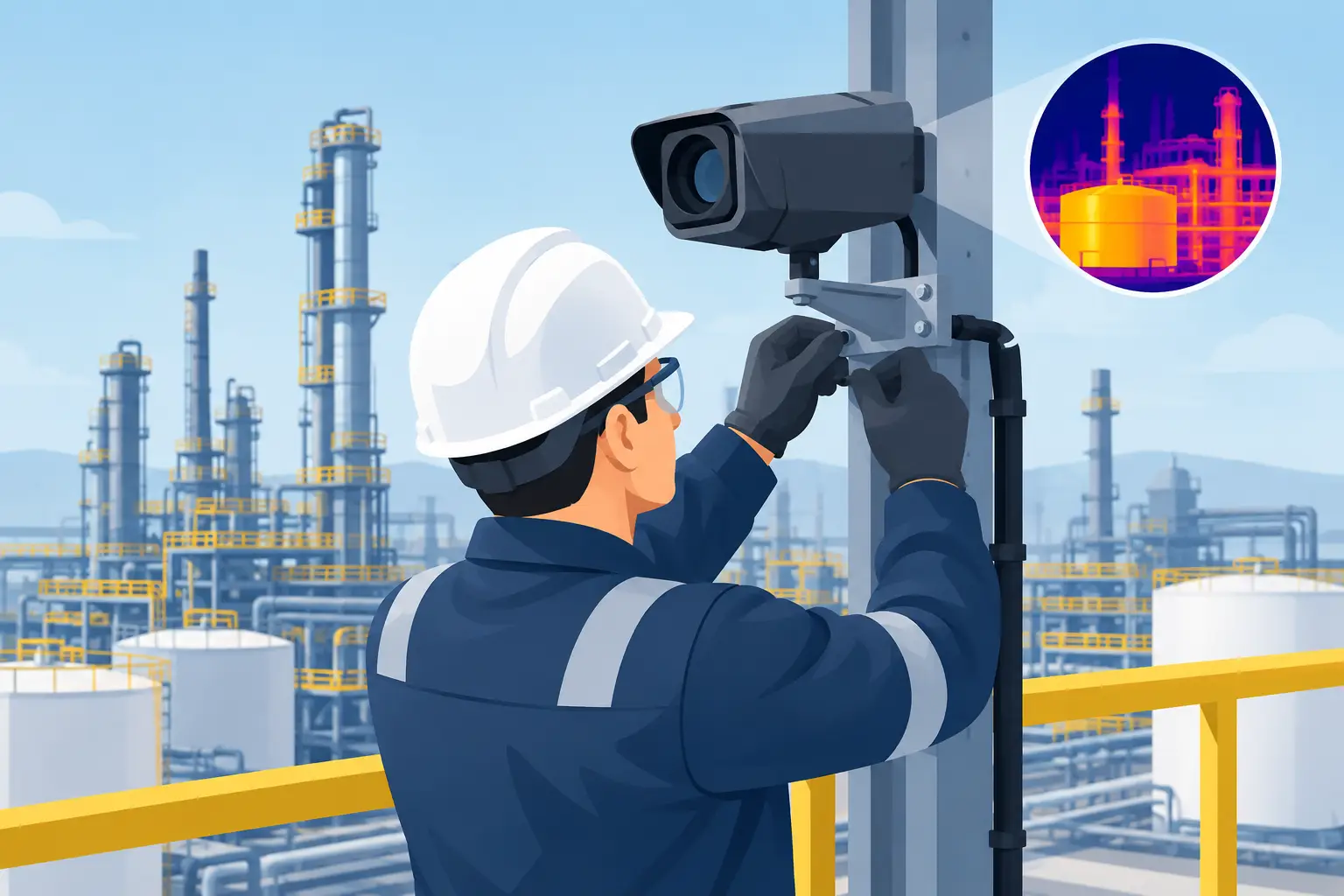
A thermal camera installed over the wrong process area can create a dangerous false sense of coverage. In a refinery, visibility is not the objective by itself. Operations teams need dependable temperature intelligence around flare systems, tank farms, loading racks, furnaces, pipe corridors, and other high-risk assets. To install refinery thermal cameras correctly, the project must begin with the operating risk, not with the camera model.
Thermal surveillance gives refinery operators a clear advantage when smoke, darkness, glare, vapor, or poor weather reduce the value of conventional imaging. It can reveal abnormal heat patterns, hot equipment, developing fires, and unauthorized activity without relying on visible light. But performance depends on engineering the complete installation: coverage, hazardous-area compliance, mounting, communications, recording, alarm integration, and service access all matter.
Start With the Detection Objective
Every refinery thermal camera installation should answer a specific operational question. Is the camera intended to detect a person entering a restricted perimeter at night? Monitor a flare stack for abnormal heat behavior? Identify a developing fire around pumps, valves, or conveyors? Support verification after a gas detection alarm? These are different applications, and each requires different field of view, temperature measurement capability, alarm rules, and mounting position.
A wide-angle camera may observe more of a tank farm, for example, but it can reduce the pixel density needed to identify a small hot spot at distance. A narrow field of view may provide better detail on a furnace face or loading arm, but it will leave adjacent areas outside coverage. Procurement teams should avoid buying on resolution alone. Lens selection, detection distance, scene temperature range, and the expected size of the target are what determine whether the system works in the field.
For fire prevention applications, specify whether the system needs thermal video only or radiometric measurement. Standard thermal imaging can show relative heat differences and support alarm verification. Radiometric thermal cameras measure temperatures across the image, allowing the system to alarm when a defined area exceeds a set threshold or changes temperature too quickly. That additional capability can be highly valuable, but it requires careful setup to avoid nuisance alarms from sun-heated surfaces, steam, hot exhaust, and normal process variation.
Perform a Site Survey Before Selecting Equipment
A proper site survey is where refinery surveillance projects are won or lost. The installer must document process hazards, sightlines, ambient conditions, existing structures, power sources, cable paths, network availability, and maintenance access. A camera that has a clear line of sight on a drawing may be blocked in reality by pipework, vehicles, insulation, temporary scaffolding, or seasonal vapor plumes.
Survey the intended installation point at the same time of day when possible. Direct sun can affect the apparent temperature of roofs, vessels, and ground surfaces. Night conditions may reveal lighting issues for associated visible cameras, while changing process conditions can affect thermal contrast. Where a critical target is routinely obscured, consider overlapping viewpoints rather than assuming one camera can protect the entire area.
The survey should also identify the hazardous-area classification for each proposed camera and junction box location. Refineries may contain Class I, Division 1 or Division 2 areas, or equivalent zone-classified areas depending on the site standard. The enclosure, cable glands, connectors, mounting accessories, and power equipment must match the classified environment. Do not treat an explosion-protected camera housing as a complete compliance solution if the supporting components are not rated for the same location.
Install Refinery Thermal Cameras With the Right Mounting Strategy
Mounting height and angle directly affect detection quality. High mounting can create broad coverage and reduce the risk of tampering, but a steep viewing angle may make it harder to distinguish the source of heat around complex equipment. Lower mounting offers a more useful horizontal view in some applications, but can increase exposure to vibration, impact, corrosion, and obstruction.
Use rigid, engineered supports rather than light poles or structures that transmit constant vibration. Thermal video can become difficult to interpret when a camera shakes in high wind or from rotating equipment. In locations near compressors, pumps, or marine loading infrastructure, confirm vibration levels and use approved brackets designed for the camera weight and environmental rating.
The camera should be positioned to avoid viewing directly into intense heat sources unless that is the intended target. Flare stacks, furnace openings, and hot exhaust can saturate part of the thermal scene or reduce detail in surrounding areas. A slight change in angle can often preserve visibility of the asset while limiting interference from extreme heat. This is where an experienced system designer adds real value: the best view is not always the most obvious view.
Environmental protection is equally important. Select housings and accessories that can withstand refinery dust, salt air in coastal facilities, high humidity, rain, washdown exposure, corrosive atmospheres, and temperature extremes. In some locations, a window wiper, washer system, sunshield, or protective shroud is justified. These additions increase initial cost, but they can protect uptime and reduce repeat maintenance visits in difficult access areas.
Design Power, Network, and Recording as One System
A thermal camera is only as useful as the infrastructure behind it. Before installation, confirm whether the system will use PoE, local AC power, fiber, copper Ethernet, wireless backhaul, or a combination of these. Long cable distances, electromagnetic interference, lightning exposure, and network segregation are common refinery concerns. Fiber is often the stronger choice for long runs and electrically noisy zones, while managed industrial network equipment supports better control and fault diagnosis.
Plan bandwidth around the required video quality, frame rate, retention period, and number of users viewing live feeds. Thermal streams can be efficient, but bandwidth planning should also account for visible-light channels, PTZ cameras, video analytics, recording servers, and remote access requirements. A system that performs well during acceptance testing may become slow once operators, security personnel, and maintenance teams all access it during an incident.
Recording configuration deserves the same attention as live monitoring. Continuous recording provides the most complete incident record, while event-based recording can reduce storage use. Many refinery deployments use a combination: continuous recording at a practical frame rate with alarm-triggered high-detail recording before and after the event. Retention requirements should be set by site policy, incident investigation needs, and available storage capacity, not guessed after the cameras are already installed.
Cybersecurity must be included from the beginning. Change factory credentials, segment surveillance devices from business networks where required, use approved remote access methods, keep firmware under a controlled update process, and document every device address and switch port. Thermal surveillance can support critical operations, so it should not become an unmanaged network exposure.
Configure Alarms for Operations, Not for Demonstrations
A thermal alarm that activates constantly will eventually be ignored. Alarm rules must reflect real operating conditions, including normal hot surfaces, planned maintenance work, vehicle movement, process startup, and weather effects. Use zones of interest to exclude known heat sources, then set thresholds based on actual site data rather than generic default values.
For radiometric applications, test both absolute temperature alarms and rate-of-rise alarms. An absolute limit may identify a surface that exceeds a defined temperature, while a rate-of-rise rule can highlight a rapidly developing event before it reaches that limit. Neither approach is universally better. Tank monitoring, electrical equipment, waste handling, and furnace surveillance all have different thermal behavior.
Integrate alarms into the workflow operators already use. Depending on site requirements, this may include the video management system, security control room, local annunciation, mobile notification, or an approved interface to other industrial systems. The camera should provide actionable verification, not create confusion about who owns the response.
Commission, Test, and Maintain the Installation
Commissioning should prove more than image quality. Test every defined use case: daytime and nighttime viewing, alarm activation, event recording, playback, remote access, loss of network, loss of power, and restoration after a reboot. Verify that camera names, maps, asset references, and alarm messages make sense to the people who will use them under pressure.
Document the final camera orientation, lens setting, field of view, network details, hazardous-area certifications, mounting arrangement, and maintenance requirements. This documentation shortens troubleshooting time and protects the investment when equipment changes hands between contractors or site teams.
Thermal cameras require periodic inspection. Clean optical windows using approved methods, inspect seals and cable entries, check for corrosion, confirm mounting integrity, review image focus, and validate alarm performance against operating conditions. A camera may still produce a picture while delivering weaker detection because the lens is contaminated or the view has shifted slightly over time.
The strongest refinery thermal camera project is not the one with the most devices. It is the one that gives operators a clear view of the hazards that matter, records evidence when conditions change, and remains dependable after months of heat, vibration, weather, and demanding operations. Choose equipment and installation support that are engineered for that reality, then verify performance in the field before the system is handed over.
🛡️ Secure Your Home or Business Today
Protect your home, office, shop, or business with reliable CCTV security cameras. Explore our range of CCTV cameras and find the right security solution for your needs.
Explore CCTV Cameras ✉️ Email Us



 Singapore :
+65-6708-9302
Singapore :
+65-6708-9302