
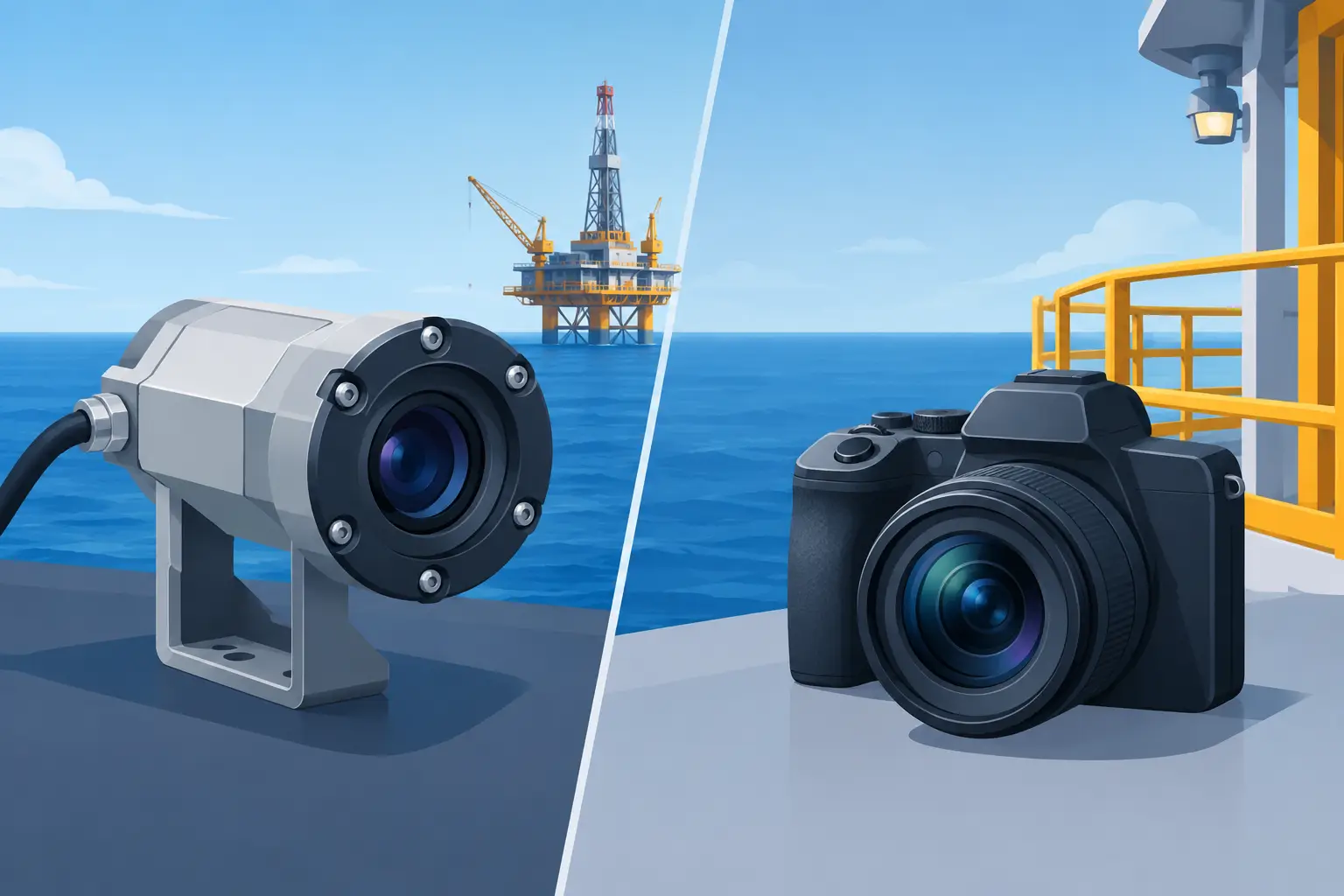
A DNV camera vs standard camera comparison is not simply about image resolution, zoom range, or purchase price. For vessel operators, offshore asset owners, and industrial procurement teams, the decision can determine whether a surveillance installation remains available through salt exposure, vibration, weather, inspection requirements, and years of continuous operation.
A standard camera may be suitable for a controlled indoor location or a low-risk perimeter. A DNV-aligned camera solution is specified for a far more demanding operating environment, where documentation, enclosure performance, power design, installation method, and equipment traceability can matter as much as the picture itself. The right choice protects operational visibility, reduces replacement cycles, and supports a security system that works when conditions are least forgiving.
What Does “DNV Camera” Actually Mean?
DNV is a classification and assurance organization widely recognized across marine, offshore, and energy sectors. In procurement language, a “DNV camera” often refers to a surveillance camera or camera system supplied with DNV type approval, DNV certification, or documentation aligned with a vessel class, offshore project, or marine equipment specification.
Those terms should not be treated as interchangeable. A camera can be built for marine use without holding the exact approval required for a particular vessel or project. Likewise, an approved component may still require the complete installation to meet project-specific requirements for cable routing, power supplies, network equipment, mounting arrangements, and hazardous-area interfaces.
This is why buyers should request the applicable certificate, approval scope, revision date, and equipment model number before placing an order. “DNV compliant” is not enough when an owner, class surveyor, EPC contractor, or flag-state requirement calls for defined evidence. The certificate must match the equipment being delivered and the use case being evaluated.
DNV Camera vs Standard Camera: The Operational Difference
The central difference is design assurance for the environment and application. A standard camera is commonly selected around basic performance specifications: megapixels, low-light capability, lens angle, storage compatibility, and price. Those features still matter offshore, but they do not answer the larger question: can the equipment keep operating reliably aboard a vessel or at an exposed industrial site?
A DNV-oriented solution is normally evaluated through a wider engineering lens. That includes environmental exposure, material selection, ingress protection, corrosion resistance, vibration tolerance, electrical behavior, electromagnetic compatibility, documentation, and quality control. The exact requirements depend on the approved product and intended location, but the procurement approach is fundamentally different.
For example, a camera watching a machinery space may face heat, moisture, vibration, and limited maintenance access. A unit mounted on an open deck may experience salt spray, wind-driven rain, UV exposure, and continuous vessel movement. A refinery installation may add hydrocarbon risk, hazardous-area requirements, process safety rules, and the need to integrate with an existing control-room network. A standard camera specified only by image quality may look attractive on a quotation, then become the weakest component in the system.
Certification Supports a Wider System Decision
DNV status does not automatically make one camera right for every deployment. It does, however, provide a structured basis for verifying fitness within the approval scope. Procurement teams can make decisions with more confidence when the product documentation aligns with the asset’s class requirements and operating conditions.
This is particularly valuable when equipment must be accepted by multiple stakeholders. The operations team wants dependable coverage. Engineering wants compatibility. Security wants usable video and remote access. Procurement needs a clear comparison of initial cost, replacement exposure, and documentation risk. Class and project teams need evidence. A properly specified solution addresses all of those pressures before installation begins.
Where Standard Cameras Can Still Be the Right Choice
A standard camera is not automatically a poor purchase. In the right location, it can be the more economical option. Protected offices, access-controlled warehouses, internal corridors, temporary project buildings, and other low-exposure areas may not require a DNV-approved camera. Selecting certified equipment where no certification is needed can add cost without delivering proportional value.
The key is to avoid treating the whole site as one environment. Industrial facilities have zones with very different risk profiles. An indoor control room, a jetty, a pump area, an engine room, and an offshore deck should not necessarily receive the same camera specification.
Standard equipment also deserves scrutiny. Buyers should still confirm enclosure rating, operating temperature, power source, network compatibility, recording requirements, and manufacturer support. Lower acquisition cost can quickly disappear if a camera fails early, produces unusable footage in low light, or cannot connect reliably to the video management platform.
The Cost Question: Purchase Price Versus Lifecycle Value
The first price on a quotation rarely tells the full story. A DNV-oriented camera system can cost more than general-purpose equipment because its materials, testing, certification, and documentation are designed for specialized duty. For a project in a harsh marine or offshore environment, that premium can be commercially justified.
Consider the real cost of replacing a failed unit. It may include technician time, work permits, vessel scheduling, lift access, cable inspection, production disruption, shipping to a remote location, and the loss of camera coverage during a security or safety event. On an offshore platform or operating vessel, a low-cost camera that requires repeated replacement is not low cost at all.
Lifecycle value is strongest when the camera is selected as part of a complete surveillance architecture. The enclosure, mount, junction box, power supply, PoE design, network switch, recording server, and remote-viewing method must all be suitable for the environment. A premium camera connected through an unsuitable network device still creates a point of failure.
Questions to Ask Before You Specify a Camera
Before comparing models, define the installation location and the outcome required from the video. Is the camera intended for security investigation, crew safety, navigation support, process observation, perimeter monitoring, or remote verification of an alarm? Each objective changes the lens, illumination, retention period, camera positioning, and network requirements.
Then verify environmental and approval requirements. Ask whether the asset is classed, whether DNV documentation is mandatory, and whether the camera is installed in a hazardous or non-hazardous area. Hazardous-area certification is a separate requirement from DNV approval. A camera may satisfy one requirement and not the other, so both must be checked against the project specification.
It is also wise to clarify how video will be used after capture. A camera that records locally may be sufficient for a small isolated application. A larger operation may need central recording, playback by authorized users, remote access from shore, network redundancy, camera health monitoring, and integration with access control or alarm systems. These requirements should be written into the purchase specification, not handled as an afterthought.
Build the Specification Around the Asset, Not the Catalog
The best surveillance procurement starts with an engineering assessment of the asset. Identify exposure zones, cable paths, available power, network capacity, mounting surfaces, maintenance restrictions, and approval obligations. From there, select cameras according to the actual duty cycle and evidence needed from the footage.
For marine and offshore projects, specify documentation deliverables as clearly as technical features. Require model-specific certificates where applicable, datasheets, drawings, environmental ratings, warranty terms, and compatibility details for the recording and network infrastructure. This prevents a common procurement failure: receiving a technically similar product that does not meet the documentation requirement.
Revlight Security supports industrial buyers with surveillance and detection equipment selected for demanding marine, offshore, refinery, and energy applications. The strongest result is not the camera with the longest feature list. It is the correctly specified system that gives operators dependable visibility, practical remote access, and fewer costly surprises after commissioning.
When the site is exposed, classed, or difficult to service, treat camera selection as infrastructure rather than a commodity purchase. The right specification gives your team clear visibility long after the initial installation crew has left the asset.
🛡️ Secure Your Home or Business Today
Protect your home, office, shop, or business with reliable CCTV security cameras. Explore our range of CCTV cameras and find the right security solution for your needs.
Explore CCTV Cameras ✉️ Email Us


 Singapore :
+65-6708-9302