
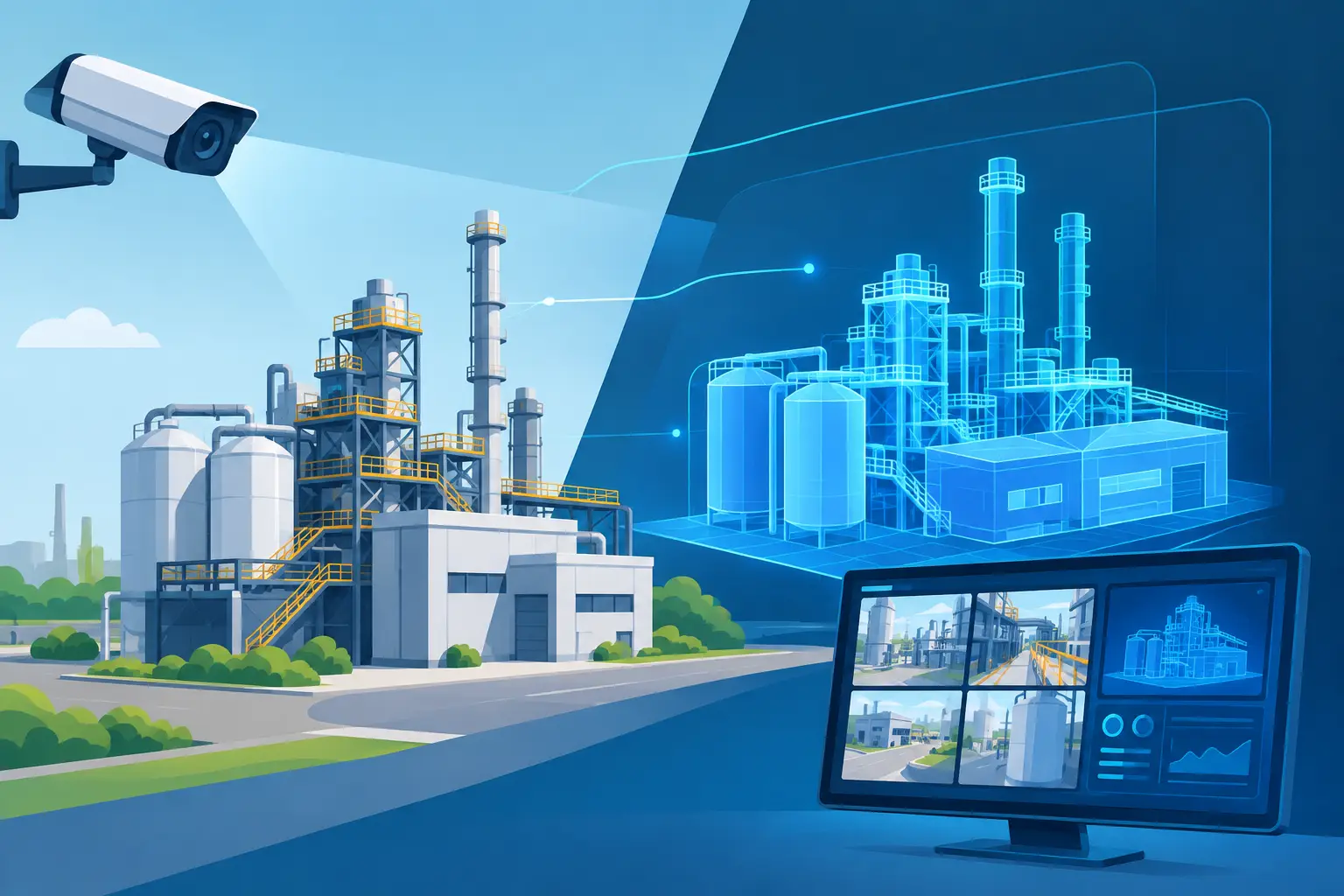
A blind spot on an offshore platform, refinery perimeter, or engine room is not a minor design flaw. It can become an incident, a delayed response, a costly shutdown, or a compliance issue. Digital twins give operations teams a practical way to identify those weaknesses before equipment is installed, moved, or expanded.
For industrial security buyers, a digital twin is not a presentation graphic. It is a working virtual model of a physical asset, process, or site. When it is built with accurate layout, equipment, network, environmental, and operational data, it allows teams to test surveillance performance under real-world constraints. That makes it a serious decision tool for facilities where access is difficult, conditions are harsh, and mistakes are expensive.
What Digital Twins Change for Security Planning
Traditional surveillance design often starts with drawings, site walks, equipment schedules, and experience. Those inputs remain valuable, but they do not always show what happens when camera views are blocked by pipework, when wireless signals pass through steel bulkheads, or when a gas plume moves through a complex process area.
Digital twins add operational context. A refinery team can model sightlines around tanks, valves, flare systems, and restricted zones. A marine operator can assess coverage across decks, corridors, machinery spaces, and access points while considering vessel movement and changing network conditions. An offshore operator can evaluate subsea inspection visibility, topside monitoring coverage, and communications paths before mobilizing personnel and equipment.
The commercial value is direct. Better design decisions reduce rework, limit unnecessary hardware purchases, shorten commissioning, and improve the chance that critical events are detected quickly. For procurement managers, the model provides a clearer basis for comparing system options. For operations managers, it turns security infrastructure from a fixed installation into a measurable operating asset.
Digital Twins for Surveillance Coverage and Detection
The strongest use case is coverage validation. A site may have enough cameras on paper but still lack useful evidence where it matters most. Distance, mounting height, lens selection, lighting, vibration, obstructions, weather exposure, and target movement all affect the quality of the final image.
A digital twin can show whether a fixed surveillance point will provide identification-level detail at a gate, process unit, dock, or restricted access route. It can also reveal overlap between devices, helping teams avoid paying for redundant coverage while protecting priority areas. This matters on large industrial sites where every mounting location, cable run, and maintenance visit carries cost.
For methane and gas leak detection systems, the value is even more operational. Detection performance depends on the monitored area, prevailing wind, process layout, emission sources, and the response procedure that follows an alarm. A virtual model can help teams examine whether a detector has an unobstructed view of likely leak points and whether control room personnel can interpret alarms alongside visual evidence.
This does not mean a model replaces field verification. It does not. Actual site conditions, local regulations, atmospheric conditions, and equipment specifications must always govern the final design. The advantage is that teams can arrive at field verification with a stronger plan and fewer assumptions.
Network performance is part of the security design
A surveillance system is only as effective as its network path. High-resolution streams, remote access, recording retention, analytics, and alarm notifications create bandwidth and storage demands that cannot be treated as an afterthought.
Digital twins allow technical teams to simulate network capacity across fiber, copper, wireless bridges, vessel networks, and remote communications links. They can identify where latency may affect live viewing, where congestion could degrade recorded footage, and where a single switch, power source, or wireless path creates an unacceptable point of failure.
For marine operators, this is particularly useful. Steel structures, changing deck configurations, satellite constraints, port connectivity, and crew access requirements can all affect system performance. A well-maintained model helps engineers plan upgrades without disrupting essential vessel operations.
Where Industrial Teams Get the Best Return
Digital twins deliver the highest return when they are connected to a real operating decision. Building an elaborate virtual site without a clear use case can consume budget without improving security. Start with the areas where visibility, response time, safety exposure, or project cost is highest.
Common high-value applications include refinery perimeter upgrades, tank farm monitoring, offshore platform expansions, subsea inspection planning, marine WiFi improvements, and integrated detection systems for high-risk process areas. They are also useful when a facility is adding equipment, altering process layouts, consolidating control rooms, or preparing for a major turnaround.
The approach is especially effective for remote and hazardous environments. Sending personnel offshore, into confined machinery spaces, near energized equipment, or into restricted production areas requires planning and permits. A digital twin cannot eliminate site work, but it can reduce unnecessary visits and help teams make each visit count.
What a Useful Security Digital Twin Needs
The model must be based on dependable information. A visually impressive 3D environment with outdated equipment locations or incomplete network data will produce poor decisions. Industrial buyers should expect a digital twin program to combine engineering discipline with security system knowledge.
At minimum, the project should define four areas clearly:
- Physical site data, including drawings, elevations, access routes, equipment locations, and likely obstructions.
- Security requirements, such as detection zones, identification needs, alarm priorities, recording periods, and remote access rules.
- Infrastructure data, including network topology, power availability, communications links, storage capacity, and environmental ratings.
- Operating scenarios, including normal operations, poor visibility, restricted access, maintenance periods, weather exposure, and alarm response procedures.
The model also needs ownership. If nobody updates it after equipment is relocated, a network cabinet is changed, or a process unit is modified, its value declines quickly. The best practice is to make updates part of change management, not an occasional visualization exercise.
Choosing the Right Level of Detail
More detail is not always better. A procurement team evaluating a preliminary surveillance upgrade may only need site geometry, device placement, coverage zones, and network estimates. An engineering team preparing for installation may need mounting details, cable routes, power calculations, switch capacity, environmental specifications, and maintenance access.
The correct level depends on the decision being made. Over-modeling slows projects and increases cost. Under-modeling creates false confidence. A capable supplier should help define the level of detail that supports the project stage, site risk, and expected return.
For example, an operator deciding between two perimeter coverage concepts needs a fast comparison of views, blind spots, infrastructure demand, and capital cost. A vessel operator planning a communications upgrade may need a more detailed wireless propagation model and network resilience assessment. Both are digital twin applications, but they require different inputs and deliverables.
From Virtual Model to Better Field Performance
The real measure of a digital twin is what happens after deployment. Did the system reduce blind spots? Did detection alarms reach the right personnel? Did remote users receive usable video without creating network bottlenecks? Did maintenance teams gain safer access to equipment information?
These questions should be built into the project from the start. Define performance targets before selecting equipment, then compare installed performance against the model during commissioning. This creates a feedback loop that improves future upgrades and gives operations teams evidence for capital planning.
At Revlight Security, the focus is not on technology for its own sake. Industrial surveillance, gas detection, underwater monitoring, and marine network systems must perform where conditions are demanding and failure has consequences. A digital twin supports that standard by making the design process more measurable, more accountable, and more commercially defensible.
The next time a site needs additional coverage, a new detection layer, or a network overhaul, do not begin by asking only which equipment to buy. Ask what the facility needs to see, detect, record, and communicate under actual operating conditions. That is where a well-built digital twin earns its place.
🛡️ Secure Your Home or Business Today
Protect your home, office, shop, or business with reliable CCTV security cameras. Explore our range of CCTV cameras and find the right security solution for your needs.
Explore CCTV Cameras ✉️ Email Us

 Singapore :
+65-6708-9302