
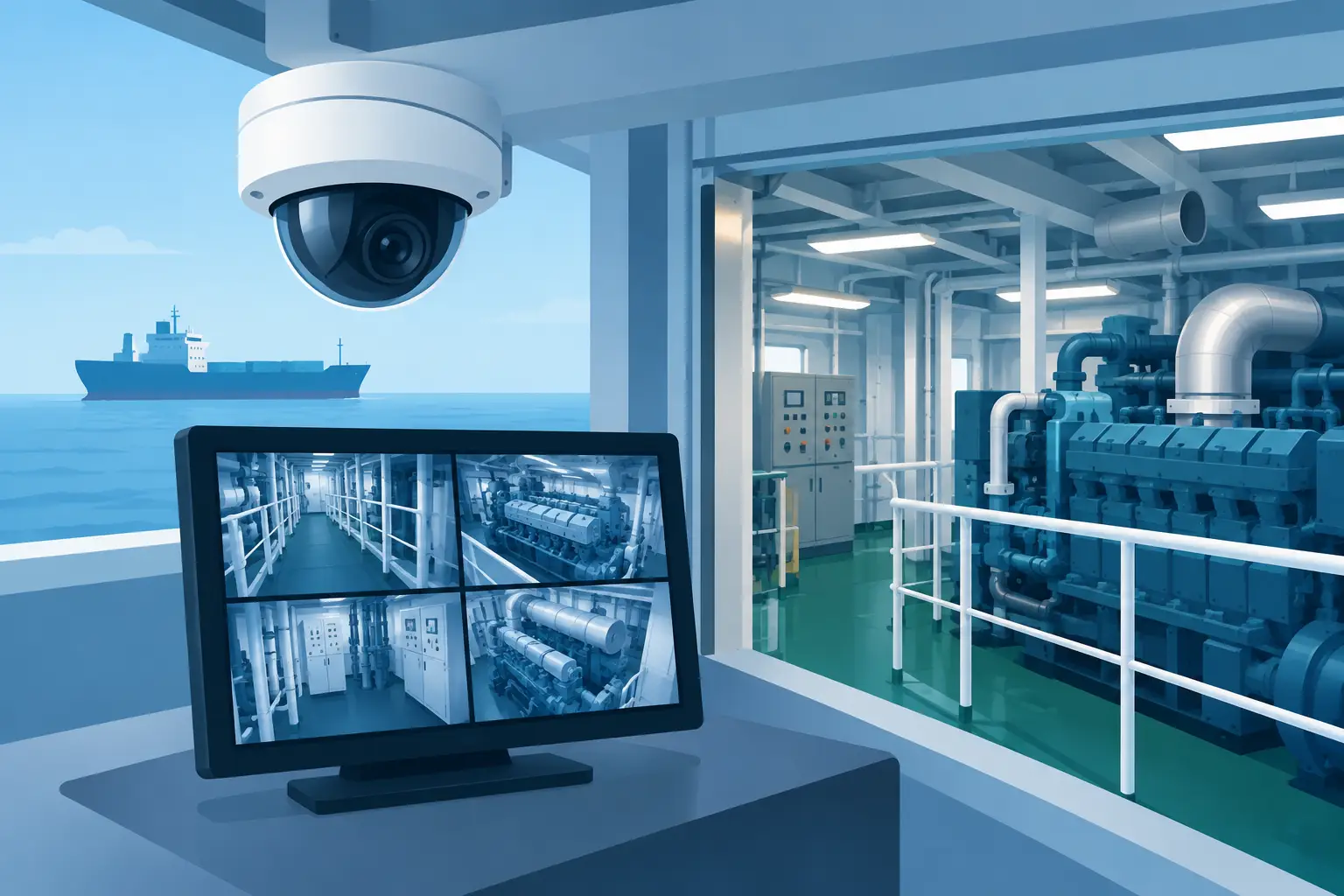
An engine room camera is not a convenience item. It is a working part of the vessel’s safety, maintenance, and operational control system. The best ship engine room cameras give crews clear evidence when machinery is operating normally, help shoreside teams investigate alarms quickly, and reduce unnecessary entry into high-noise, high-heat spaces.
For ship managers and technical buyers, the decision is not simply about selecting the highest-resolution unit. The right system must continue recording through vibration, heat, humidity, electrical interference, poor lighting, and unstable network conditions. It also has to fit the vessel’s power, cabling, recording, and class requirements without creating a maintenance burden of its own.
What the Best Ship Engine Room Cameras Must Handle
A standard indoor security camera may produce a sharp image at commissioning, then fail after months beside a main engine or auxiliary generator. Marine engine rooms demand equipment built for continuous industrial exposure. Heat cycling can affect electronics and lens performance. Vibration can loosen connectors and disrupt focus. Oil mist, steam, and airborne contamination can obscure the viewing window. Salt-laden air accelerates corrosion wherever enclosures, glands, and brackets are not properly specified.
Start with the operating environment, not the catalog image. A suitable camera should have a temperature rating that exceeds the expected local ambient temperature, particularly around generators, exhaust areas, separators, and machinery spaces with limited ventilation. It should also have a rugged, corrosion-resistant housing, a properly rated ingress-protection enclosure, and mounting hardware designed for marine vibration.
IP66 or IP67 protection is commonly appropriate where washdown, spray, condensation, or heavy contamination are possible. However, the enclosure rating alone does not make a system marine-ready. Cable glands, junction boxes, connectors, and brackets must match the same environmental standard. One weak connection can be the point that takes a critical view offline.
Low Light and Difficult Contrast Matter More Than Marketing Resolution
Engine rooms contain bright inspection lights, dark corners, reflective pipework, and moving machinery. A high-resolution camera with poor low-light performance can deliver less operational value than a lower-resolution model with strong wide dynamic range, low-light sensitivity, and controlled infrared illumination.
Wide dynamic range is especially valuable near access doors, skylights, and bulkhead openings where bright external light can wash out details inside the space. For continuously dark locations, infrared capability can support monitoring without adding permanent lighting. The installation must be planned carefully, though. Infrared can reflect from polished metal, mist, or nearby guards and create glare that hides the very area being monitored.
The goal is not a visually impressive image. The goal is a usable image that lets an engineer identify leaks, smoke development, unauthorized access, abnormal belt movement, flooding, or unsafe activity at the moment it matters.
Camera Types and Where They Deliver Value
The best deployment normally combines fixed views rather than relying on one centrally mounted unit. A fixed camera aimed at a generator front, purifier area, engine control room entrance, or bilge zone creates a dependable reference point for live viewing and playback. Fixed views are easier to document, easier to review after an incident, and less likely to lose coverage due to a changed preset position.
Pan-tilt-zoom cameras add value in larger machinery spaces where an engineer or shoreside operator needs to inspect several zones from one position. They are useful for guided remote inspections and alarm verification, but should not be treated as a substitute for fixed coverage at high-risk points. If a PTZ is looking at one area, it is not protecting another.
Thermal cameras can be a strong addition around high-temperature equipment, electrical panels, exhaust systems, and machinery where abnormal heat patterns can indicate developing faults. Thermal imaging should be positioned as an early-warning and verification tool, not as a replacement for certified fire detection, gas detection, or statutory alarm systems. The final system design must respect the vessel’s approved safety architecture.
For areas where fuel vapor or hazardous gases may be present, certification requirements need close attention. Depending on the location, vessel type, class rules, and flag-state requirements, the camera may need hazardous-area approval such as ATEX or IECEx. Procurement teams should confirm the zone classification before specifying equipment. An incorrectly selected non-certified device can introduce compliance risk and expensive rework.
Build the System Around Coverage, Not Camera Count
A camera count is not a coverage plan. Before selecting hardware, map the areas that support safe operation and fast investigation. This usually includes the main engine, diesel generators, purifier room, boiler or incinerator area, fuel handling points, electrical switchboards, bilge areas, machinery access doors, and the engine control room.
Camera placement should account for service access, sight lines, vibration sources, maintenance clearance, and contamination. A view mounted too close to a hot surface may shorten equipment life. A camera aimed across a line of pipework may miss a leak source completely. A low-mounted camera can be blocked by stored equipment or personnel during the moment of need.
Use a site survey to identify each scene, the event that must be observed, the required image detail, and the viewing distance. For example, a general machinery overview needs broad coverage, while a fuel transfer valve station may need enough detail to confirm the status of a handle, indicator, or local gauge. These are different design requirements and may need different lenses.
Recording Retention Is an Operational Decision
Continuous recording provides the strongest evidence trail for machinery incidents, safety events, and maintenance investigations. Motion recording can reduce storage use, but engine rooms contain constant movement from vibration, lighting changes, steam, and rotating components. Poorly configured motion detection can either miss activity or create excessive recordings.
Specify retention based on the vessel’s operating profile, incident-reporting process, and available network bandwidth. Thirty days is a common planning point, but it may not be enough for vessels with delayed reporting cycles or limited shoreside access. Recording resolution, frame rate, camera quantity, and compression settings all affect storage capacity.
A commercial-grade network video recorder with health monitoring is the right foundation for most installations. It should report camera loss, storage faults, recording failures, and unauthorized access. Redundant storage may be justified on critical vessels, especially when surveillance footage supports safety investigations, insurance claims, or operational disputes.
Network Design Determines Whether Remote Viewing Works
Remote access is one of the clearest reasons to install engine room surveillance, but it must be designed for maritime connectivity. Satellite and cellular links may have limited bandwidth, high latency, or expensive data usage. Sending full-resolution live streams from every camera to shore is rarely the best approach.
A properly engineered system records locally on board and provides lower-bandwidth substreams for remote live viewing. Authorized users can then call up higher-quality footage when required. Network segmentation is equally important. Surveillance devices should sit on a managed network separated from navigation, propulsion control, and other critical operational technology systems.
Power over Ethernet can simplify installation by carrying power and data through one cable, but the switch, power budget, cable route, and backup supply must be engineered for the vessel. Where long cable runs, electrical noise, or separation requirements apply, fiber links or industrial network equipment may be the better investment.
Cybersecurity cannot be added after commissioning. Replace default credentials, restrict user permissions, apply firmware controls, disable unnecessary services, and use encrypted remote access. A camera system that provides visibility into the engine room must not become an entry point into the vessel network.
How to Specify a Purchase With Confidence
The strongest procurement specification describes outcomes rather than copying generic camera features. Require the supplier to state the environmental rating, operating temperature, housing material, vibration suitability, lens selection, network topology, recording retention, remote-access method, and any required hazardous-area certification. Ask how the system reports device faults and how replacement equipment will be supported across your operating regions.
Price matters, but low initial cost can become expensive when cameras corrode, recordings fail, or remote troubleshooting is impossible. The best value comes from a complete system that is correctly engineered, documented, installed, and supported. Revlight Security supplies specialist surveillance infrastructure built around these practical marine conditions, including network design and environment-specific camera selection.
Before issuing a purchase order, ask for a coverage drawing and verify every high-consequence view with the chief engineer or superintendent. A camera system earns its place on board when it gives the right person a clear answer before a minor machinery concern becomes downtime, damage, or a safety event.
🛡️ Secure Your Home or Business Today
Protect your home, office, shop, or business with reliable CCTV security cameras. Explore our range of CCTV cameras and find the right security solution for your needs.
Explore CCTV Cameras ✉️ Email Us


 Singapore :
+65-6708-9302