
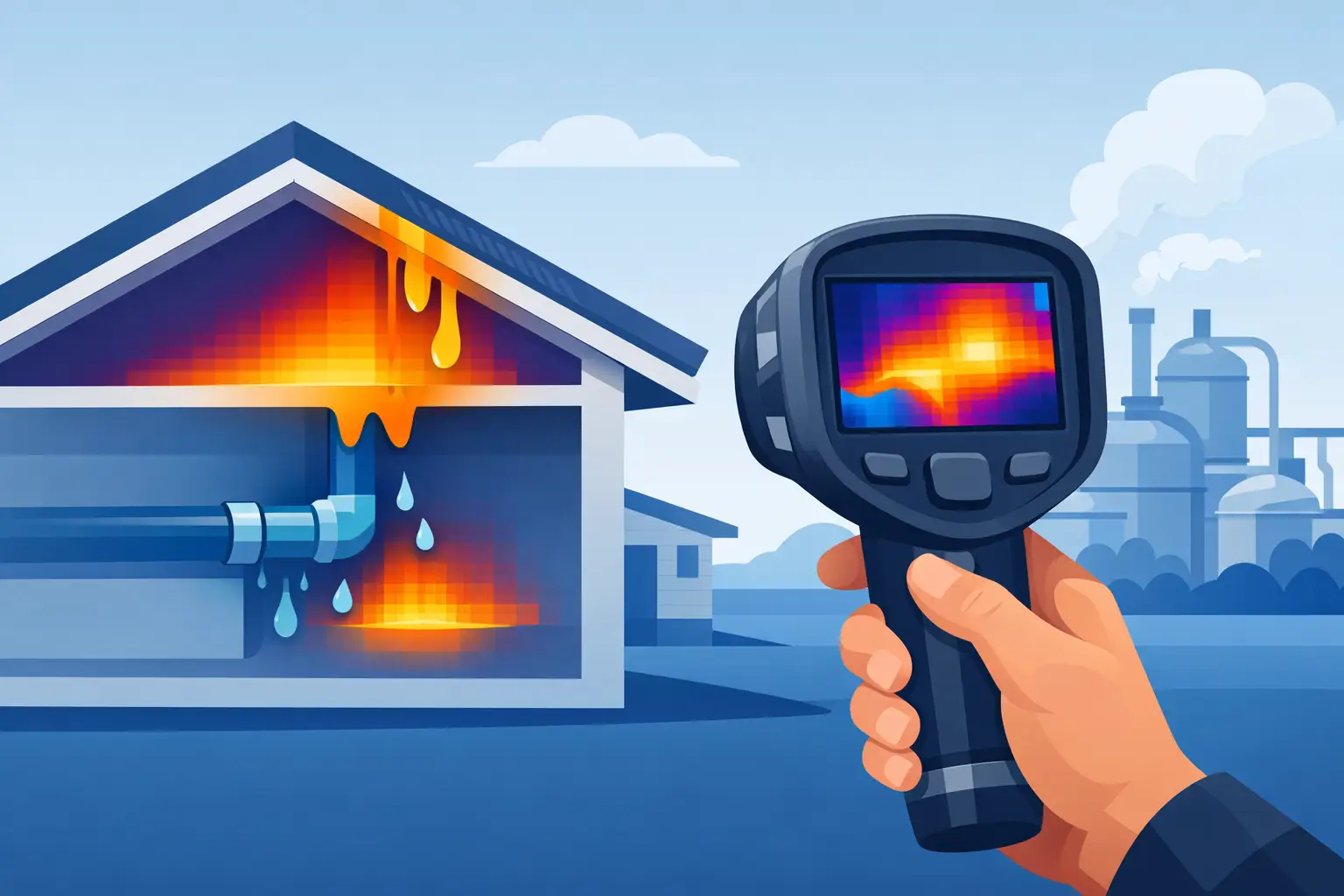
A refinery leak rarely announces itself at a convenient time. It may begin as a minor temperature change at a flange, a cold line on insulated pipework, or an invisible gas plume moving with the wind. Can thermal cameras detect leaks? Yes, in the right conditions, but not every thermal camera can see every leak. The difference matters when a missed release can create safety exposure, production loss, environmental liability, or an unplanned shutdown.
For industrial operators, thermal imaging should be treated as a targeted detection technology, not a universal leak-finding promise. The camera must match the substance, process temperature, background conditions, distance, and inspection objective.
Can Thermal Cameras Detect Leaks in Industrial Facilities?
Thermal cameras detect infrared radiation emitted or reflected by surfaces. They display temperature differences as an image, allowing operators to identify abnormal hot or cold patterns that may indicate a leak. In many cases, the camera does not see the leaking material itself. It sees the thermal effect that material creates.
A leaking hot-water line may produce a warm trace on a wall, deck, or insulated surface. A refrigerant leak can create a sharply cold area around a fitting. Steam escaping through a failed valve or gasket may alter the temperature of nearby metalwork. Oil or hydraulic fluid escaping from a pressurized system may change the surface temperature of equipment, especially where it spreads across a component or reduces lubrication.
This is valuable because temperature anomalies often appear before visible damage, pooling, corrosion, or equipment failure becomes obvious. A fixed thermal monitoring system can also observe difficult areas continuously, rather than relying solely on periodic inspection rounds.
The limitation is straightforward: if a leak does not create a measurable temperature contrast, a conventional thermal camera may not reveal it. A small leak at ambient temperature against an ambient background can remain invisible. Wind, rain, sun loading, reflective metal, insulation quality, and viewing angle can all weaken or distort the thermal signature.
Thermal Imaging Versus Gas Detection Cameras
For methane, volatile organic compounds, and many hydrocarbon gases, standard thermal imaging is not enough. These gases are often invisible to ordinary infrared cameras because they do not produce a useful temperature contrast against the background.
Optical gas imaging cameras use carefully selected infrared wavelengths to visualize particular gases. A methane detection camera, for example, is designed to identify the way hydrocarbon gases absorb infrared energy in a specific spectral band. The result is a visible moving plume on screen, allowing an operator to locate the source at valves, seals, compressors, storage connections, piping joints, and process equipment.
This distinction is critical during procurement. A thermal surveillance camera can be highly effective for overheating equipment, steam-related anomalies, insulation failures, and temperature-driven liquid leaks. It should not be specified as a methane imaging solution unless its sensor and spectral response are expressly designed for that application.
Gas imaging performance also depends on the gas type, leak rate, distance, atmospheric conditions, temperature difference between gas and background, and operator technique. A gas camera is a powerful detection layer, but it does not replace fixed gas sensors, process instrumentation, maintenance discipline, or emergency response procedures. The strongest facilities combine these systems according to their risk profile.
Where Thermal Cameras Deliver the Best Results
Thermal leak detection delivers the most commercial value where the process creates repeatable, meaningful temperature differences. Industrial facilities can use it to investigate suspected leaks and to monitor high-risk assets where a failure could escalate quickly.
Steam, Hot Water, and Heat-Transfer Systems
Leaks from steam lines, heat exchangers, boilers, condensate systems, and hot-water circuits can create clear thermal signatures. A camera may reveal hot spots around valve stems, flange faces, joints, and failed insulation. It can also show cold zones where a process line is losing heat unexpectedly.
For power stations, chemical plants, and refinery process units, this supports faster maintenance prioritization. Instead of opening insulation or taking equipment offline based only on suspicion, teams can use thermal evidence to focus the inspection scope.
Refrigeration and Chilled Systems
A refrigerant release can cool nearby components, making thermal imaging useful for identifying suspect fittings and lines. However, performance varies by refrigerant, leak size, equipment load, and ambient conditions. The camera may show the cooling effect rather than the refrigerant plume itself.
This is particularly useful for marine machinery spaces, cold storage areas, and industrial cooling systems where physical access is constrained and equipment uptime is commercially important.
Roof, Building, and Containment Moisture
Water intrusion often changes the thermal behavior of a roof, wall, tank insulation system, or containment structure. Wet materials heat and cool differently than dry materials. Under suitable conditions, thermal surveys can identify areas that warrant closer investigation before corrosion, electrical issues, or structural deterioration spread.
This application requires disciplined timing. Surveys are often more revealing after solar heating or during a controlled temperature transition. A poorly timed scan can create false confidence or false alarms.
Electrical and Mechanical Consequences of Leaks
Not every inspection begins with the leak itself. A loss of lubricant, coolant, or process fluid can raise equipment temperature and expose bearings, motors, pumps, and connections to accelerated failure. Thermal monitoring can identify these secondary effects early enough to protect production assets.
That makes thermal surveillance a strong complement to condition monitoring programs. It helps operations teams see the developing consequence, while maintenance teams determine the root cause.
What Can Cause False Readings?
Industrial thermal images must be interpreted in context. Shiny stainless steel, wet surfaces, direct sunlight, hot exhaust paths, and changing wind can all make a component appear hotter or colder than it truly is. Reflected heat from adjacent equipment is especially common around vessels, pipe racks, engine rooms, and offshore process modules.
Emissivity is another major factor. Painted steel, oxidized metal, bare metal, insulation, water, and composite materials emit infrared energy differently. A camera can reliably show contrast, but an exact temperature measurement may require correct emissivity settings, reflected-temperature compensation, and a suitable viewing angle.
For this reason, a high-quality camera alone does not guarantee a dependable inspection result. Operators need defined survey routes, baseline images, alarm thresholds appropriate to the application, and verification procedures. On critical assets, the image should be assessed alongside pressure trends, gas sensor data, maintenance history, and process readings.
How to Specify a Leak Detection Camera System
The right specification starts with the question: what leak are you trying to find? Procurement teams should identify the target substance, expected leak locations, required detection distance, operating temperatures, area classification, and whether continuous monitoring or periodic inspection is needed.
For gas applications, confirm the camera is certified or engineered for the gases of concern. Ask for detection capability under representative site conditions, not only ideal demonstration conditions. Resolution, thermal sensitivity, lens selection, image processing, recording capacity, remote viewing, and integration with control room systems all affect operational value.
For fixed installations, housing durability is equally important. Offshore platforms, marine vessels, refineries, and power facilities need equipment that can withstand salt spray, vibration, dust, humidity, corrosive atmospheres, and temperature extremes. Hazardous-area requirements must be addressed at the system-design stage, including power, network architecture, mounting position, and maintenance access.
A camera that produces a useful image but cannot survive the environment is not a cost-saving solution. The best service provider will help align detection performance with installation realities, rather than offering a one-size-fits-all device.
Fixed Monitoring or Inspection-Based Deployment?
Fixed thermal and gas imaging systems are well suited to high-consequence zones such as compressor areas, tank farms, loading points, critical pump skids, turbine enclosures, and remote offshore modules. They can provide continuous observation, alarm integration, recorded evidence, and remote access for control rooms or shore-based technical teams.
Inspection-based deployment is often the better commercial choice for broad asset coverage, planned maintenance programs, and troubleshooting work. It gives engineering teams flexibility to examine pipe runs, heat exchangers, electrical rooms, and rotating equipment as operating conditions change.
Many operators use both. Fixed cameras protect known high-risk locations, while inspection programs investigate developing issues across the wider facility. This layered approach reduces blind spots without forcing a permanent system into every area.
The Decision That Protects Uptime
Thermal imaging is exceptionally effective when a leak changes the temperature of its surroundings. Optical gas imaging is the specialist answer when the objective is to visualize methane or hydrocarbon emissions. Selecting between them is not a matter of choosing the most expensive camera. It is a matter of matching sensor technology to the hazard, the environment, and the cost of missed detection.
For operations leaders, the practical next step is to map the leak scenarios that create the greatest safety, environmental, and downtime exposure. Then specify detection coverage around those scenarios with the same rigor used for any other critical security or process-control asset.
🛡️ Secure Your Home or Business Today
Protect your home, office, shop, or business with reliable CCTV security cameras. Explore our range of CCTV cameras and find the right security solution for your needs.
Explore CCTV Cameras ✉️ Email Us

 Singapore :
+65-6708-9302
Singapore :
+65-6708-9302