
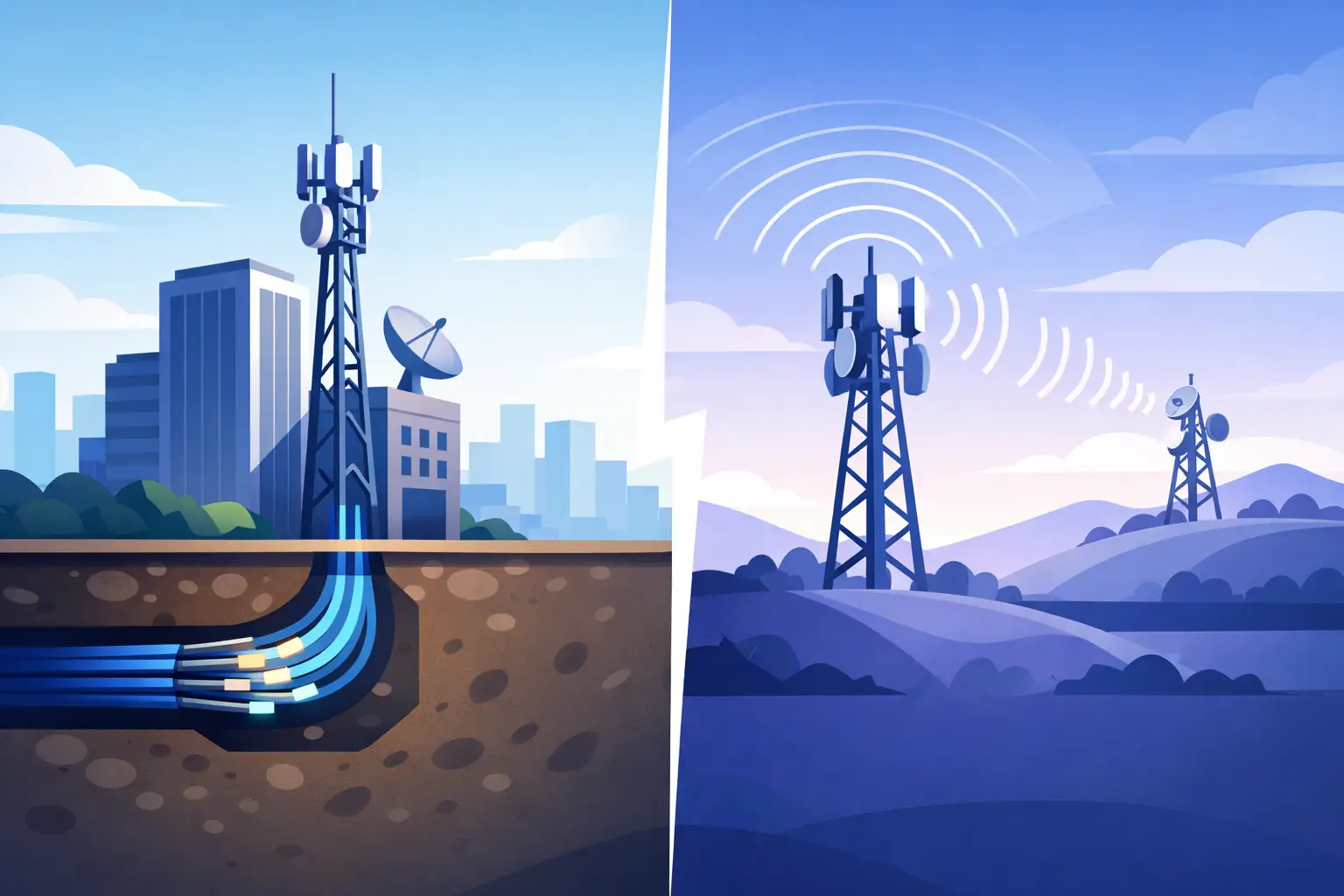
A refinery surveillance network can be limited by one overlooked decision: how video, sensor, access-control, and operational data travel from the field to the control room. In the fiber versus wireless backhaul decision, the right answer is rarely based on bandwidth alone. It depends on distance, hazard zones, available infrastructure, outage tolerance, expansion plans, and the cost of getting a reliable path in place.
For industrial operators, backhaul is not a background IT detail. It determines whether high-resolution perimeter cameras retain usable evidence, whether gas detection alerts reach operators without delay, and whether an offshore installation can be monitored from shore. The best service provider starts with the operating environment and designs the transport layer around the security outcome.
Fiber Versus Wireless Backhaul in Industrial Security
Backhaul is the connection that carries traffic between a remote network location and the central network. In a security deployment, that may mean moving video from tank-farm cameras to a security operations center, connecting an offshore platform to an onshore facility, or linking marine vessels, docks, and terminal buildings.
Fiber uses optical cable to transmit data as light. Wireless backhaul uses licensed or unlicensed radio links, typically point-to-point or point-to-multipoint equipment, to carry that traffic through the air. Both can support serious industrial surveillance infrastructure. Their differences become clear when the site demands continuous recording, predictable performance, difficult installation conditions, and controlled long-term operating costs.
Fiber is usually the performance benchmark. It provides very high capacity, low latency, stable throughput, and a physical connection that is not affected by rain, fog, vessel movement, or line-of-sight obstructions. A properly designed fiber route can support a large number of IP cameras, thermal systems, detection devices, workstations, and future network additions without becoming the bottleneck.
Wireless backhaul delivers a different advantage: speed of deployment. Where trenching is expensive, prohibited, slow, or physically impractical, a correctly engineered radio link can bring a remote facility online in days rather than months. This is especially valuable across water, between separated buildings, around active processing areas, and at temporary project locations.
Neither option is automatically better. A remote camera tower with clear line of sight may be an excellent wireless candidate. A main security corridor supporting hundreds of cameras and critical alarms is often better served by fiber.
When Fiber Is the Better Investment
Fiber should be the first choice when a site requires maximum capacity and the route can be installed safely within a sensible budget. It is particularly strong for permanent facilities where video retention, remote viewing, analytics, and system growth are core requirements.
High-camera-count installations benefit immediately. Modern fixed, PTZ, thermal, and specialty surveillance systems can create substantial traffic, particularly when multiple users view live feeds or recording servers collect high-bitrate streams. Fiber gives the network room to maintain image quality instead of reducing frame rates or compressing video aggressively to accommodate limited links.
Fiber also supports a more predictable availability model. Radio links depend on clear paths and careful spectrum planning. Fiber avoids interference from neighboring transmitters, heavy equipment, structures, and changing site conditions. In refineries, chemical plants, power stations, and marine terminals, that consistency can be worth far more than the initial installation savings of a lower-cost connection.
Security is another consideration. Fiber is a contained physical medium, making it more difficult to intercept than an over-the-air signal. It still needs proper network segmentation, access control, encryption, and monitoring, but it removes a major wireless exposure from the transport layer.
The trade-off is construction. Civil works, cable routing, permits, crossings, hazardous-area procedures, subsea requirements, and shutdown windows can turn an apparently simple fiber project into a major capital expense. A cable cut can also be disruptive if the route has no redundancy. For critical paths, diverse fiber routes and resilient network architecture should be specified from the start.
Best-fit fiber applications
Fiber is generally the right commercial choice for permanent refinery security networks, large industrial campuses, control-room connections, data center uplinks, high-volume video recording, and fixed offshore installations with existing cable pathways. It is also the stronger option when a site expects to add cameras, gas detection equipment, analytics servers, or remote operations capabilities over time.
When Wireless Backhaul Delivers Better Value
Wireless backhaul is not a compromise when it is specified for the environment. It is a strategic tool for closing distances that cable cannot reach efficiently.
A point-to-point wireless link can connect a gatehouse, jetty, storage yard, remote pump station, or vessel berth to the primary network without excavation. For offshore and marine operators, wireless can bridge separated structures or provide a practical connection across water where laying cable would create excessive cost and operational complexity.
The business case is strongest when installation time matters. A new surveillance zone may be needed after a security assessment, an expansion project, an incident, or a change in operating conditions. Wireless enables operators to deploy cameras and network access quickly while a longer-term fiber project is evaluated.
It can also be highly effective as a redundant path. A properly separated wireless link can keep priority alarm traffic, selected live video feeds, and remote access available if a primary fiber route is damaged. This should not be confused with simply installing a radio link beside the same physical risk area. True resilience requires separation in both route and failure mode.
Wireless performance depends on engineering discipline. The radios need verified line of sight, adequate mounting stability, protected power, grounding, surge protection, capacity planning, and spectrum analysis. At marine sites, salt exposure, vibration, wind loading, and vessel movement must be considered. At industrial sites, steel structures, cranes, flare stacks, and future construction can affect the radio path.
Questions that determine wireless success
Before purchasing equipment, operations teams should confirm the actual path between endpoints, not just the distance on a map. A short link blocked by a tank, new warehouse, or gantry crane can fail where a longer clear link performs exceptionally well. The design should also account for required throughput during peak recording and live-view conditions, acceptable latency, weather exposure, and the availability of protected mounting locations.
Licensed spectrum may be appropriate for high-priority applications where interference risk cannot be accepted. Unlicensed equipment can provide excellent value in controlled conditions, but it requires more careful spectrum management and ongoing monitoring. The lowest equipment price is not always the lowest lifecycle cost.
Capacity, Latency, and Video Quality
Backhaul capacity should be calculated from real traffic, not from a camera count alone. Camera resolution, codec, frame rate, scene complexity, low-light conditions, recording method, and simultaneous live users all affect bandwidth demand. A busy loading area at night may produce substantially more traffic than a quiet daylight scene.
Latency matters most for PTZ control, real-time alarm verification, voice systems, and remote operational support. Fiber typically delivers the lowest and most consistent latency. Well-designed wireless can also achieve low latency suitable for demanding surveillance applications, but performance must be validated at the installed location.
Do not design a link to operate constantly at its maximum advertised rate. Leave capacity for overhead, short-term traffic spikes, future devices, failover conditions, and maintenance. A network that looks acceptable during commissioning can become unreliable after more cameras are added or operators begin pulling multiple live streams during an incident.
A Practical Selection Framework
Start by classifying each connection as permanent, temporary, or rapidly deployable. Next, identify the consequence of an outage. A link supporting routine monitoring can tolerate different risk than one carrying perimeter detection, emergency communications, or critical process visibility.
Then compare total installed cost, not hardware cost. Fiber estimates must include engineering, trenching, conduit, cable protection, splicing, testing, permits, shutdown coordination, and route redundancy. Wireless estimates must include site surveys, towers or mounts, protected enclosures, power, lightning protection, alignment, spectrum planning, maintenance access, and replacement planning.
Finally, plan for hybrid architecture. Many high-performing industrial networks use fiber as the core transport and wireless as the extension and resilience layer. This approach concentrates fiber where capacity and permanence justify it, while using wireless to reach remote assets quickly and economically.
Revlight Security supports industrial and marine operators with top-of-the-line network and surveillance system options built around site conditions, not generic specifications. The objective is clear: give teams reliable visibility where it is needed, while protecting the investment from avoidable network limitations.
The right next step is to survey the actual route, model the traffic generated by the planned devices, and define what must remain online during a failure. That disciplined assessment turns a fiber versus wireless backhaul debate into a security infrastructure decision with measurable operational value.
🛡️ Secure Your Home or Business Today
Protect your home, office, shop, or business with reliable CCTV security cameras. Explore our range of CCTV cameras and find the right security solution for your needs.
Explore CCTV Cameras ✉️ Email Us



 Singapore :
+65-6708-9302
Singapore :
+65-6708-9302