
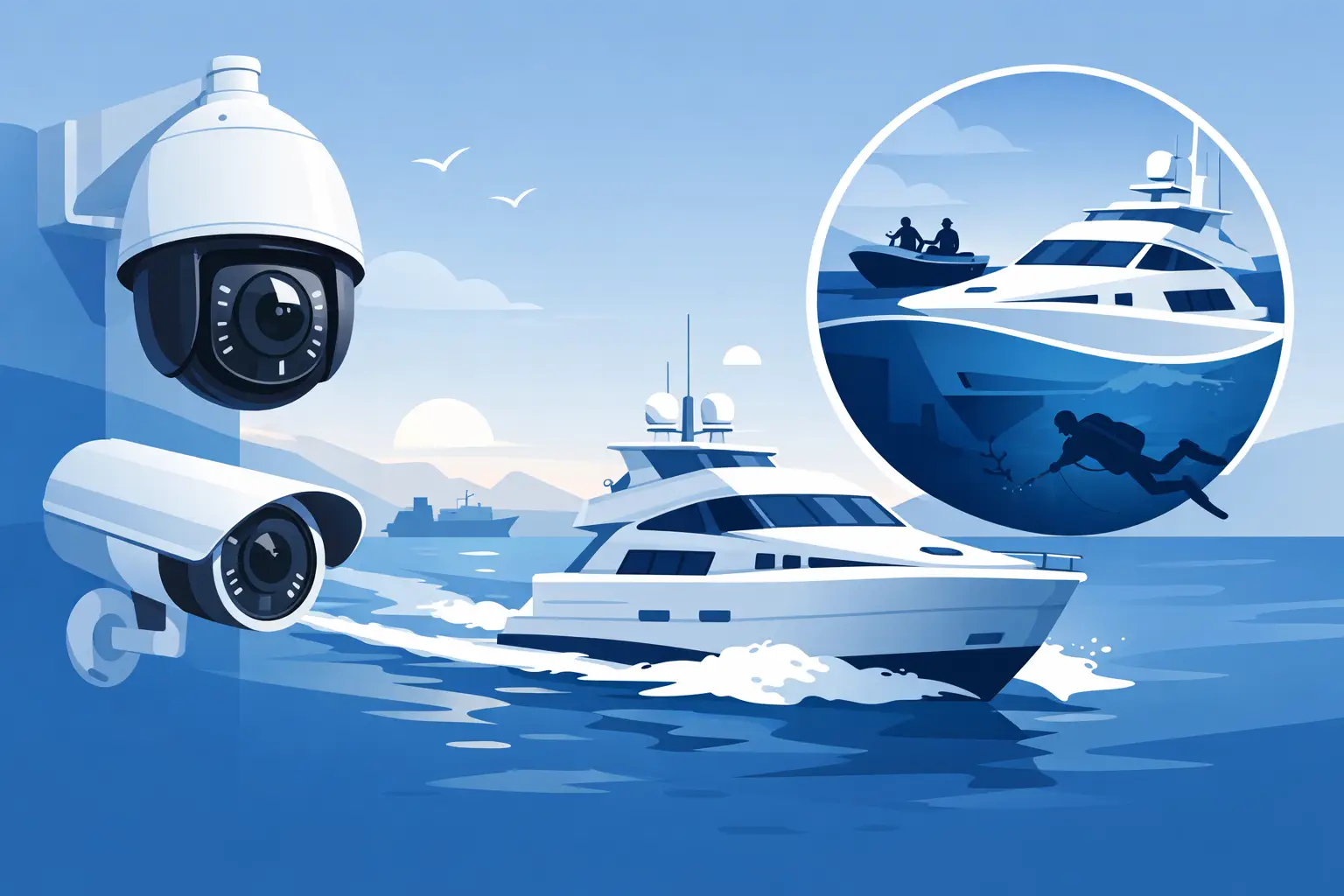
A camera that performs well on land can fail fast at sea. Salt spray, vibration, heavy rain, engine-room heat, low-light decks, and constant motion expose weak points quickly. That is why marine cameras are not a standard CCTV purchase with a different label. For commercial fleets, offshore operators, and marine facilities, they are a core part of operational visibility, incident recording, and onboard security.
Buyers in this space are rarely looking for image quality alone. They need dependable coverage across bridges, decks, engine spaces, cargo areas, gangways, and perimeter zones. They need recordings that hold up after a weather event, live viewing that remains usable in poor light, and hardware that can stay in service without becoming a maintenance burden. The right specification protects assets, supports compliance, and reduces avoidable downtime.
What makes marine cameras different
Marine environments punish electronics. Housings must resist corrosion, seals must hold against moisture ingress, and mounts must remain stable under vibration and vessel movement. If the unit is installed near exposed decks or offshore structures, UV resistance and temperature tolerance matter just as much as ingress protection.
Image performance also changes offshore. Glare from water, shifting shadows, fog, and low ambient light can limit a camera that looks acceptable in a warehouse or office yard. Marine cameras need balanced low-light capability, useful wide dynamic range, and optics that suit real viewing distances rather than brochure claims. A camera pointed at a gangway has a different job from one monitoring an open deck or machinery access point.
Then there is the network side. Many marine operators want live view, playback, and remote access from a bridge display, control room, or shoreside team. That requires stable integration with vessel networks, recorders, and in some cases marine WiFi or wider communications infrastructure. The camera cannot be treated as a stand-alone device if the end goal is operational awareness across the whole platform.
Where marine cameras deliver the most value
Security is the obvious use case, but it is not the only one. On working vessels and offshore assets, cameras support routine operations as much as threat detection. Deck activity can be verified in real time. Boarding points can be reviewed after an incident. Cargo handling, machinery access, and restricted zones can be monitored without assigning extra personnel to stand watch continuously.
For superintendents and operations managers, the commercial case is straightforward. Better visibility helps reduce losses from theft, unsafe access, false claims, and disputed incidents. Recorded footage can speed up investigations and provide a clear timeline when multiple teams are involved. On remote or high-risk sites, that can save far more than the cost of the system.
Ports, terminals, and offshore platforms benefit in a similar way. Cameras extend visual oversight across exposed areas where fixed patrols are costly or inconsistent. In harsh environments, a properly specified surveillance network becomes part of the site’s working infrastructure, not an optional add-on.
How to choose marine cameras for real deployment
The first question is not resolution. It is placement. A buyer should start with the operational problem: what needs to be seen, from where, under which conditions, and by whom. A bridge wing camera, an engine-room camera, and a perimeter camera on an offshore platform will all have different enclosure, lens, and mounting requirements.
Environmental rating comes next. Corrosion resistance, ingress protection, and temperature range should match the exact exposure level. Some locations need more than weatherproofing. They may need heavy-duty housings, anti-vibration mounting, wipers or washers, or specialized construction for hazardous areas. Specifying too low creates failures. Specifying too high across every position increases cost without a return.
Low-light performance deserves close attention because many marine incidents happen outside peak daylight conditions. Buyers should look past marketing terms and focus on usable night imaging. That includes sensor quality, infrared support where appropriate, and how well the camera handles mixed lighting from deck lamps, navigation lighting, and reflective surfaces.
Recording architecture matters as well. Some operators need continuous recording across multiple channels. Others prioritize event-based recording with quick retrieval. Storage duration, video compression, and playback speed all affect how useful the system will be after an incident. A camera network is only as strong as its ability to produce clear, accessible evidence when needed.
Marine cameras and network integration
For larger vessels and industrial sites, surveillance performance depends heavily on integration. Cameras should work cleanly with recorders, displays, monitoring software, and remote access tools. If the network is unstable or poorly planned, even top-of-the-line offers on camera hardware will underperform.
This is where procurement teams should look at the full surveillance path. Video streams need enough bandwidth, storage must be sized properly, and remote users should be able to access footage without compromising system reliability. Some operations also need segmentation between critical control systems and surveillance traffic. That is not a small technical detail. It is central to uptime and security.
Wireless connectivity can help in selected marine applications, but it is not a blanket answer. In some areas, hardwired infrastructure remains the better option for consistency and resilience. In others, marine-grade wireless systems can reduce installation complexity and expand coverage where cabling is difficult. The right choice depends on vessel layout, interference risks, and maintenance strategy.
Fixed, PTZ, and specialized marine cameras
Fixed cameras remain the workhorse for most marine security deployments. They are efficient, reliable, and ideal for constant coverage of access points, decks, corridors, and machinery zones. When correctly positioned, they provide dependable evidence capture with fewer moving parts to maintain.
PTZ cameras add flexibility where operators need active monitoring over wide zones. They are often used for perimeter watch, open deck observation, and offshore situational awareness. The trade-off is complexity. PTZ units can cover more ground, but they need stronger control integration and should not replace fixed cameras in locations where uninterrupted recording of a specific angle is required.
Some applications call for highly specialized units, including underwater systems for subsea inspection or cameras built for hazardous industrial atmospheres. In these cases, the buyer should be looking at environment-specific engineering first and price second. A lower-cost unit that fails certification, corrodes prematurely, or cannot maintain image stability is not a saving.
Common buying mistakes
One of the most common mistakes is treating marine cameras as a simple product comparison based on resolution and price. That approach overlooks housing quality, connector integrity, mount stability, and long-term exposure performance. The result is often early failure, poor image quality in bad conditions, or expensive retrofits after installation.
Another mistake is underestimating service access. Even the best system should be maintainable. If a camera is mounted in a difficult location, the housing design, cleaning requirements, and replacement process should be considered upfront. A lower-maintenance system often delivers better value over its operating life than a cheaper one with frequent service needs.
There is also a tendency to overspecify some areas and underspecify others. Not every camera point needs the same feature set, but every point should be matched to its task. Commercially focused buyers get the best return when they build a mixed system around actual operational priorities rather than chasing one-size-fits-all hardware.
What serious buyers should expect from a supplier
A serious supplier should do more than quote camera models. They should understand marine operating conditions, recommend fit-for-purpose configurations, and support the wider surveillance infrastructure around the cameras. That includes recording, remote viewing, power considerations, and network compatibility.
They should also be able to talk clearly about trade-offs. For example, stronger housings may increase cost and weight, higher frame rates may increase storage demand, and advanced night performance may not be needed at every position. Good specification is not about adding every feature. It is about building the most dependable system for the job.
For buyers managing vessel fleets, offshore platforms, or industrial marine facilities, that level of guidance has direct commercial value. It reduces specification risk, shortens procurement cycles, and improves confidence that the final system will perform under pressure. That is exactly where Revlight Security positions itself as a best service provider for demanding surveillance environments.
Marine cameras are a practical investment when they are chosen with the environment, network, and operational objective in mind. Get that right, and the system does more than record events – it gives crews and management a clearer, stronger view of what matters every day.
🛡️ Secure Your Home or Business Today
Protect your home, office, shop, or business with reliable CCTV security cameras. Explore our range of CCTV cameras and find the right security solution for your needs.
Explore CCTV Cameras ✉️ Email Us


 Singapore :
+65-6708-9302
Singapore :
+65-6708-9302