
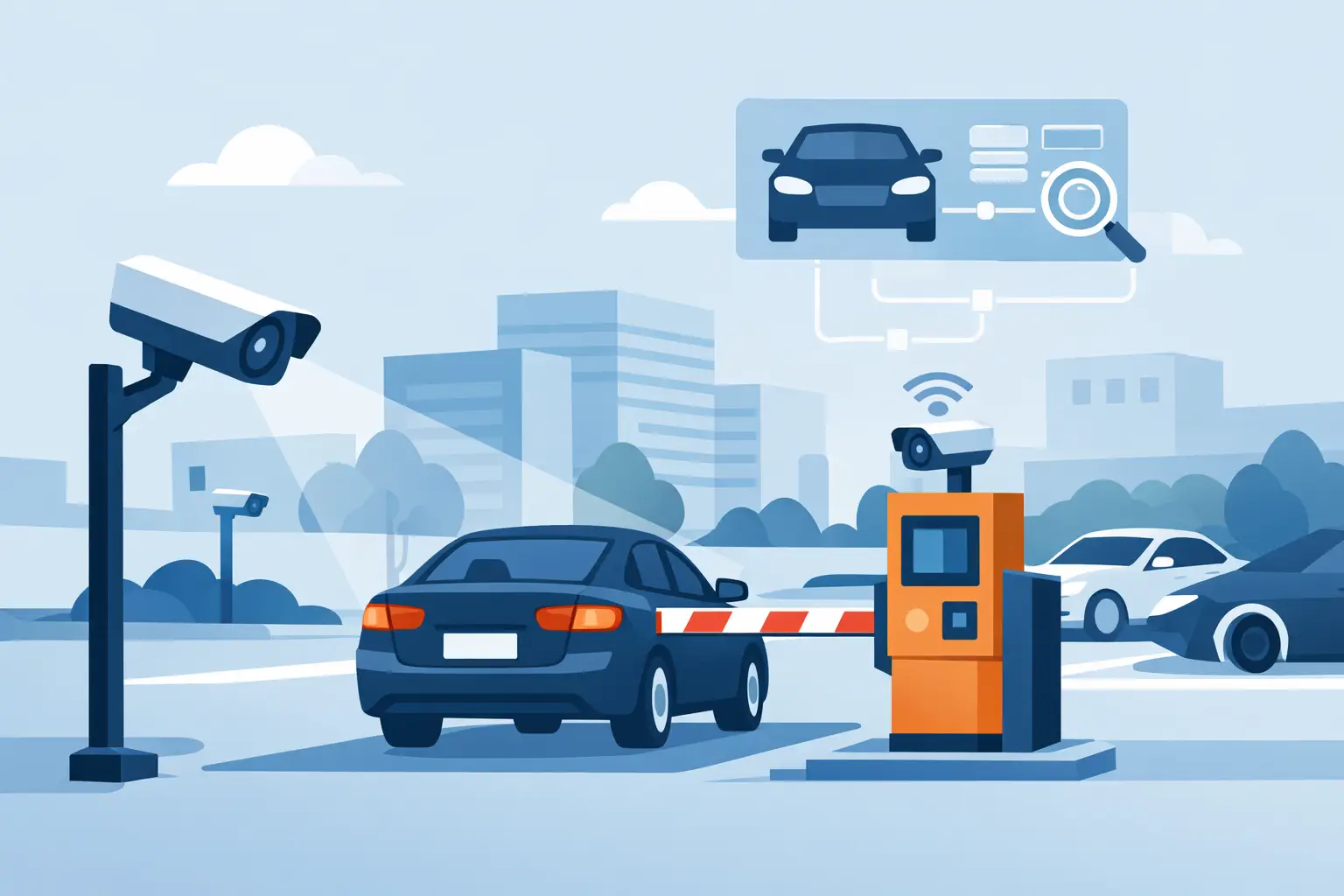
At 5:45 a.m., a contractor pickup reaches a refinery parking entrance while shift traffic is building behind it. A well-designed parking lot LPR deployment example does more than read the plate and lift a barrier. It confirms authorized vehicle access, records a usable event, gives security a clear review path, and keeps traffic moving without adding pressure to the gate team.
For industrial operators, license plate recognition is a controlled access and investigation tool. It can support employee parking, contractor verification, restricted-area monitoring, vehicle watchlists, and after-hours incident review. The result depends far less on the software label than on the lane design, camera geometry, lighting, network reliability, and operating rules behind it.
A Parking Lot LPR Deployment Example at a Refinery
Consider a refinery with a main employee and contractor parking lot beside the administration building. The lot has two inbound lanes, one outbound lane, a visitor overflow area, and a separate service-vehicle entrance that connects to a restricted operations road. Security needs to verify recurring vehicles, document exceptions, and investigate unauthorized access without creating a bottleneck during shift change.
The best deployment divides these traffic points by purpose. The two main inbound lanes use dedicated LPR cameras to capture front plates at the barrier line. An overview camera covers each approach so operators can see the vehicle type, lane activity, tailgating behavior, and any obstruction around the gate. The outbound lane records rear plates for a complete arrival and departure history. The service entrance is treated as a higher-security lane, with a tighter authorization list and alarm workflow for unknown vehicles.
This arrangement matters because an LPR camera is not a substitute for scene coverage. It is a specialized capture point. The overview camera explains the event; the LPR camera delivers the plate data needed to search, verify, and report.
Define the access decision before selecting equipment
An industrial facility should first decide what happens when a plate is recognized. For standard employee parking, a valid plate may open the barrier automatically and create a timestamped entry record. For contractors, recognition may trigger a check against an active work authorization list. For a vehicle on a watchlist, the system should alert the security desk while keeping the response proportionate to the site procedure.
Not every lane needs automatic opening. At chemical plants, power stations, terminals, and marine facilities, LPR may be used strictly for monitoring at one entrance while guards retain the access decision. That can be the right choice where driver credentials, cargo documentation, safety checks, or vehicle inspections remain mandatory.
The design must also identify exceptions. A plate may be dirty, bent, covered by glare, missing from the database, or registered to a vehicle that has been reassigned. A controlled manual-review workflow prevents an unread plate from becoming an uncontrolled entry.
Parking Lot LPR Deployment: Camera and Lane Design
The camera should be installed for the lane, not for the parking lot as a whole. A plate is easiest to read when the vehicle passes through a predictable capture zone at a controlled speed. Mounting an LPR camera high on a distant building may appear convenient, but steep vertical angles, wide lane coverage, headlight flare, and vehicle movement can reduce usable reads.
For most entry lanes, position the camera so it sees one vehicle path clearly and captures plates within the lens manufacturer’s recommended distance range. Keep horizontal and vertical viewing angles as shallow as practical. The final height, distance, focal length, and field of view should be confirmed during an on-site test because lane width, bollards, islands, vehicle mix, and barrier position all affect the image.
Lighting must be designed around the plate, not just the pavement. Integrated infrared illumination can support night capture, while good exposure control helps manage headlights, reflective plates, rain, and low winter sun. In high-contrast locations, wide dynamic range is valuable. Avoid placing the capture zone where direct glare from security lights, gatehouse windows, or vehicle headlights dominates the image.
A paired overview camera should capture the driver-side context, lane boundaries, barrier arm, and vehicle classification details. It gives security personnel evidence when the LPR result needs confirmation and is especially useful for trailers, fleet trucks, service vans, and vehicles that follow too closely through a gate.
Build a network that supports evidence, not just live viewing
A parking lot camera installation often sits at the edge of a large industrial site, where distance and exposure create practical challenges. Fiber backhaul is generally the strongest choice for long runs between parking entrances and the security network. Where copper is used, installers should account for distance limits, surge protection, grounding, and industrial-rated enclosures.
Separate surveillance traffic from routine business traffic through a properly managed network segment. LPR events, video streams, access-control commands, and management interfaces should be protected with controlled user permissions and secure remote access. A lost network connection should not leave the site without evidence, so local edge recording and health alerts are essential.
Power design also deserves attention. PoE simplifies many camera installations, but the switch, enclosure, and backup power source must be sized for the actual load. Outdoor hardware needs appropriate temperature, moisture, corrosion, and vibration protection. Marine-adjacent and coastal facilities should give special attention to salt exposure and enclosure ratings.
Turn Plate Reads Into Useful Operating Records
The LPR platform should connect each recognized plate with the information security actually needs: entry time, exit time, lane, associated access group, snapshot, and linked video. For recurring vehicles, that creates a searchable parking and access history. For an investigation, operators can locate all events associated with a plate without manually reviewing hours of footage.
Authorization lists should be maintained by a defined owner. Human resources may manage employee vehicles, contractors may be sponsored by project managers, and fleet records may be handled by transportation or maintenance teams. Without ownership, the database becomes unreliable quickly. Former employees, expired contractors, and retired fleet vehicles should be removed under a set review schedule.
Privacy and retention rules must match company policy, local requirements, and the operational purpose of the system. License plate data should be accessible only to authorized personnel, retained for a justified period, and protected in the same disciplined manner as other security records. Industrial sites operating across multiple jurisdictions should validate these requirements before activating analytics or automated alerts.
Commission the System Against Real Conditions
A successful installation is proven in the lane, not in a configuration screen. Test the system with the vehicle types that use the facility, including sedans, pickups, delivery trucks, fleet vehicles, and trailers. Run tests during daylight, darkness, rain, direct sun, peak shift traffic, and low-speed queue conditions.
Measure three different outcomes. Detection rate shows whether the system identifies that a vehicle has entered the capture zone. Plate-read rate shows whether it produces usable plate characters. Match accuracy shows whether that plate is correctly associated with the authorized record or access action. These are different measurements, and combining them can hide a real problem.
There is no universal performance percentage that applies to every site. A low-speed employee lot with clean lane markings should deliver better results than an open service road used by muddy trucks during storms. The right target is the one that supports the facility’s security and throughput requirements, with documented testing to prove it.
Common Failure Points That Reduce LPR Value
The most expensive LPR problems usually begin with a poor deployment decision rather than a failed camera. Avoid these recurring issues:
- Covering multiple lanes with one LPR camera and expecting consistent plate reads.
- Mounting the camera too far from the capture zone or at an excessive angle.
- Ignoring night lighting, headlight flare, and reflective plate behavior during commissioning.
- Using an unmaintained authorization list with no owner or expiration process.
- Sending alerts without giving security personnel a defined response procedure.
A final consideration is gate throughput. If an access rule requires a guard review, design the lane with enough queue space so stopped vehicles do not block public roads, emergency routes, or critical site circulation. Security controls must protect the operation without creating a safety issue at the entrance.
Revlight Security supports industrial buyers with surveillance infrastructure selected for demanding environments, including the network and video foundation required for dependable LPR operations. The strongest result comes from matching the camera, access workflow, and environmental protection to the exact lane risk.
Start with one high-value entrance, document its traffic pattern, and test it under the conditions that cause the most operational pressure. A proven lane design gives procurement and operations teams the evidence needed to expand LPR coverage with confidence.
🛡️ Secure Your Home or Business Today
Protect your home, office, shop, or business with reliable CCTV security cameras. Explore our range of CCTV cameras and find the right security solution for your needs.
Explore CCTV Cameras ✉️ Email Us


 Singapore :
+65-6708-9302
Singapore :
+65-6708-9302