
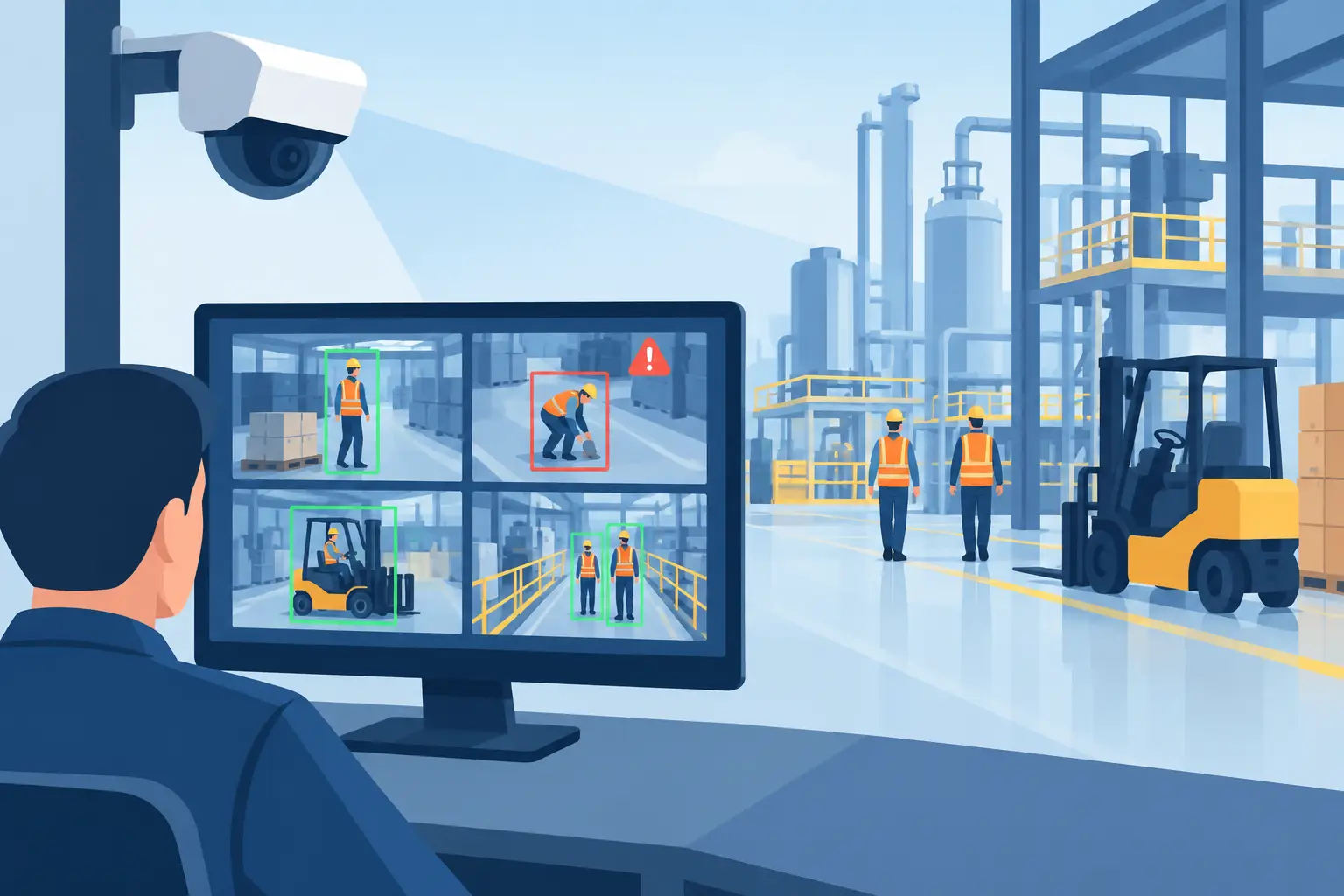
A refinery control room can receive hundreds of video feeds, while an offshore vessel may rely on a limited watch team covering critical deck, perimeter, and machinery areas. Neither operation has the luxury of treating every alert as equally urgent. Industrial video analytics changes the role of surveillance by identifying defined events, conditions, and movements that require attention before they become a safety, security, or production problem.
For industrial operators, this is not about adding more screens to a security room. It is about making existing and new surveillance infrastructure more useful: detecting a person in a restricted zone, confirming whether a vehicle enters an exclusion area, flagging smoke or flame indicators, monitoring a man-overboard boundary, or alerting an operator when a process area remains unexpectedly occupied. The right system gives teams a faster path from visual data to an informed response.
What Industrial Video Analytics Actually Does
Video analytics software examines live or recorded video streams and applies rules, models, or both to recognize predefined activity. A conventional surveillance system records what happened. An analytics-enabled system can call attention to what is happening now and make recorded incidents easier to find later.
The strongest applications are specific. A system can be configured to detect intrusion across a virtual line, prolonged loitering near critical equipment, vehicle movement in a prohibited direction, crowding around an evacuation route, or an object left near a controlled access point. On marine sites, it can support deck monitoring, gangway oversight, perimeter awareness, and access control verification. In energy and chemical operations, it can help teams watch tank farms, substations, loading areas, pipeline corridors, and high-risk process zones.
Analytics does not replace trained operators, safety procedures, or properly designed detection equipment. It helps those resources work with better priorities. A valid alert should give a control room operator a clear video event, a time reference, and the ability to assess the scene quickly rather than search through hours of footage.
Where Video Analytics Delivers Commercial Value
The commercial case is strongest where a missed event carries a high cost. That cost may be an injury, shutdown, theft, environmental exposure, delayed emergency response, insurance scrutiny, or damage to an operator’s reputation. Analytics can reduce the burden of continuous manual monitoring and direct attention toward the areas that matter most.
At an oil and gas facility, a virtual perimeter rule can identify unauthorized access around storage, loading, or processing areas. In a power station, occupancy analytics can provide an additional layer of awareness near restricted electrical infrastructure. On a vessel, a defined detection zone can help the bridge or security team monitor access points during port calls and operations alongside offshore assets.
Recorded-video search is often just as valuable as real-time alerts. After an incident, investigation teams need answers without spending an entire shift reviewing footage. Filters for person, vehicle, direction of travel, time window, and area can shorten that process considerably. The savings are practical: less time spent searching, faster incident reports, and stronger evidence when decisions are challenged.
There is also a maintenance benefit. Repeated alerts in one location may reveal a lighting weakness, poor traffic flow, a broken access-control practice, or a camera position that no longer matches site activity. When surveillance data is reviewed as operational intelligence, it can expose gaps that would otherwise remain hidden.
Industrial Video Analytics Must Fit the Environment
Analytics quality begins with image quality. A sophisticated rule set cannot overcome a poorly positioned camera, inadequate illumination, blocked field of view, unstable mounting, or bandwidth-starved network. Industrial projects fail when analytics are treated as a software-only purchase.
In corrosive coastal environments, cameras and housings must tolerate salt spray, wind loading, vibration, and temperature variation. Offshore installations may require specialized enclosures and network design suited to hazardous or exposed areas. Refineries, chemical plants, and gas facilities need equipment selections that reflect hazardous-area classifications, site procedures, and the operational risks around each zone.
Low light is another frequent challenge. A perimeter rule that works reliably at noon may create nuisance alarms after sunset if headlights, reflections, weather, insects, or moving shadows are not accounted for. Thermal imaging can be a stronger option in areas where visible-light performance is inconsistent, although it serves a different purpose than high-detail visual identification. The correct choice depends on whether the requirement is detection, classification, identification, process observation, or a combination of these outcomes.
Network capacity deserves equal attention. High-resolution streams, remote access, recording retention, and analytics processing all consume resources. Edge analytics can process events at the camera or local device, reducing unnecessary video transmission in some deployments. Centralized analytics can offer more consistent management across a large estate. Neither model is automatically better. Remote platforms with constrained communications may favor local processing, while multi-site operators may prioritize centralized oversight and standardized reporting.
Start With the Event, Not the Equipment
A reliable project starts by defining the event that should trigger action. “Improve security” is too broad to engineer. “Alert the control room if a person enters the unmanned pump enclosure between 8 p.m. and 6 a.m.” is measurable. So is “notify the bridge if an unauthorized vessel crosses the monitored approach line” or “flag vehicles traveling against the designated route at the loading rack.”
Once the event is clear, the system design can address scene coverage, lens selection, mounting height, lighting, weather exposure, analytics rules, alarm escalation, recording requirements, and operator response. That process prevents a common purchasing mistake: installing technology that produces a large number of alerts but very little operational value.
How to Reduce False Alarms Without Missing Real Threats
False alarms are the fastest way to lose confidence in an analytics deployment. If operators receive repeated alerts caused by rain, wildlife, steam plumes, reflections, or routine activity, they will eventually stop treating notifications as urgent. The answer is not simply lowering sensitivity until alerts disappear. It is tuning the system around the real operating environment.
Detection zones should exclude predictable sources of movement where possible. Rules can include schedules, direction filters, dwell times, minimum object size, and specific classes such as people or vehicles. A person crossing a security boundary may require an immediate alert, while a vehicle passing through a designated roadway may be normal. The system needs to understand the difference through careful configuration.
Commissioning should include day, night, poor-weather, and high-activity testing. Industrial sites change over time as equipment is moved, vegetation grows, lighting is modified, and traffic patterns shift. Analytics should be reviewed after operational changes, not left with the original settings indefinitely. This is especially important during turnarounds, port calls, construction activity, and major maintenance campaigns, when normal site behavior can change dramatically.
Integrating Analytics With Detection and Response
Video analytics is most effective when it supports a wider security and safety architecture. An alarm from a fence sensor, access-control door, radar system, gas detection device, or thermal monitoring point can call up the relevant video view immediately. Conversely, a video event can prompt an operator to verify the situation before escalating a response.
For methane and gas-risk environments, specialized optical gas detection and conventional video surveillance serve different but complementary roles. Gas detection equipment is selected for its ability to identify emissions under suitable operating conditions. Video analytics can add situational awareness around the affected area, monitor access, and support incident review. Procurement teams should avoid treating general analytics as a replacement for purpose-built gas detection technology.
The same principle applies to marine safety. A virtual line or deck occupancy rule can improve awareness, but it does not replace navigational watchkeeping, safety management procedures, or certified marine equipment. Buyers get better results when every technology has a defined job and the response path is clear.
Cybersecurity and Data Governance Are Part of the Specification
Any networked surveillance system creates a cybersecurity responsibility. Cameras, recorders, switches, remote-access platforms, and analytics servers should be included in the site’s cybersecurity plan from the beginning. Segmented networks, strong credential management, controlled remote access, firmware maintenance, and audit trails are practical requirements, not optional extras.
Data retention also needs a commercial and legal decision. Longer retention requires more storage and can increase costs. Shorter retention may limit investigation value. The appropriate period depends on incident risk, regulatory obligations, vessel or facility policy, bandwidth, and available storage capacity. Privacy rules and workforce policies should be considered when coverage includes employee work areas, access points, or contractor zones.
Selecting an Industrial Analytics Partner
The best provider will ask detailed questions before recommending a system. Expect discussions about operating conditions, hazardous-area requirements, target distances, lighting, existing network capacity, recording duration, remote viewing needs, integration points, and who will respond to alarms. A serious supplier should be able to explain where analytics will perform well and where environmental conditions may limit accuracy.
Look beyond a feature list. The value of industrial video analytics comes from dependable performance at the point of use: the alarm reaches the right team, the video is clear enough to assess, the system remains available in difficult conditions, and the event can be retrieved when management or investigators need evidence.
For procurement teams, the strongest investment is not the lowest initial equipment price. It is a properly engineered surveillance solution that reduces operator workload, protects critical assets, and gives operations a faster, clearer view when conditions change. Start with the event your team cannot afford to miss, then build the detection, video, network, and response process around it.
🛡️ Secure Your Home or Business Today
Protect your home, office, shop, or business with reliable CCTV security cameras. Explore our range of CCTV cameras and find the right security solution for your needs.
Explore CCTV Cameras ✉️ Email Us

 Singapore :
+65-6708-9302