
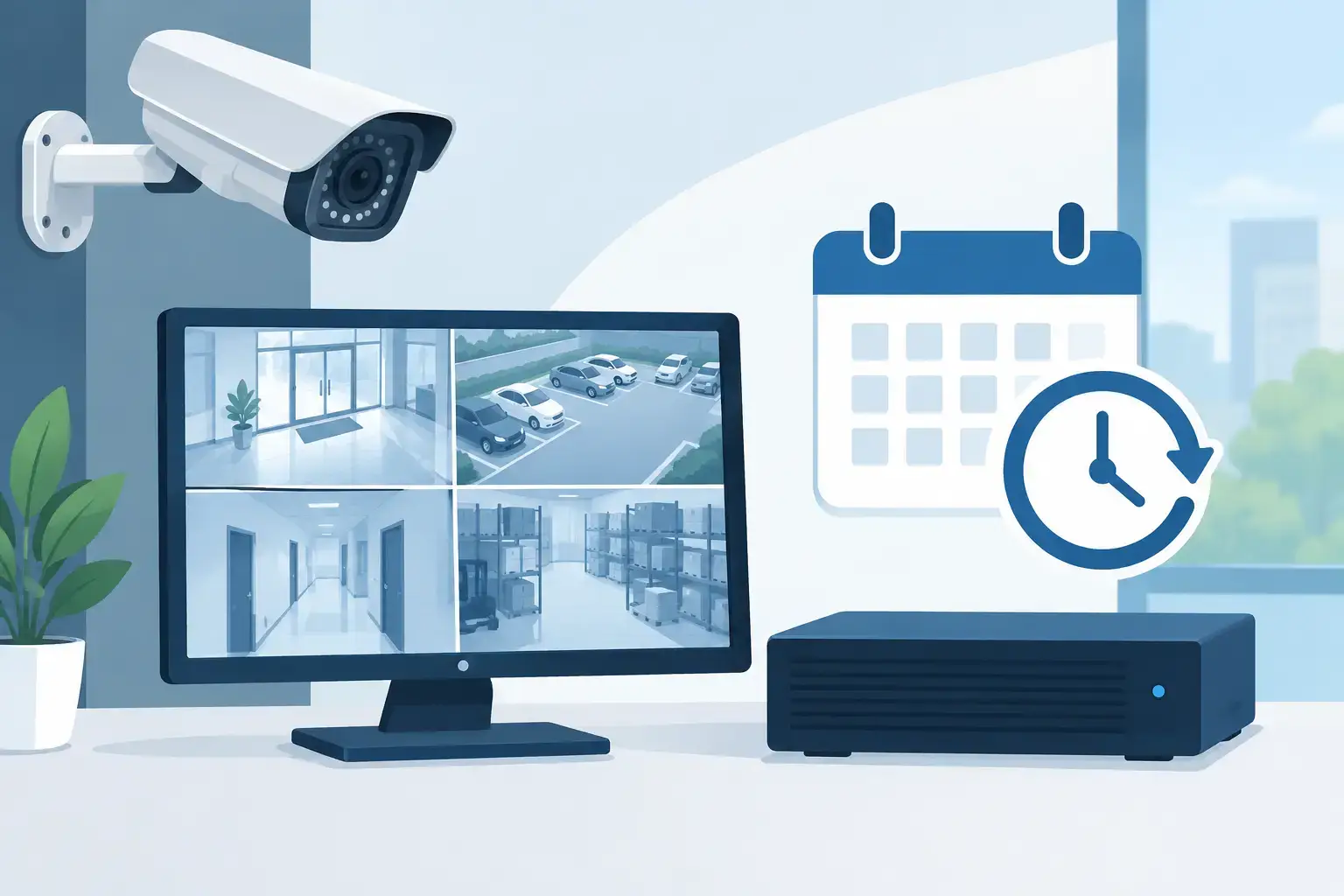
A refinery incident may not be reported until a contractor has left the site, a vessel has reached its next port, or a maintenance team reviews a fault days later. By then, overwritten video can turn a manageable investigation into an expensive blind spot. When operators ask, “how long retain CCTV footage,” the right answer is not a single number. It is a retention decision based on operational risk, incident reporting time, regulatory obligations, available storage, and the quality of the recording system.
For industrial sites, offshore assets, power facilities, and marine operations, retention is part of the surveillance design. A camera system that delivers clear footage but overwrites it before an event is identified does not provide the evidence, accountability, or security return the operation requires.
How Long to Retain CCTV Footage at Industrial Sites
Many commercial systems are configured for 30 days of retention because it is practical, familiar, and often sufficient for routine security monitoring. But 30 days should be a starting point for assessment, not an automatic policy.
Higher-risk areas frequently require 60, 90, or more days of retention. These can include perimeter approaches, loading and transfer points, control-room entrances, hazardous-material areas, marine gangways, engine spaces, fuel handling zones, and locations where theft, sabotage, safety breaches, or environmental events may be discovered late.
A shorter period can be reasonable for low-risk views with high activity, provided the business has a documented basis for it and the footage is reviewed or escalated quickly. Conversely, a long retention period is not automatically better if it creates unmanageable storage costs, weakens system performance, or results in a huge archive that nobody can search effectively.
The defensible answer is the period that gives your team enough time to identify, report, preserve, and investigate an event before normal overwrite occurs. Local privacy, labor, maritime, insurance, contractual, and sector-specific requirements may also set minimum or maximum expectations. Confirm those rules for every operating jurisdiction rather than applying one global setting without review.
Build Retention Around Risk and Reporting Delays
Security managers should begin with the question: how long can it take for this type of incident to become known? The answer is often longer than a standard shift cycle.
At an offshore installation, a missing tool, unauthorized access concern, or procedural breach may only surface during a later inventory check or handover. On a vessel, a claim may arise after docking, cargo transfer, or crew rotation. At a refinery or chemical facility, process deviations can require a multi-day review before investigators need to establish who entered an area, what equipment was accessed, or whether required controls were followed.
Set retention by camera group rather than forcing every camera into one rule. This keeps storage investment focused on evidence that matters most.
A practical retention model
Start by classifying cameras according to the consequence of an unavailable recording. Critical cameras cover safety-sensitive, restricted, high-value, or operationally essential areas. These normally warrant the longest retention period and the highest recording integrity. Important cameras cover access routes, work areas, and logistics zones where incidents are plausible but consequences are lower. General-observation cameras support routine awareness and may operate with a shorter archive.
Consider four factors for each group:
- The likely time between an event and its discovery
- The operational, legal, safety, and financial consequence of missing footage
- Whether footage may be required for an investigation, claim, audit, or disciplinary process
- The cost of recording at the required resolution, frame rate, and retention period
This approach produces a policy that procurement teams can defend commercially and operations teams can apply consistently. It also prevents a common failure: investing heavily in cameras while under-sizing the video management and storage environment.
Storage Capacity Determines What Is Achievable
Retention targets are only real when the recorder, server, network, and storage architecture can sustain them. Capacity planning must account for camera count, resolution, frame rate, compression settings, scene activity, continuous versus motion-based recording, redundancy, and export requirements.
A busy gate or marine berth generates far more data than a quiet corridor. A camera monitoring an active flare area, production line, or loading point may experience constant motion and deliver little storage benefit from motion recording. For such locations, continuous recording is often the more dependable choice. It captures the lead-up to an event and avoids gaps caused by poor motion settings, weather, spray, steam, vibration, or changing light.
Resolution and frame rate should also match the task. Identification at a vehicle gate, evidential coverage of a transfer point, and broad situational monitoring do not need identical settings. Recording every stream at maximum specifications may reduce retention without improving the usable evidence. A properly engineered system preserves detail where it has commercial and security value.
Build capacity with headroom. Storage calculations based on perfect conditions fail when cameras are added, bit rates rise during bad weather, retention requirements change, or an incident requires footage to be held beyond normal overwrite. Redundant storage, health monitoring, and alerts for recording failures are equally important. Retention does not matter if the relevant camera was offline.
Preserve Footage as Soon as an Event Is Flagged
Normal retention is an overwrite cycle, not an evidence-preservation process. Once an incident, near miss, access violation, allegation, or claim is reported, the relevant footage should be secured immediately. Include the period before and after the known event time, since the cause may begin earlier than expected.
A controlled export process protects the value of the recording. Restrict who can retrieve and delete footage, maintain an audit trail, record the camera identifiers and time zone, and store exported files in a protected location. Where evidence may be used in a formal investigation, document who handled it and when. This supports chain-of-custody requirements and reduces disputes about whether video has been altered or lost.
Remote access can speed up this response, especially across dispersed sites and vessels, but access should be role-based and protected. Security operators need rapid visibility; that does not mean every user needs unrestricted access to historic recordings.
Offshore and Marine Conditions Need Extra Planning
Industrial surveillance is not deployed in a clean, predictable office environment. Offshore platforms, tankers, terminals, and exposed energy sites contend with variable connectivity, salt exposure, vibration, weather, power interruptions, and remote support constraints. These realities affect retention directly.
If a vessel or remote asset has limited backhaul capacity, sending every high-resolution stream to shore may be unrealistic. Local recording with secure synchronization of selected events or lower-bandwidth streams can be the better commercial design. The key is ensuring that local storage is sized for the period between service opportunities, connectivity restoration, or physical access to the asset.
For harsh environments, dependable housings, stable network design, and equipment rated for the installation conditions protect more than the live image. They protect the archive. Revlight Security supports surveillance infrastructure built around recording reliability, remote visibility, and environment-specific performance for demanding industrial operations.
Put the Decision Into a Retention Policy
A retention policy should state which cameras fall into each retention tier, how long recordings remain available, who can access them, when clips must be preserved, and how the organization responds to equipment failures. It should also identify the policy owner and require periodic review after major changes, such as an expansion, new process area, incident trend, or revised compliance obligation.
Do not leave retention settings buried in a recorder menu with no ownership. Operations, security, IT, compliance, and procurement should agree on the outcome: the right footage must be available for long enough, at the right quality, without paying for unnecessary capacity.
The best next step is to test your current system against a real scenario. Ask whether your team could retrieve clear footage from the right camera 45 or 90 days after an incident, preserve it securely, and prove the recording remained intact. If the answer is uncertain, your retention period is not yet a policy – it is a risk waiting to be exposed.
🛡️ Secure Your Home or Business Today
Protect your home, office, shop, or business with reliable CCTV security cameras. Explore our range of CCTV cameras and find the right security solution for your needs.
Explore CCTV Cameras ✉️ Email Us



 Singapore :
+65-6708-9302