
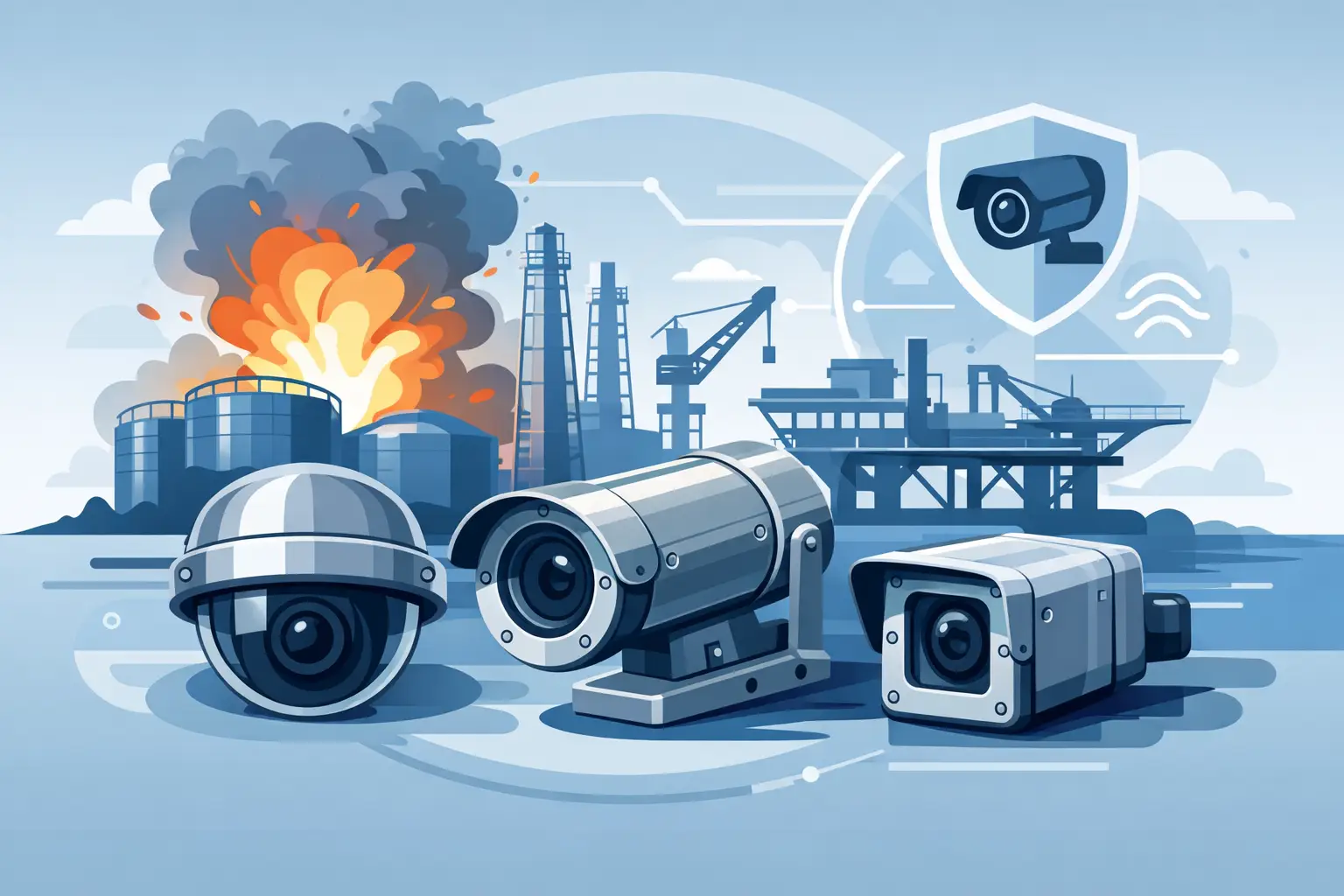
A camera that works flawlessly in a warehouse can become a liability the moment it is installed near gas vapors, volatile dust, or corrosive salt air. That is why an explosion proof camera selection guide matters at the buying stage, not after a system is already specified, shipped, and delayed on site. For operators in oil and gas, marine, chemical, and power environments, the right choice protects visibility, compliance, uptime, and budget at the same time.
What an explosion proof camera selection guide should solve
Procurement teams rarely need just a camera. They need a surveillance asset that fits a hazardous area classification, integrates with an existing network, survives aggressive conditions, and delivers useful images when an incident occurs. A lower-priced unit that fails certification checks or cannot handle washdown, vibration, or low-light performance is not a saving. It is a replacement cycle waiting to happen.
The strongest selection process starts with the site, not the catalog. Hazardous area classification comes first because it determines whether the camera housing and complete assembly are suitable for the environment. In oil terminals, refineries, FPSOs, tank farms, and chemical plants, the difference between Zone 1 and Zone 2, or Class I Division 1 and Division 2, is not a paperwork detail. It drives what can legally and safely be installed.
Start with certification, not features
If a camera is not properly certified for the location, every other feature becomes irrelevant. Buyers should confirm the exact approval marking, the gas group or dust group where relevant, and the ambient temperature range. Some units are marketed loosely as heavy-duty or hazardous-area capable, but serious industrial procurement requires documented certification aligned to the installation site.
This is also where global operations need extra care. A project may be designed in one region, procured in another, and installed offshore or at an international facility with different compliance expectations. A camera acceptable for one framework may not satisfy another authority or end user specification. For multinational operators, standardizing around recognized approvals can reduce delays and simplify maintenance planning.
Match the camera to the hazard and the task
An explosion proof camera is not a single product category with one correct specification. The right model depends on what the camera must actually do. Perimeter monitoring, process observation, flare monitoring support, loading area coverage, and remote machinery verification all place different demands on optics, positioning, and image quality.
A fixed camera can be the right commercial decision where the viewing angle is stable and the target area is clearly defined. It usually lowers complexity and can reduce maintenance points. A PTZ camera makes sense when operators need flexible coverage across a larger zone, want to track activity remotely, or need fewer installed camera positions. The trade-off is cost, moving parts, and in some cases additional planning around preset tours, zoom performance, and operator workflow.
Resolution matters, but optics matter more
Many buyers focus first on megapixel count. That is understandable, but not enough. High resolution does not compensate for poor lens selection, weak low-light capability, or the wrong field of view. A camera watching a jetty approach, a process skid, or a loading bay should be selected around the identification distance and the operational goal. Do you need broad situational awareness, or do you need to read labels, confirm valve position, or identify personnel activity?
In long-range outdoor applications, optical zoom and sensor performance often have more practical value than headline resolution. In enclosed process areas, wide dynamic range can be the difference between a usable image and a washout caused by glare, reflections, or uneven lighting. This is especially relevant for sites with floodlights, reflective metal surfaces, and shifting daylight conditions.
Environmental durability is where many systems win or fail
Hazardous certification is only one part of suitability. Industrial sites punish equipment in other ways. Offshore assets deal with salt spray, wind, vibration, and constant moisture. Refineries and chemical plants may expose equipment to corrosive atmospheres, washdown procedures, and temperature extremes. Power stations and heavy industrial facilities can introduce dust loading, heat stress, and mechanical wear.
A proper explosion proof camera selection guide must account for enclosure material, ingress protection, heater and blower options where applicable, operating temperature range, and resistance to corrosion. Stainless steel housings are often the preferred choice for offshore and marine settings because they hold up better in aggressive environments. Aluminum may be viable in some installations, but it depends on exposure level, maintenance regime, and total lifecycle cost.
Window material and wiper options also deserve attention. In exposed locations, image quality can degrade quickly if the viewing window accumulates spray, residue, or dust. Buyers sometimes under-specify this part of the package and then discover that the camera is technically operational but visually compromised. A dependable surveillance system is not just powered on. It must deliver clear evidence and live visibility when needed.
Network compatibility and video management should be decided early
Industrial buyers increasingly want remote access, centralized recording, and integration across multiple assets. That means the camera cannot be chosen in isolation from the wider surveillance architecture. IP-based systems offer strong flexibility, but network bandwidth, storage load, cybersecurity requirements, and compatibility with existing video management software all need review before purchase.
For offshore platforms, marine vessels, and remote energy sites, transmission conditions may be less forgiving than at a standard industrial campus. Latency, limited bandwidth, and segmented networks can affect how video is streamed and recorded. In these cases, edge recording, compression efficiency, and alarm-triggered transmission can be commercially smarter than trying to push continuous high-bitrate video across constrained links.
Power requirements also matter. PoE can simplify installation in some environments, but not every hazardous-area deployment will support the same approach. Fiber connectivity, media converters, junction boxes, and certified accessories can add real cost and should be included in the specification from the beginning. A camera with an attractive purchase price can become expensive once the full installation path is understood.
Low-light, thermal, and gas detection use cases are different buying decisions
Not every hazardous-area camera is there solely for conventional video surveillance. Some projects need thermal imaging for early detection of overheating equipment, perimeter visibility in darkness, or situational awareness through smoke and haze. Others require optical gas imaging or specialized detection capability in environments where methane or hydrocarbon leak monitoring is part of the operational risk profile.
These are not interchangeable categories. A standard visible-light explosion proof camera may be ideal for access control verification and operational monitoring, but it will not replace thermal analytics or gas leak visualization where those functions are required. The right commercial move is to define the problem clearly. If the goal is security coverage, choose for security performance. If the goal is leak detection or process-risk awareness, specify the sensor type around that mission.
Think about maintenance access before the order is placed
Some installations make maintenance straightforward. Others involve shutdown planning, rope access, vessel scheduling, permit control, or hazardous work procedures that increase service costs substantially. In those cases, product reliability and serviceability carry even more value than usual.
Ask practical questions early. How easy is the unit to commission? Are spare parts available? Can the camera be serviced in the field, or does it need full replacement? What is the lead time for a matching unit if a project expands or a failure occurs? The best service provider is not only selling hardware. They are reducing future disruption.
The commercial checklist buyers should use
The smartest buyers compare explosion proof cameras against six commercial realities: certification fit, image performance, environmental durability, integration compatibility, maintenance burden, and total installed cost. This keeps the discussion focused on outcomes instead of brochure language.
A lower-cost model may still be the right decision in a sheltered Zone 2 application with simple monitoring needs. A premium unit is often justified in offshore, corrosive, mission-critical, or high-access-cost locations where failure is expensive. It depends on the site, the risk level, and how valuable uninterrupted visibility is to operations.
This is where experienced suppliers stand apart. They can help match housing material, lens type, network format, and certification to the actual operating environment instead of pushing a generic top-of-the-line offer that is misaligned with the task. For industrial security infrastructure, the strongest value comes from fit, not excess.
How to avoid the most common specification mistakes
The first mistake is buying on hazardous-area labeling alone and overlooking image quality. The second is overbuying advanced features that operators will never use. The third is ignoring the installation ecosystem, including mounts, cable entry, recording, network load, and access requirements.
Another common issue is treating marine, refinery, and chemical environments as if they place the same demands on equipment. They do not. Salt exposure, washdown routines, hydrocarbon risk, and ambient temperature profiles change what a dependable camera looks like in practice. Revlight Security works in exactly these specialist conditions, where camera selection has to support both compliance and operational performance.
A serious procurement process should end with a specification that installers understand, operators can use, and maintenance teams can support over time. That is how surveillance becomes a working asset rather than another project complication.
Choose the camera that fits the hazard, the environment, and the job it must do on day one. That decision will pay for itself long after the purchase order is closed.
🛡️ Secure Your Home or Business Today
Protect your home, office, shop, or business with reliable CCTV security cameras. Explore our range of CCTV cameras and find the right security solution for your needs.
Explore CCTV Cameras ✉️ Email Us

 Singapore :
+65-6708-9302
Singapore :
+65-6708-9302