
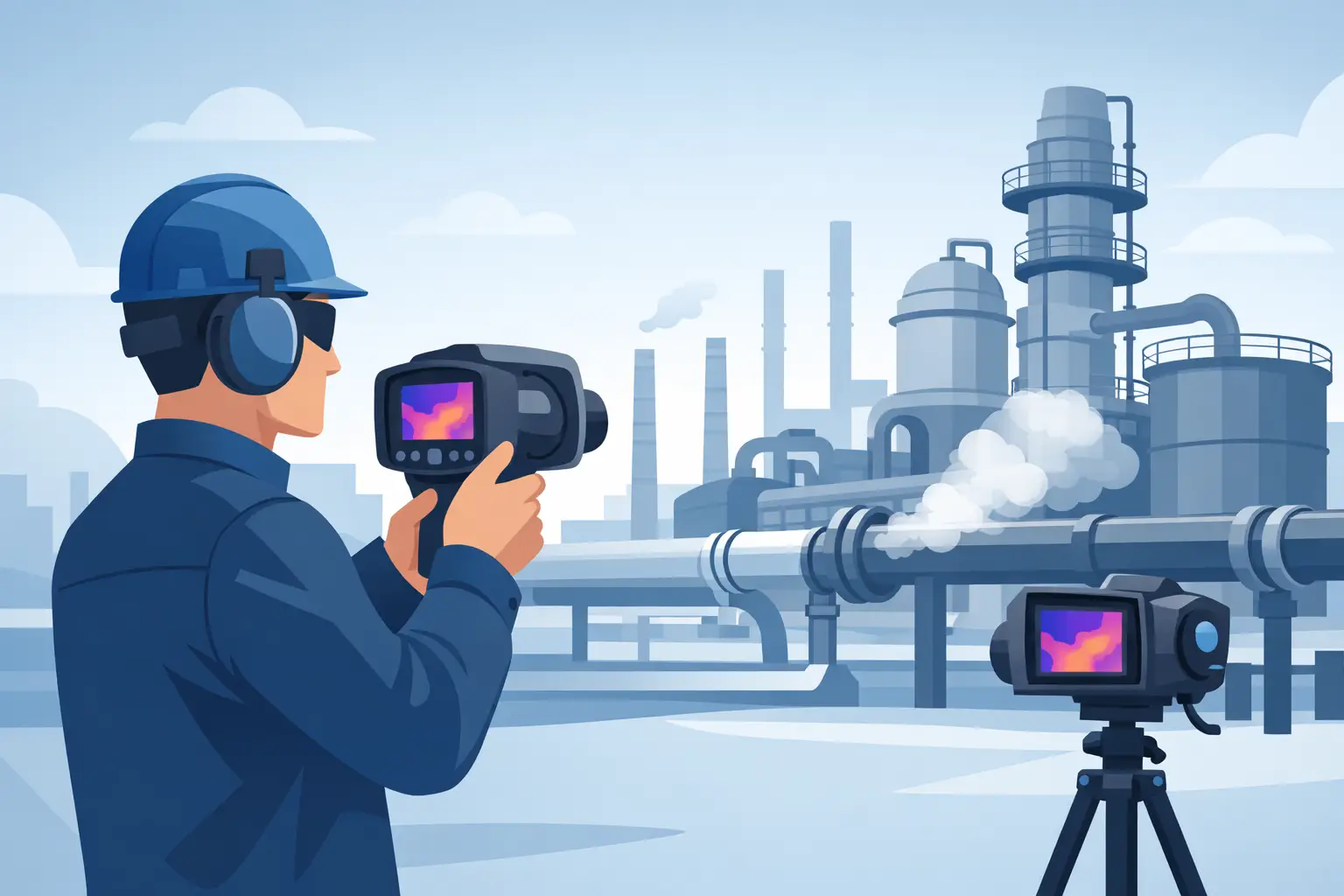
A leaking valve stem on a process unit can release valuable product for weeks before a conventional alarm, odor report, or inspection round identifies the source. That is why use gas leak imaging cameras is a practical business question, not simply a technology question. For refineries, offshore assets, chemical plants, power facilities, and marine operations, these systems give teams a fast visual method for locating certain gas emissions and directing maintenance resources where they will have the greatest operational impact.
Optical gas imaging turns an otherwise difficult inspection problem into evidence your operators, engineers, contractors, and management teams can see. Instead of treating a suspected leak as a broad-area search, personnel can observe a gas plume against the equipment background, confirm the likely source area, record the finding, and organize corrective action. The result is stronger asset visibility, more efficient field work, and a better basis for controlling safety, environmental, and production risks.
Why Use Gas Leak Imaging Cameras Instead of Inspection Alone?
Traditional leak detection methods still have a place. Fixed detectors, gas sensors, ultrasonic instruments, pressure trending, and close-range survey equipment each provide valuable information. But they do not solve every inspection scenario equally well. A fixed detector monitors its installed area, while a conventional survey can require an inspector to work through a large number of components one at a time.
A gas leak imaging camera gives the inspection team broad visual coverage. Operators can scan pipe racks, compressor areas, tank connections, loading equipment, flare systems, manifolds, and process skids from a safer standoff position when site conditions allow. A visible plume helps personnel focus on the component that needs attention rather than spending time testing every possible source in the vicinity.
This matters particularly where equipment density is high. Refineries and chemical facilities may have thousands of valves, connectors, pumps, seals, and fittings. Offshore platforms add weather exposure, salt air, restricted access, and the cost of mobilizing personnel and equipment. On marine assets, tight machinery spaces and cargo-handling areas demand inspections that are quick, controlled, and documented. Imaging systems help reduce uncertainty before a repair team is assigned.
The visual output also improves communication. A maintenance request stating that a leak is believed to be near a compressor is useful. Recorded imagery showing the apparent emission at a specific seal, flange, or valve provides a much clearer work scope. Supervisors can prioritize the repair, planners can prepare the correct materials, and management can see why the work matters.
Faster Leak Location Means Better Maintenance Decisions
The direct value of optical gas imaging is speed, but speed only matters when it leads to better decisions. Finding an emission earlier can prevent a minor sealing issue from becoming lost product, an unplanned outage, a larger atmospheric release, or an exposure concern for personnel.
For operations managers, the strongest use case is usually prioritization. Not every leak has the same consequence. An imaging survey can help teams distinguish between a minor issue scheduled for the next maintenance window and a source that requires immediate control measures. The recorded evidence supports risk-based maintenance planning rather than relying solely on anecdotal reports or routine intervals.
It can also shorten troubleshooting during abnormal operating conditions. When pressure behavior, consumption figures, or process alarms suggest a possible loss of containment, a properly specified imaging system can help investigate without delaying the response. The camera does not replace plant procedures, gas testing, or permit controls. It provides an additional layer of situational awareness that helps the team move from suspicion to a defined inspection target.
For commercial decision-makers, less wasted labor is only part of the equation. Product loss, repair scope, shutdown duration, contractor access, and regulatory exposure all affect the cost of a leak. A system that helps identify emissions before they escalate can protect uptime and improve the return on maintenance spending.
What Gas Leak Imaging Cameras Can and Cannot Detect
Gas imaging is highly effective when the camera is matched to the target gas and operating environment. That qualification is essential. These systems use specialized optical technology tuned to spectral absorption characteristics, allowing certain gases to appear as a moving plume under suitable conditions.
A camera designed for hydrocarbon gases may be used to identify methane and other volatile organic compound emissions within its specified detection capability. Other models are configured for gases such as sulfur hexafluoride. The right choice depends on the gases handled at the site, expected leak characteristics, process temperature, background contrast, viewing distance, and applicable inspection requirements.
Detection is not automatic under every condition. Wind can disperse a plume quickly. The temperature contrast between the gas and background can affect visibility. Rain, humidity, glare, line-of-sight obstructions, and the emission rate can also influence results. A camera may show a plume clearly at one viewing angle and poorly from another. Experienced operators understand these variables and adjust their position, settings, and inspection plan accordingly.
That is why procurement should avoid treating all gas imaging equipment as interchangeable. A low purchase price has little value if the system is not configured for the gas, zone classification, range, and operational conditions that matter at your facility. The best deployment starts with the inspection objective, then specifies the technology around that objective.
A Stronger Safety and Environmental Control Layer
Gas emissions can present different risks depending on the process. Some gases are flammable, some displace oxygen, some contribute to environmental emissions, and some can create serious process-safety consequences. Imaging cameras help personnel identify suspected releases while maintaining appropriate distance and following site safety protocols.
They are especially useful for surveys of elevated lines, remote equipment, and areas where access is difficult or disruptive. A visual inspection from an approved observation point may reduce unnecessary exposure before closer investigation is planned. For offshore and marine environments, this can be significant: access often depends on weather, vessel operations, work permits, and limited maintenance windows.
Environmental performance is another major driver. Methane and VOC emissions are under increasing scrutiny from regulators, customers, investors, and internal sustainability programs. Imaging systems produce timestamped visual records that can support inspection documentation, repair verification, contractor oversight, and emissions-management workflows. They do not remove the need for a formal leak detection and repair program, but they make that program easier to execute with defensible field evidence.
How to Specify the Right System for Your Facility
The right camera is not simply the one with the longest specification sheet. It is the one that fits the mission and can be deployed reliably by the people responsible for inspection. Procurement teams should assess at least these five areas before selecting equipment:
- Target gases and sensitivity: Confirm the camera is intended for the gases your process handles and review performance data under expected operating conditions.
- Hazardous-area suitability: Verify certifications and installation requirements for the classified zone. This is non-negotiable in refineries, chemical plants, terminals, and offshore facilities.
- Fixed or survey deployment: A fixed system can provide continuous observation of a critical area, while a survey configuration supports planned rounds and response investigations. Some sites require both.
- Image recording and reporting: Look for clear video capture, timestamps, secure storage options, and a workflow that supports maintenance records and audit requirements.
- Environmental durability and support: Enclosures, operating temperature range, corrosion resistance, network integration, commissioning, and technical support determine whether the equipment will perform beyond the first demonstration.
Integration deserves particular attention. A camera that produces useful imagery but cannot fit into the site network, control-room workflow, or security architecture may create a separate operational burden. Industrial buyers should consider power availability, fiber or Ethernet connectivity, remote viewing permissions, cybersecurity controls, and how footage will be retained and reviewed.
For fixed installations, location is equally important. A poorly positioned unit can be blocked by structures, see only a limited background, or miss the likely plume path. Site surveys should consider prevailing wind, equipment layout, lighting, access for maintenance, and the boundaries of the area that needs monitoring. Engineering input at this stage protects the investment.
Where Imaging Delivers the Strongest Return
The strongest return usually comes from high-value or high-risk equipment, not from placing cameras everywhere without a plan. Compressor seals, pump seals, valves, pressure-relief devices, storage and transfer connections, loading operations, gas-processing equipment, and remote pipework are common priority areas. Facilities with recurring fugitive-emission findings or costly access constraints often see the clearest operational benefit.
There is also a case for using imaging during turnaround planning and post-repair verification. Before a shutdown, inspections can identify items that deserve inclusion in the work list. After repairs, recorded imaging can help confirm whether the apparent emission has been addressed before the team closes the task. This makes maintenance records more useful and reduces the chance that the same issue returns as an unresolved work order.
Revlight Security supplies specialist detection and surveillance infrastructure for demanding industrial and marine environments, where equipment performance, network compatibility, and dependable support must work together. The right gas imaging deployment should be treated as part of the wider safety and asset-visibility strategy, not as an isolated purchase.
A well-specified gas leak imaging camera gives your team a clearer next move: identify the source, assess the consequence, assign the right repair, and retain the evidence. Start by mapping the gases, critical assets, hazardous zones, and inspection bottlenecks at your site. That assessment will point to the system configuration that can deliver measurable value from the first survey.
🛡️ Secure Your Home or Business Today
Protect your home, office, shop, or business with reliable CCTV security cameras. Explore our range of CCTV cameras and find the right security solution for your needs.
Explore CCTV Cameras ✉️ Email Us


 Singapore :
+65-6708-9302
Singapore :
+65-6708-9302