
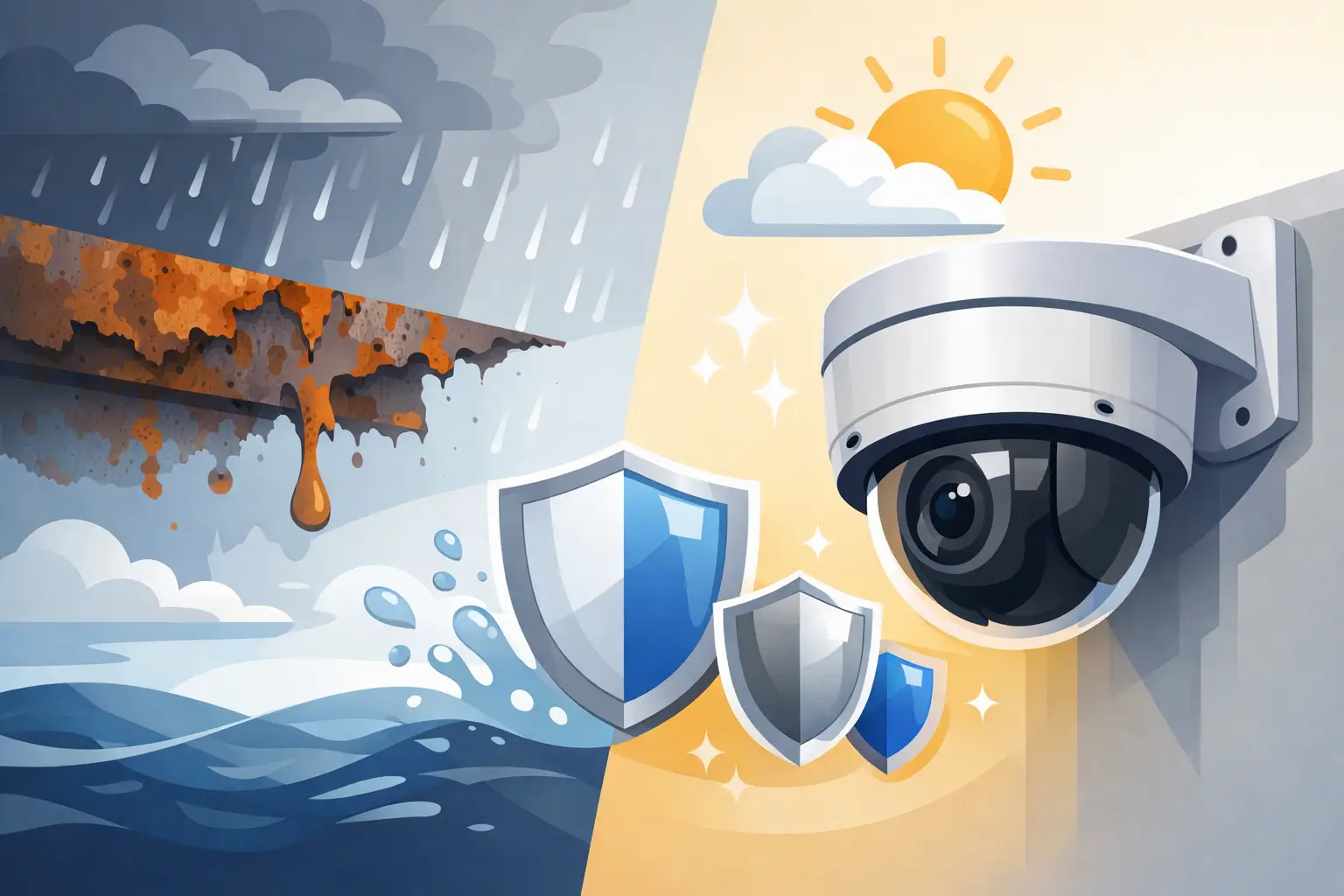
A camera can have excellent low-light performance, optical zoom, and network capability, then fail early because a housing seam, fastener, cable gland, or lens window was specified for the wrong environment. For offshore platforms, refineries, terminals, vessels, and power facilities, anti corrosion camera materials are not a cosmetic specification. They determine whether critical surveillance remains available when salt spray, hydrogen sulfide, washdown chemicals, humidity, and temperature cycling begin attacking the installation.
The right material selection reduces replacement cycles, protects recorded evidence, and limits the costly access work required to service equipment in hazardous or difficult-to-reach locations. It also needs to be assessed as a complete camera assembly, not simply by reading the housing material on a data sheet.
Why corrosion resistance is a surveillance requirement
Industrial surveillance equipment is often installed where maintenance is expensive and operational visibility cannot be interrupted. A camera overlooking a flare area, loading berth, process unit, engine room, or subsea structure may be exposed continuously to contaminants that ordinary commercial enclosures were never designed to handle.
Salt-laden air is particularly aggressive because chloride deposits attract moisture and accelerate pitting. On marine assets, salt collects in housing joints, around mounting brackets, beneath sunshields, and inside poorly sealed cable entries. On chemical and oil and gas sites, the challenge can also include sulfur compounds, acids, alkaline cleaning agents, hydrocarbons, and airborne process residue.
Corrosion creates more than an appearance problem. It can compromise enclosure integrity, weaken brackets, seize adjustment points, damage connectors, cloud optical surfaces, and allow moisture to reach electronics. A failed surveillance point can leave operators without visual confirmation during a safety event, security incident, or process investigation.
The main anti corrosion camera materials
There is no single best material for every deployment. The correct choice depends on the corrosion mechanism, temperature range, mounting location, washdown routine, required certification, and expected service life. Buyers should match the material package to the actual exposure rather than choosing solely on the initial purchase price.
316L stainless steel for demanding coastal and industrial sites
316L stainless steel is a proven choice for many marine, offshore, and industrial camera housings. Its molybdenum content provides better resistance to chloride attack than 304 stainless steel, making it well suited to salt-air exposure and many process-area installations. The low-carbon grade also helps reduce the risk of sensitization after welding.
For topside offshore locations, coastal terminals, and ship decks, 316L provides a strong balance of corrosion resistance, mechanical strength, and availability. It is frequently appropriate for housings, brackets, mounting hardware, and protective accessories.
However, 316L is not immune to corrosion. Crevices that retain seawater, constant wet-dry cycles, and concentrated chloride deposits can still lead to pitting or crevice corrosion. A 316L enclosure with unsuitable screws or an unsealed mounting interface will not deliver the service life the material suggests. Regular freshwater rinsing may also be necessary where salt accumulation is heavy.
Duplex stainless steel where chloride exposure is severe
Duplex stainless steel offers higher strength and generally greater resistance to pitting and stress corrosion cracking than 316L. It is an excellent option for highly exposed marine structures, splash-zone installations, coastal process plants, and locations where chloride levels and temperature make standard stainless steel a less conservative choice.
Its higher strength can allow for durable, compact mechanical components, while its corrosion performance supports longer deployment intervals in punishing conditions. The trade-off is cost and fabrication complexity. Duplex is not automatically required for every offshore camera, but it deserves serious consideration when failure access requires cranes, shutdown permits, rope access, or vessel support.
Titanium for maximum seawater resistance
Titanium is one of the strongest material choices for prolonged seawater exposure. It is highly resistant to corrosion in marine environments and is especially valuable for subsea camera housings, underwater inspection systems, and deepwater applications where recovery and repair are costly.
Titanium’s performance comes with a higher material and machining cost. It also requires careful engineering where it contacts other metals. Used correctly, titanium can deliver exceptional lifecycle value in subsea surveillance, ROV observation, and permanent underwater monitoring where lesser materials would create unnecessary replacement risk.
Marine-grade aluminum with the right coating system
Aluminum can be useful where weight matters, including elevated mast installations, vessel superstructures, and large pan-tilt systems. Marine-grade aluminum alloys can perform well when protected by a properly specified coating system, such as hard anodizing and high-quality marine paint or powder coating.
The limitation is that coating damage exposes the base metal. Scratches, chipped edges, and poorly finished drilled holes become initiation points for corrosion, particularly in salt environments. Aluminum also requires attention to galvanic compatibility when connected to stainless steel or carbon steel structures. Insulating washers, isolation pads, and compatible fasteners are not optional details.
Engineered polymers, glass, and optical components
Not every corrosion-resistant part must be metal. High-performance polymers can be effective for radomes, sunshields, cable fittings, and certain enclosure components. They can resist many chemicals, reduce weight, and avoid galvanic corrosion. Their limits involve UV stability, temperature, mechanical impact, fire performance, and long-term brittleness.
The viewing window deserves equal scrutiny. Tempered glass, borosilicate glass, and sapphire each serve different requirements. Sapphire provides outstanding scratch resistance and can be highly valuable in abrasive or underwater applications. Glass selection must account for pressure, impact, thermal cycling, cleaning chemicals, and optical clarity. A corroded housing is obvious, but a degraded window can quietly reduce image quality until a camera no longer supports identification or inspection work.
Materials alone do not stop corrosion
A corrosion-resistant housing can still fail because the complete assembly was not engineered for the environment. Procurement teams should evaluate the following elements together:
- Housing, bracket, fasteners, hinges, and mounting plates should have compatible corrosion performance.
- Cable glands, conduit entries, seals, and connectors must retain their environmental rating after installation.
- Dissimilar metals need electrical isolation where galvanic corrosion is possible.
- Coatings must cover edges, welds, cutouts, and field-modified areas, not only broad visible surfaces.
- Lens windows and wiper systems must tolerate the cleaning method and the process contaminants present.
This system-level view matters because fasteners are a common weak point. Carbon steel screws on a stainless housing can stain, seize, and deteriorate quickly. A camera bracket attached directly to an incompatible steel support can develop galvanic attack at the interface. Even high-grade materials will underperform if moisture is allowed to sit in unventilated pockets.
Match the specification to the deployment zone
For a protected indoor control-room perimeter, a painted metal enclosure may be entirely adequate. For an exposed ship deck, 316L stainless steel with marine-suitable hardware and sealed glands is often the more practical baseline. For splash-zone structures, high-chloride coastal sites, or difficult-access installations, duplex stainless steel may justify its additional cost. For permanent subsea use, titanium and pressure-rated optical materials are frequently the better commercial decision.
Chemical exposure must be evaluated separately from marine exposure. An enclosure that tolerates seawater may not tolerate a specific acid vapor, solvent, chlorine-based cleaning agent, or high-temperature process atmosphere. Ask for compatibility guidance based on the chemicals, concentration, temperature, and exposure frequency at the proposed mounting point.
Ingress protection and hazardous-area certification also matter, but they do not replace material selection. An IP-rated or explosion-protected camera can still suffer premature external corrosion if its metals, coatings, and seals are not suitable for the site. Treat environmental protection, certification, and corrosion resistance as connected requirements.
Questions to ask before issuing a purchase order
Specify where the camera will be installed, not just what it will monitor. Is it sheltered or fully exposed? Does it face prevailing salt spray? Will it be washed down weekly? Is it near emissions, cooling towers, chemical transfer points, or exhaust outlets? Can a technician safely reach it without a shutdown?
Then request clear confirmation of housing material, fastener grade, coating type, window material, seal composition, operating temperature, and cable-entry design. Generic claims such as “weatherproof” or “marine ready” are not sufficient for a high-value industrial deployment. The supplier should be able to explain why the camera construction fits the service conditions.
Revlight Security helps industrial buyers assess surveillance hardware against real installation risks, including offshore exposure, corrosive process environments, and underwater operation. The aim is straightforward: specify equipment that stays online, delivers usable footage, and does not create a recurring maintenance burden.
The lowest-cost camera is rarely the lowest-cost installation when it must be replaced after one harsh season. Select materials for the environment you actually have, engineer the interfaces with equal care, and give your operation a surveillance system built to keep watching when conditions turn against it.
🛡️ Secure Your Home or Business Today
Protect your home, office, shop, or business with reliable CCTV security cameras. Explore our range of CCTV cameras and find the right security solution for your needs.
Explore CCTV Cameras ✉️ Email Us


 Singapore :
+65-6708-9302
Singapore :
+65-6708-9302