
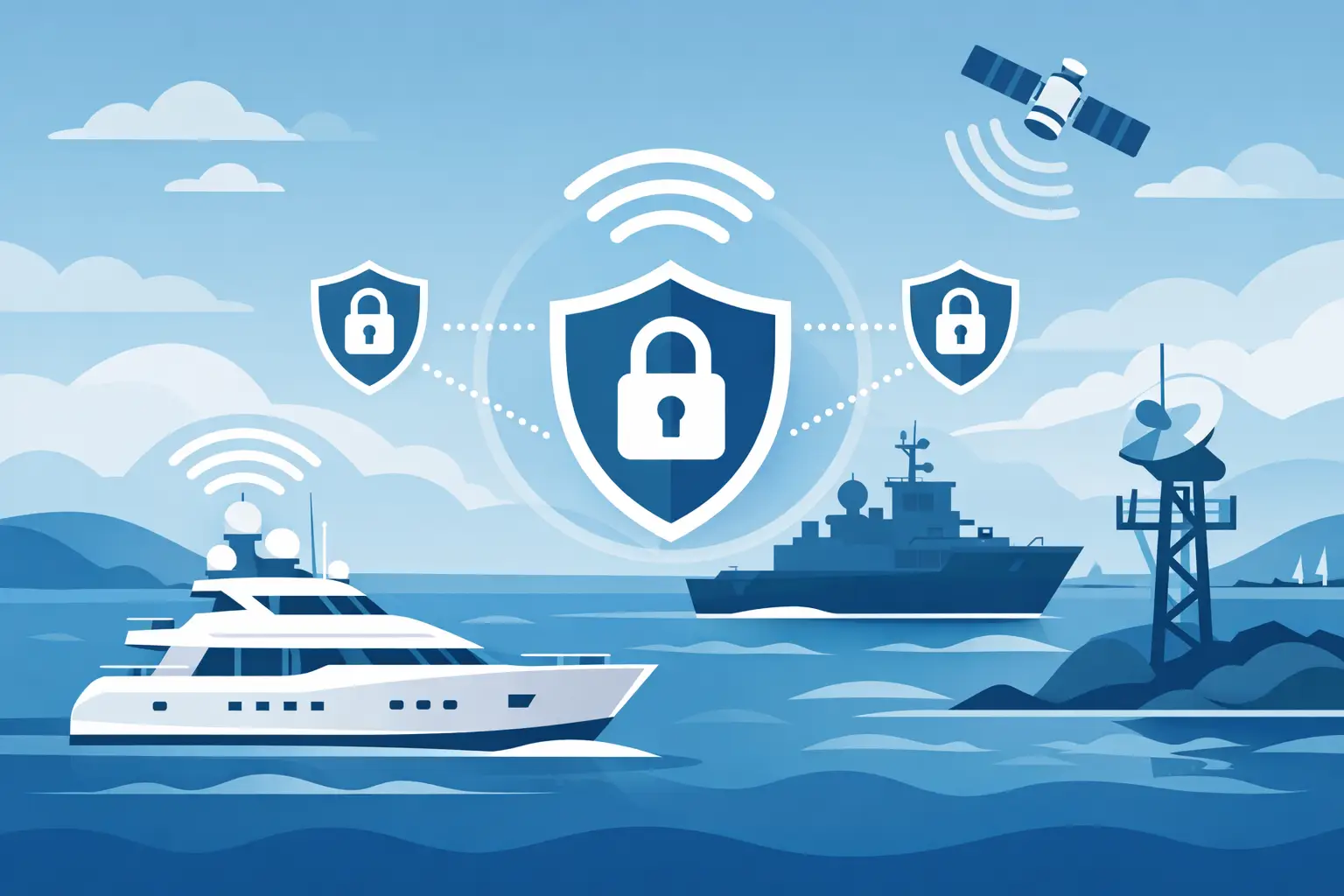
A vessel can have a high-capacity satellite connection and still suffer from dead zones on the bridge wing, unstable crew access below deck, and intermittent camera feeds at the quay. The weak point is often the onboard network, not the internet service. Marine wifi systems are built to distribute connectivity where it is needed while protecting operational traffic from guest, crew, and noncritical devices.
For ship managers, captains, offshore operators, and procurement teams, the right system is not a consumer router mounted in a cabinet. It is a managed communications layer designed around vessel layout, steel bulkheads, salt exposure, power availability, security policy, and the applications that must keep working when conditions deteriorate.
What Marine WiFi Systems Must Deliver
A properly specified system provides more than onboard internet. It creates controlled wireless coverage for operational teams, crew welfare access, remote security monitoring, maintenance terminals, and approved mobile devices. It should support the services that matter to the vessel without allowing one traffic type to consume all available bandwidth.
That distinction matters when the shore connection is limited or costly. Guest streaming, software updates, and personal devices can quickly affect bridge communications, remote video viewing, cloud synchronization, or access to operational records if every user shares one open network. Segmented networks and defined bandwidth rules keep critical functions at the front of the line.
The best architecture also gives authorized administrators visibility. They need to identify connected devices, check access point status, review utilization, apply updates, and troubleshoot faults without searching through unmanaged equipment installed across multiple decks. Centralized management turns the network from an afterthought into dependable operating infrastructure.
Start With the Vessel’s Real Coverage Requirements
Coverage cannot be designed from vessel length alone. A small workboat with an open deck has different radio behavior from a tanker, drill support vessel, offshore platform, or multi-level passenger vessel. Metal structures block and reflect wireless signals. Watertight doors, engine rooms, refrigerated spaces, cargo areas, and dense machinery introduce further obstacles.
A site survey or detailed deck-plan review should establish where users and connected equipment actually operate. Bridge areas, accommodation blocks, workshops, control rooms, gangways, dockside work zones, and external decks may each require a different access point position or antenna approach. Installing fewer units at higher power is not always the answer. Excessive power can create interference and poor roaming, especially in confined areas.
Coverage targets should be stated in commercial terms before equipment is selected. Is the priority reliable crew access in accommodation? Continuous connectivity for remote monitoring? Yard-side access during loading? Secure access for maintenance personnel? A clear answer prevents spending on coverage that looks impressive on paper but does not support the vessel’s working routine.
The Backhaul Is Not the Same as the Wireless Network
Marine WiFi and internet backhaul are related, but they solve different problems. The backhaul brings connectivity onboard through satellite, cellular, microwave, shore-based service, or another approved transport. The WiFi network distributes that connection locally to approved users and devices.
This separation is critical during procurement. A fast satellite package will not correct poor onboard access point placement. Conversely, excellent wireless coverage cannot overcome a constrained or unavailable backhaul link. The complete design must account for both, including automatic failover where operational requirements justify it.
When the vessel is near shore, cellular or port connectivity may be available and economical. Offshore, satellite is often the primary route. Operators should define how traffic will be prioritized during each condition, what happens when a link drops, and which functions remain available on the local network without outside connectivity.
Build Security Into the Network Design
A single shared wireless password is not an acceptable security strategy for industrial or marine operations. It creates weak accountability, makes offboarding difficult, and can expose sensitive operational systems to devices that do not need access.
A serious deployment separates traffic through VLANs or equivalent network segmentation. Operational systems, surveillance equipment, corporate devices, crew access, guest access, and vendor maintenance connections should be isolated according to risk and business need. Firewalls and access rules then control which segments can communicate.
For example, an IP surveillance network may need protected access to a recorder and authorized remote viewers, while crew devices should have internet access only. A contractor may require temporary connectivity to a specific maintenance terminal, not visibility of the wider vessel network. This is a practical security control, not unnecessary complexity.
Strong authentication, encrypted wireless access, password governance, and regular firmware management also belong in the specification. Remote access must be controlled through approved methods, with clear user permissions and activity records where required. In a marine environment, a network fault can become an operational delay. A security incident can become far more expensive.
Choose Hardware for Marine Conditions
Standard office-grade equipment is rarely the right long-term value on deck or in exposed industrial locations. Marine deployments may require weather-resistant enclosures, corrosion-aware materials, wide operating temperature support, protected cable routes, and mounting hardware that withstands vibration and movement.
Indoor equipment still needs careful selection. Electrical rooms, machinery spaces, and humid areas can place greater demands on switches, power supplies, connectors, and cable management than a conventional office installation. Power over Ethernet, or PoE, is particularly useful because it can supply access points through the network cable, reducing the need for local power outlets at every installation point.
However, PoE budgets must be calculated, not assumed. A switch must provide enough power for every connected access point, camera, bridge device, and other PoE endpoint under expected load. Specifying the right switch capacity at the start is more cost-effective than correcting power instability after commissioning.
Managed Switching and Cabling Matter
Wireless performance depends on the wired network behind it. Managed switches provide visibility, segmentation, port controls, and diagnostics that unmanaged hardware cannot. They also help technical teams identify whether a problem comes from the access point, cable, uplink, power source, or external connection.
Cabling should be routed and protected for the vessel environment, with appropriate termination and labeling. In areas affected by electrical noise, distance, or environmental exposure, fiber may be the stronger choice for backbone links. The correct medium depends on the route, the electrical environment, the required capacity, and maintenance access.
Capacity Planning Prevents Frustration at Sea
A network that supports 10 users does not automatically support 100 users simply by adding bandwidth. The number of simultaneous devices, application types, radio congestion, and access point density all affect the user experience. Smartphones, tablets, laptops, crew welfare devices, sensors, and authorized industrial endpoints can produce a far higher device count than the headcount suggests.
Capacity planning should consider peak demand. Crew shifts, meal periods, port calls, and operational events can create concentrated usage. Video calls, cloud backups, large downloads, and remote video viewing may require rules that protect business-critical traffic. Quality of service policies, rate limits, and scheduled updates make available bandwidth work harder.
There is also a cost decision. It may be unnecessary to engineer full high-speed coverage across every low-use technical space. In contrast, a bridge, operations room, accommodation block, or security control point may justify higher capacity and redundancy. The right marine WiFi system matches investment to the consequence of poor connectivity.
Commissioning, Support, and Lifecycle Value
Installation is only the beginning. Commissioning should include coverage validation, device registration, segmentation testing, failover checks where installed, and verification that authorized users can access the services assigned to them. Network diagrams, port records, configuration backups, and clear handover documents reduce downtime later.
Ongoing support should cover monitoring, software updates, replacement planning, and a defined response process for faults. For fleet operators, consistent network standards across vessels make support faster and simplify crew transitions. A one-off collection of mixed hardware may appear cheaper initially, but it raises troubleshooting time, spare-part complexity, and security exposure.
Revlight Security supplies specialist marine network and surveillance infrastructure for operators that need dependable performance, controlled access, and practical support for demanding environments. The focus should always be on an engineered system that supports operations rather than a collection of disconnected wireless products.
Before issuing a purchase order, ask for a design that shows coverage zones, access point locations, power requirements, segmentation, backhaul integration, and support responsibilities. That level of detail gives your vessel a network built for working conditions, not just a signal indicator that looks good at the dock.
🛡️ Secure Your Home or Business Today
Protect your home, office, shop, or business with reliable CCTV security cameras. Explore our range of CCTV cameras and find the right security solution for your needs.
Explore CCTV Cameras ✉️ Email Us




 Singapore :
+65-6708-9302
Singapore :
+65-6708-9302