
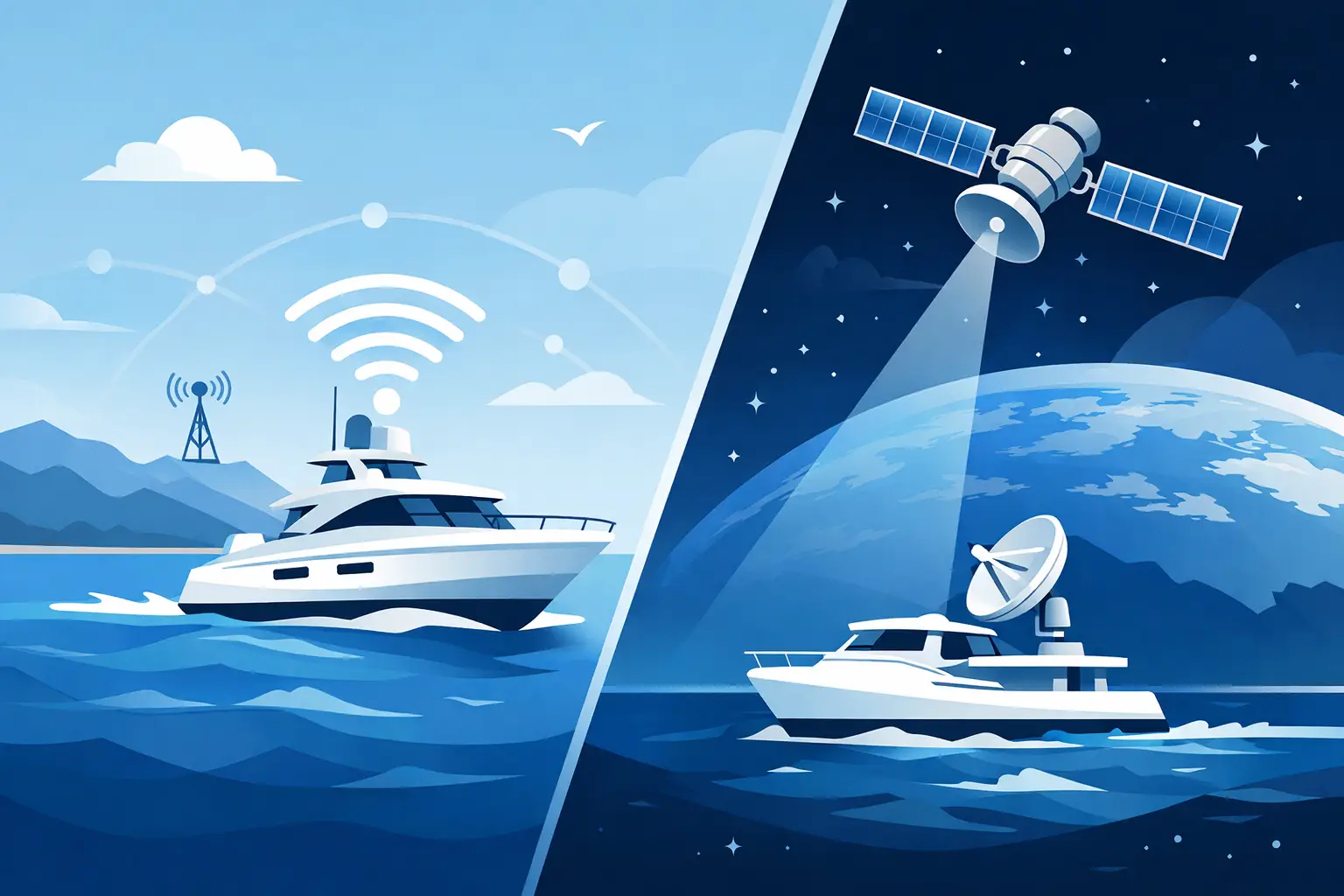
A vessel leaves port with full charts, working radar, and a crew expecting constant access to operational data. Ten miles later, the network starts dropping. That is where the real marine wifi vs satellite internet decision shows up – not in a spec sheet, but in daily operations, safety, and cost control.
For ship operators, offshore teams, and industrial buyers, connectivity is no longer a convenience line item. It supports CCTV backhaul, remote diagnostics, engine data transfer, email, VoIP, welfare access, and coordination with shore teams. The wrong choice creates blind spots, delays, and avoidable spending. The right choice gives you stable communications where you actually operate.
Marine WiFi vs satellite internet: the core difference
Marine WiFi connects a vessel to a shore-based or platform-based network using radio links. It performs best when your vessel works within range of a coastal site, harbor, terminal, offshore platform, or private network point. In the right deployment, marine WiFi delivers strong speeds, low latency, and far lower recurring costs than satellite.
Satellite internet connects through orbiting satellites rather than local towers or access points. Its biggest advantage is coverage far beyond the shoreline. If a vessel moves deep offshore, crosses open water, or operates where no local radio infrastructure exists, satellite becomes the practical option.
That is the real split. Marine WiFi is usually the best-value option for nearshore and fixed-route operations. Satellite is the coverage-first option for long-range and remote deployments.
Where marine WiFi wins
If your operations stay within controlled corridors, marine WiFi can be the smarter commercial decision by a wide margin. Ports, dredging zones, harbor patrol routes, offshore wind farms, tug and barge operations, pilot boats, and support vessels often do not need global coverage. They need dependable high-speed connectivity in known working areas.
In those conditions, marine WiFi offers lower latency than satellite, which matters for live monitoring, video transmission, and remote system access. If you are moving surveillance footage from vessel to shore, checking remote NVR status, or allowing engineers to access onboard systems, lower latency creates a better working network.
Cost is another major advantage. Once the infrastructure is in place, marine WiFi can reduce monthly bandwidth costs significantly compared with satellite airtime. For fleet operators managing multiple vessels, that cost difference adds up quickly. A well-designed marine WiFi network can support daily operational traffic without the ongoing premium that often comes with offshore satellite plans.
There is also more control. Private marine WiFi networks can be built around your facility, terminal, or offshore asset, giving your team greater oversight of security settings, traffic prioritization, and coverage design. For industrial users focused on surveillance, asset monitoring, and remote operations, that level of control is commercially attractive.
Where satellite internet wins
Satellite internet is harder to beat once a vessel moves beyond the practical range of shore-linked networks. Ocean-going ships, offshore service vessels, exploration support fleets, and operators working across wide territories need coverage that does not end at the harbor mouth.
That coverage comes at a price, but it solves a real problem. If your vessel spends long periods outside coastal range, satellite is not a luxury purchase. It is operational infrastructure. Without it, remote reporting, emergency communications, cloud synchronization, and crew connectivity become unreliable or unavailable.
Satellite also has an edge where geography works against radio links. Mountain-lined coasts, highly congested ports, severe weather patterns, and isolated offshore areas can all weaken the value of marine WiFi if no strong network architecture supports it. In those cases, satellite offers consistency across changing routes.
For many buyers, the decision is less about which technology is superior and more about where coverage failure becomes unacceptable. If a vessel cannot afford dead zones, satellite often becomes the safer procurement choice.
Performance trade-offs that matter offshore
Speed numbers alone can mislead buyers. Real-world performance at sea depends on range, antenna quality, line of sight, onboard equipment, network congestion, weather, and the type of traffic being carried.
Marine WiFi can deliver excellent throughput when conditions are right. In nearshore environments with properly aligned antennas and quality hardware, performance can support video, voice, operational systems, and standard crew internet use without difficulty. But range limitations are real. As the vessel moves farther from the access point, quality can fall sharply.
Satellite brings broader coverage, but latency remains a known issue in many setups. That may not stop email, file transfers, or standard reporting, but it can affect live applications. Real-time video review, low-delay calls, and remote control functions can feel less responsive depending on the service type and terminal configuration.
Weather is another factor. Marine WiFi is affected by signal obstruction, sea state, and installation quality. Satellite can also suffer performance hits during heavy rain or severe atmospheric conditions. No marine communication system is completely immune to environmental impact. That is why professional installation and realistic coverage planning matter more than marketing claims.
Cost comparison: upfront spend vs ongoing spend
For procurement teams, marine wifi vs satellite internet usually comes down to total cost of ownership, not just purchase price.
Marine WiFi often requires investment in access points, marine-grade antennas, onboard network hardware, and in some cases shore-side infrastructure. The upfront design work matters because poor positioning or low-grade hardware will limit the return. But once deployed correctly, operating costs are usually more favorable, especially across repetitive routes or local work zones.
Satellite can require higher hardware costs as well, depending on terminal size and service class, but the larger concern is recurring service cost. Airtime, data limits, bandwidth tiers, and service commitments can make satellite substantially more expensive over time. For operators transferring large files, surveillance streams, or frequent reports, usage planning becomes critical.
This is where many marine operators make the wrong comparison. They evaluate hardware only and ignore monthly burn rate. A cheaper installation can become the more expensive network within a year if service charges climb with every operational demand.
The best fit by vessel type and operation
A harbor vessel, tug, crew transfer boat, patrol craft, or terminal support vessel often gets better value from marine WiFi, especially if it returns to the same zones every day. These operations benefit from predictable geography and the ability to connect into fixed infrastructure.
An offshore support vessel working around platforms may also perform well on marine WiFi if the operator has access to a private offshore network. In these cases, the network can support not only internet access but also surveillance transmission, platform communications, and secure operational data exchange.
By contrast, blue-water shipping, remote survey work, and deep offshore operations are stronger satellite candidates. The farther the route extends from owned or accessible network points, the harder it is to justify a WiFi-only approach.
There is also a middle ground. Many serious operators now choose a hybrid setup. Marine WiFi handles high-speed, lower-cost traffic whenever the vessel is within range. Satellite takes over when coverage drops. This approach improves uptime, controls cost, and gives operations teams a more resilient communications layer.
Security and network control
For industrial buyers, this is not just an internet question. It is a network security question.
Marine WiFi can be integrated into controlled vessel and facility networks with defined traffic rules, segmented access, and dedicated pathways for surveillance and operational systems. That can be valuable for ports, offshore assets, and marine operators that need dependable remote visibility without exposing critical systems to unnecessary risk.
Satellite networks can also be secured effectively, but they often rely more heavily on service-provider architecture and plan limitations. Buyers should look beyond headline bandwidth and review how traffic is managed, how remote access is protected, and whether the network can support business-critical systems without interruption.
For surveillance-heavy operations, that matters. If remote cameras, playback access, event alerts, or system health checks depend on the link, the communications layer has to be selected as seriously as the camera hardware itself. Revlight Security works in that reality every day, where connectivity and visibility are part of the same operational requirement.
So which one should you buy?
If your vessels operate near shore, around ports, terminals, offshore structures, or fixed industrial sites, marine WiFi is often the stronger value. It can deliver faster local performance, lower latency, and lower recurring cost when designed properly.
If your operations move far offshore, cover unpredictable routes, or cannot tolerate loss of wide-area coverage, satellite internet is the stronger choice. It costs more in many cases, but it solves the coverage problem marine WiFi cannot.
If you want the most practical answer, buy based on operating geography first, bandwidth second, and headline speed last. A network that matches the route will outperform a cheaper system that loses coverage where the work actually happens. The strongest communications setup is the one that keeps your vessel connected when the job gets harder, not when it is still tied up at the dock.
🛡️ Secure Your Home or Business Today
Protect your home, office, shop, or business with reliable CCTV security cameras. Explore our range of CCTV cameras and find the right security solution for your needs.
Explore CCTV Cameras ✉️ Email Us



 Singapore :
+65-6708-9302
Singapore :
+65-6708-9302