
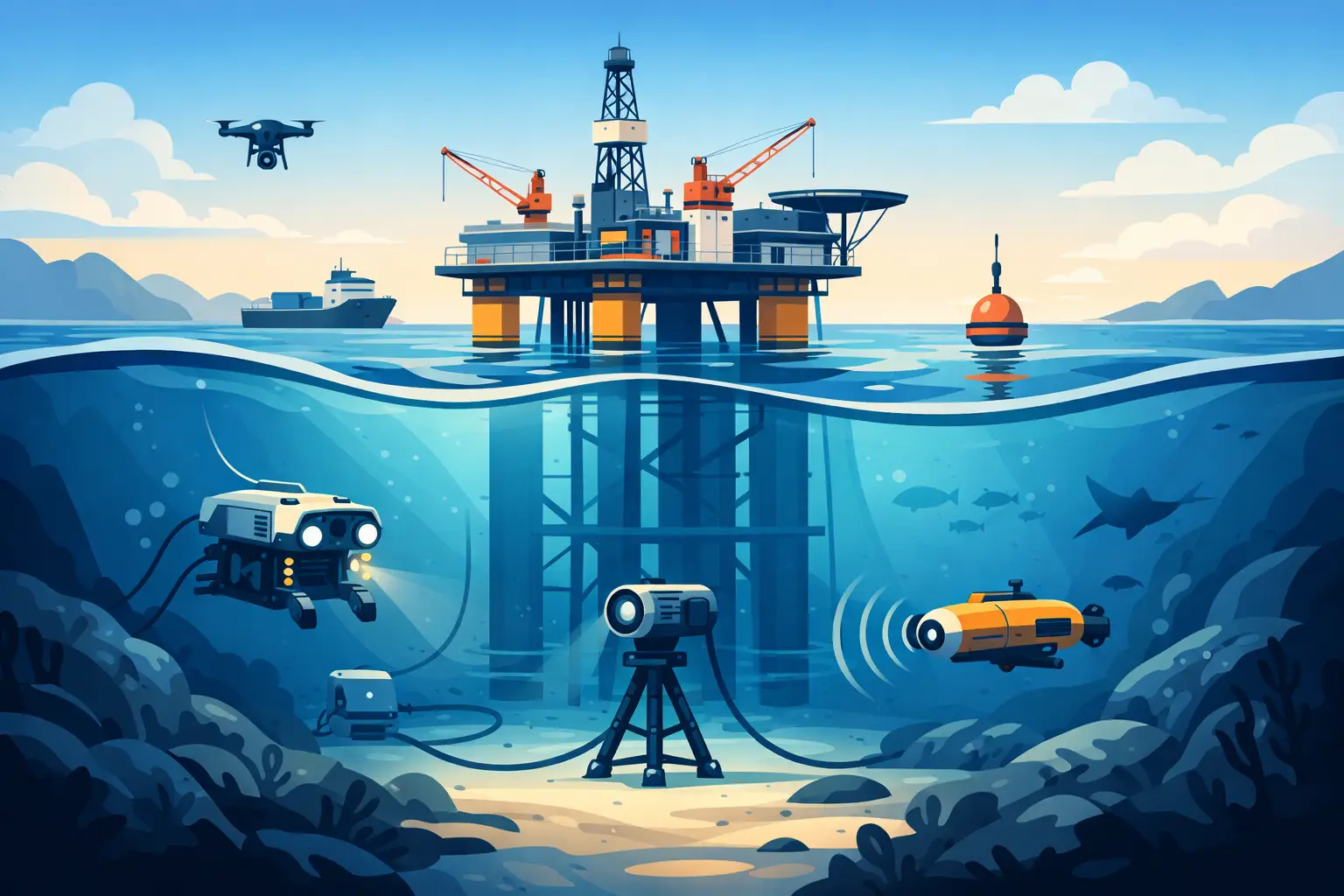
A dropped object near a riser, unexpected marine growth on a brace, or a diver support delay during bad weather can turn into real cost fast. That is why knowing how to monitor offshore platform underwater is not a niche technical question. It is a core operations decision that affects safety, uptime, inspection quality, and how quickly your team can respond when conditions change below the waterline.
For most operators, the mistake is not lack of interest. It is treating underwater monitoring as a single camera purchase instead of a working surveillance system. Offshore environments punish weak housings, poor lighting, unstable networks, and poorly planned installation points. If the system cannot hold image quality, transmit reliably, and support inspections without repeated intervention, it will not deliver value when you need it most.
How to monitor offshore platform underwater the right way
The right approach starts with the monitoring objective. Some platforms need continuous visual coverage around landing legs, braces, conductors, and splash-zone transitions. Others need event-based inspection support for structural checks, leak investigations, marine growth assessment, or unauthorized approach detection. Those use cases sound similar, but they drive different camera layouts, lighting requirements, storage plans, and network priorities.
A fixed underwater surveillance system is usually the strongest option when you need repeatable visibility and rapid remote access. It gives operations teams a live view of critical subsea areas without waiting for a vessel, dive team, or ROV mobilization. That matters when sea state, crew scheduling, and permit requirements can slow down conventional inspection methods.
Still, permanent monitoring is not always the entire answer. Some operators pair fixed cameras with scheduled ROV verification or sensor-based inspection programs. That mixed model often makes commercial sense. You reduce the number of expensive offshore interventions while keeping the flexibility to investigate anomalies in more detail when the fixed system shows something worth checking.
Start with the subsea risk map
Before specifying equipment, define what has to be seen and why. On an offshore platform, underwater monitoring usually centers on structural integrity, leak detection support, corrosion progression, scouring around foundations, marine growth buildup, and security awareness around critical assets. If your team cannot rank those priorities, it becomes easy to overspend on the wrong parts of the system and underspecify the ones that matter most.
Visibility range is one of the first practical limits. Water clarity, turbidity, current, and biofouling all affect usable image quality. A camera that looks excellent in a controlled test tank may perform very differently at depth near active infrastructure with suspended particles and changing light conditions. This is why serious offshore buyers focus on delivered performance in operating conditions, not just catalog resolution.
Mounting position also matters more than many procurement teams expect. A camera placed too close to a target may lose situational context. Too far away, and critical defects become difficult to interpret. Good system design usually combines overview positions with tighter inspection views so operators can understand both the broader scene and the specific condition of an asset.
Choosing the right underwater camera system
If you are evaluating how to monitor offshore platform underwater for long-term use, the camera housing and subsea durability should come before almost everything else. Pressure tolerance, corrosion resistance, sealing integrity, and long-service reliability are the foundation. Without those, high image specifications mean very little.
Low-light performance is equally important. Underwater environments absorb light quickly, and fixed platform structures create shadows even in shallower conditions. Integrated or paired underwater lighting is often necessary, but stronger lighting is not always better. Excessive illumination can increase backscatter in turbid water, reducing visibility rather than improving it. The best result usually comes from matching beam angle, light placement, and camera sensitivity to the site conditions.
Wide-angle coverage has value for general observation, but critical asset monitoring often needs a more deliberate field of view. Operators may need to distinguish coating damage, marine growth accumulation, or structural change at a level that generic wide coverage cannot support. In those cases, a system with carefully selected optics and stable mounting provides better operational value than simply adding more cameras.
Recording and playback functions should be treated as operational tools, not optional extras. Live video helps immediate decisions, but recorded subsea footage supports trend analysis, contractor verification, incident review, and maintenance planning. For many offshore teams, the real return comes from being able to compare the same underwater zone over time without repeated manual inspection campaigns.
Networking and remote access are part of the system
A subsea camera that cannot deliver stable data topside is only doing half the job. Offshore platform monitoring depends on the network path between the underwater equipment, local control points, and remote operations teams. That includes transmission stability, bandwidth planning, video compression, storage capacity, and secure remote access.
Fiber-based integration is often preferred where high reliability and image quality are priorities, especially across larger offshore installations. In other deployments, hybrid network architecture may be more practical depending on platform layout and existing communications infrastructure. The point is simple: camera performance and network performance must be specified together.
Remote access can be a major cost saver when done correctly. Engineers, superintendents, and operations managers can review underwater conditions from control rooms or onshore support locations instead of waiting for manual visual confirmation. That shortens the decision cycle and can reduce unnecessary offshore attendance. But remote access has to be secure, controlled, and simple enough for operational use under pressure.
Installation planning makes or breaks results
Even top-of-the-line offers fail if installation is treated as an afterthought. Offshore subsea monitoring systems need proper cable routing, protected connectors, stable mounting brackets, and service-friendly access planning. Every component has to be chosen with corrosion, movement, vibration, and maintenance intervals in mind.
The splash zone deserves special attention. It is one of the most punishing areas in the offshore environment because of wave action, salt exposure, and repetitive mechanical stress. If your system crosses or monitors this zone, the design standard must reflect that reality. It is not enough to use underwater-rated equipment if the transition points and mountings are weak.
You also need to think about cleaning and fouling control. Marine growth can degrade visibility much faster than many non-specialist buyers expect. Depending on water conditions, lens cleaning systems, protective design features, or planned maintenance intervals may be necessary to keep the image usable over time. There is always a trade-off between lower upfront spend and lower service burden later.
When to add sensors and detection layers
Video is powerful, but it is not the only tool worth using. Some offshore operators benefit from combining underwater cameras with other detection layers such as leak indication inputs, structural monitoring data, and platform security alerts. That gives the control team context rather than isolated footage.
For example, if an alert suggests an anomaly around subsea infrastructure, the camera system can provide immediate visual verification before a larger inspection response is triggered. That can prevent overreaction, but it can also help teams move faster when the situation is genuine. In commercial terms, integrated monitoring reduces wasted interventions and improves confidence in operational decisions.
This is where supplier quality matters. The best service provider does not just ship a camera and leave the integration problem to the client. Serious industrial buyers need a partner that understands offshore surveillance architecture, environmental durability, and how recording, playback, remote access, and network reliability work together in the field.
What good underwater monitoring looks like in practice
A strong offshore setup usually delivers continuous or scheduled visibility in key subsea zones, clear enough imaging for practical decision-making, reliable transmission to topside systems, and recorded footage that supports maintenance and compliance. It should reduce avoidable offshore inspection costs, improve response speed, and give operations managers a more direct view of underwater asset condition.
That does not mean every platform needs the same design. A shallow-water installation with frequent service access may justify a different specification than a remote asset where intervention is expensive and weather windows are tight. Procurement teams should expect some variation in camera count, lighting intensity, network design, and service planning based on the operating profile.
For buyers comparing systems, the smart question is not which unit has the biggest spec sheet. It is which system will keep producing useful subsea visibility month after month in your actual operating environment. That is the standard that protects budgets and supports safer offshore operations.
Underwater monitoring works best when it is planned as critical infrastructure rather than added later as a visual extra. Get the objectives, mounting, imaging, transmission, and maintenance strategy right, and the system becomes a practical asset your team will rely on every day.
🛡️ Secure Your Home or Business Today
Protect your home, office, shop, or business with reliable CCTV security cameras. Explore our range of CCTV cameras and find the right security solution for your needs.
Explore CCTV Cameras ✉️ Email Us


 Singapore :
+65-6708-9302
Singapore :
+65-6708-9302