
A single camera on a gate is not a CCTV strategy. For a refinery, offshore vessel, terminal yard, or power site, surveillance has to do more than capture footage. It has to support live monitoring, evidence retention, remote access, perimeter awareness, and reliable performance in harsh conditions. That is why understanding what is CCTV and its types matters before you compare models, pricing, or deployment plans.
CCTV stands for closed-circuit television. In simple terms, it is a video surveillance system where cameras send signals to a defined set of monitors, recorders, or networked devices rather than broadcasting publicly. The “closed-circuit” part is the key point. The video feed is intended for authorized users such as security teams, operations managers, marine officers, control room staff, or site leadership.
For industrial buyers, CCTV is not just about seeing what happened after an incident. It is part of operational control. A well-designed system can monitor restricted zones, track vehicle movement, verify process-area activity, support incident investigations, reduce theft, and improve response times across large or remote assets.
What is CCTV and its types in practical terms?
When buyers ask what is CCTV and its types, they are usually trying to answer a more commercial question: which system will deliver the right coverage, durability, and scalability for the site? The answer depends on the environment, infrastructure, and risk profile.
At the broadest level, CCTV systems are grouped by how they transmit and manage video. The main types are analog CCTV, HD-over-coax CCTV, IP CCTV, wireless CCTV, and specialized CCTV systems built for demanding environments such as marine, offshore, hazardous, or underwater use. Each has a place. The best option is the one that matches operational demands, not the one with the most marketing claims.
Analog CCTV
Analog CCTV is the traditional format. Cameras send video over coaxial cable to a digital video recorder, often called a DVR. This type is still found in older facilities and budget-conscious upgrades because it can reuse existing cabling and reduce upfront replacement costs.
The advantage is straightforward installation in legacy sites. If a facility already has coax infrastructure, analog can be a practical way to keep surveillance running without a full network redesign. It is also familiar to many maintenance teams.
The trade-off is performance and flexibility. Traditional analog systems generally offer lower image quality than modern IP systems, and they are less adaptable when you want advanced analytics, easy remote scaling, or integration with wider security networks. For basic observation they can still work, but for critical industrial use, they are often no longer the top-of-the-line offer.
HD-over-coax CCTV
HD-over-coax sits between analog and IP. It uses coaxial cable like legacy systems but delivers higher resolution video. For sites that need a visible jump in image quality without replacing all cabling, this format can make strong commercial sense.
This type often appeals to operators upgrading warehouses, loading areas, plant perimeters, and utility compounds. You get clearer footage for identification and incident review while controlling installation costs.
Still, HD-over-coax has limits. It improves image quality, but it does not always match the network flexibility, remote management options, and intelligent features available in IP-based systems. It is often a cost-effective upgrade path rather than the final answer for expanding multi-site operations.
IP CCTV systems
IP CCTV, or Internet Protocol CCTV, is the preferred choice for many industrial and marine buyers. These cameras transmit video data over an IP network to a network video recorder, known as an NVR, or to a centralized management platform. This architecture supports higher resolutions, more advanced control, and stronger system integration.
For modern facilities, the benefits are substantial. IP systems can support remote viewing, centralized monitoring across multiple assets, motion-based alerts, video analytics, and easier expansion as requirements grow. On a vessel, offshore platform, refinery, or large energy site, that flexibility matters.
IP CCTV also supports a broader range of camera types and specialist applications. Thermal imaging, gas leak visualization, corrosion-resistant housings, explosion-protected configurations, and low-light performance can all be part of a wider networked surveillance setup. That is where procurement decisions become more strategic. You are not only buying cameras. You are building a security and operational visibility layer.
The trade-off is that IP systems usually require stronger network planning, storage design, cybersecurity controls, and more disciplined installation standards. A poor network environment can compromise performance. Done properly, though, IP CCTV delivers the ultimate in security surveillance systems for demanding operations.
Wireless CCTV
Wireless CCTV uses radio or WiFi transmission to send video rather than relying entirely on physical cabling. This can be useful in temporary sites, remote compounds, marine settings, or difficult retrofit areas where cable runs are expensive or disruptive.
Wireless systems can speed up deployment and reduce civil works. For short-term projects, isolated observation points, and certain marine applications, they are often commercially attractive.
However, wireless is not automatically the best choice for every critical location. Signal interference, bandwidth limitations, environmental obstacles, and power requirements all have to be assessed carefully. In high-risk industrial zones, reliability comes first. Wireless can be highly effective, but only when the site conditions support it.
Specialized CCTV for harsh and high-risk environments
This is where standard retail-grade surveillance stops being enough. Industrial buyers often need CCTV systems engineered for conditions that ordinary commercial cameras cannot handle.
Marine CCTV is designed for salt exposure, vibration, changing weather, and long operating cycles. Offshore and shipboard systems need sealed housings, corrosion resistance, and dependable network performance under movement and moisture.
Hazardous-area CCTV is built for explosive or flammable environments such as refineries, chemical plants, and gas processing sites. In these zones, camera design is tied directly to safety compliance. Equipment must be suitable for the classification of the area, not simply weather-resistant.
Thermal CCTV detects heat signatures rather than relying only on visible light. That makes it valuable for perimeter protection, night surveillance, equipment monitoring, and conditions where smoke, darkness, or distance make standard imaging less effective.
Underwater CCTV serves offshore structures, hull inspections, subsea monitoring, and marine engineering work. These systems are purpose-built for pressure, water ingress prevention, and clear imaging below the surface.
In sectors such as oil and gas, energy, marine, and critical infrastructure, specialized CCTV is often not optional. It is the difference between generic surveillance and fit-for-purpose performance.
Key camera forms within CCTV systems
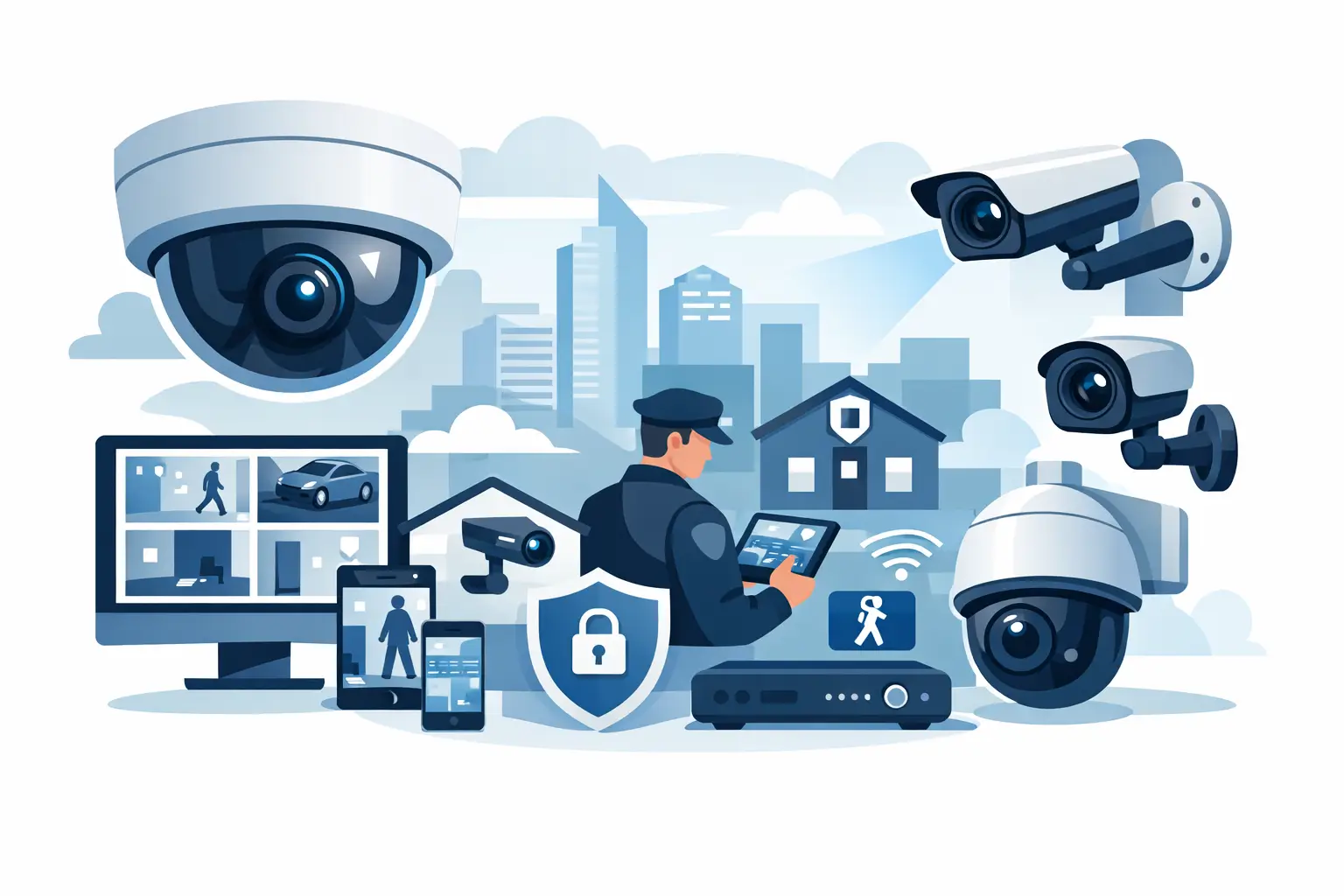
Beyond transmission type, CCTV also comes in different camera formats. Dome cameras are common for indoor and sheltered areas because they are compact and harder to tamper with. Bullet cameras are widely used outdoors where long-range directional coverage is needed. PTZ cameras, which pan, tilt, and zoom, are ideal for large perimeters, berths, tank farms, and wide operational zones where live operators need flexible control.
There are also fixed cameras for constant monitoring, thermal cameras for low-visibility conditions, and explosion-protected or stainless-steel variants for demanding environments. The right mix depends on what the site needs to observe, record, and verify.
How to choose the right CCTV type
Start with the operating environment. A warehouse, tanker, offshore platform, and chemical plant do not have the same surveillance demands. Exposure to corrosion, water, dust, vibration, heat, and hazardous gases changes the equipment specification immediately.
Next, look at image requirements. If you need clear identification at gates, process areas, or loading points, higher resolution and proper lens selection matter. If your priority is wide-area awareness in darkness or fog, thermal coverage may deliver better results than standard visual imaging.
Then consider infrastructure. Existing coax cable may support a cost-saving HD-over-coax upgrade. A strong network backbone may justify a full IP CCTV rollout. Remote sites may need a carefully planned wireless or hybrid solution.
Storage and access are just as important. Procurement teams should ask how long footage must be retained, who needs remote viewing, how playback will be managed, and whether the system must integrate with alarms, access control, or detection technologies.
Finally, assess lifecycle value, not just purchase price. Cheaper systems often create higher costs later through weak reliability, poor image performance, limited expansion, or premature replacement. Serious operators buy for uptime, evidence quality, and site fit.
What buyers should ask before purchasing
A good supplier should be able to explain not only what is CCTV and its types, but why one configuration outperforms another in your exact setting. Ask about recorder capacity, remote access options, environmental ratings, camera housing materials, night performance, maintenance needs, and system expansion. If the site is high-risk, ask how the equipment handles corrosion, hazardous-area requirements, or offshore conditions.
This is especially relevant for industrial and marine operators, where surveillance is tied to safety, compliance, and asset protection. The best service provider will not push a one-size-fits-all package. They will specify a system that matches operational reality and protects your investment over the long term.
For buyers who need surveillance to work under pressure, CCTV is not just a camera network. It is a decision about visibility, response, and resilience. Choose the type that fits the environment, and the system will keep delivering long after installation day.
🛡️ Secure Your Home or Business Today
Protect your home, office, shop, or business with reliable CCTV security cameras. Explore our range of CCTV cameras and find the right security solution for your needs.
Explore CCTV Cameras ✉️ Email Us


 Singapore :
+65-6708-9302
Singapore :
+65-6708-9302