
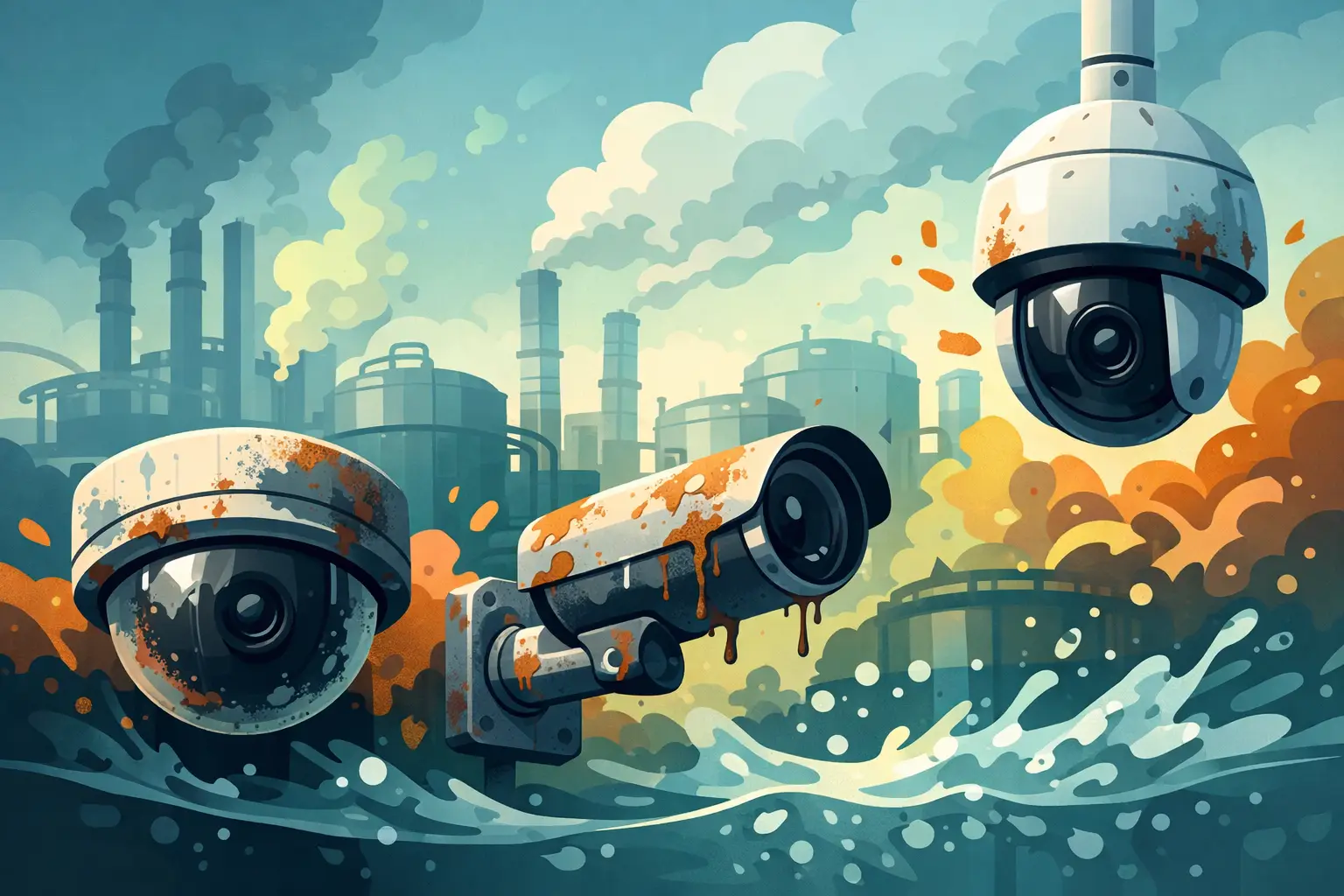
Salt mist gets into seals. Acid vapors haze lenses. Washdown chemicals attack brackets long before the image fails. That is why buyers asking what cameras work in corrosive environments are not really asking about image quality first – they are asking which systems will still operate after months of exposure in harsh industrial conditions.
For offshore platforms, refineries, chemical plants, wastewater facilities, marine vessels, and coastal energy sites, standard security hardware is usually a short-term purchase with a long-term failure cost. The right answer is not one camera type for every site. It depends on the chemical exposure, the mounting position, the inspection objective, and whether the unit also needs explosion protection, remote networking, or continuous recording.
What cameras work in corrosive environments
The cameras that perform best in corrosive environments are purpose-built industrial systems with corrosion-resistant housings, sealed connectors, stable optics, and materials selected for the site chemistry. In most serious applications, that means fixed surveillance or detection cameras built in 316L stainless steel, marine-grade alloys, or other chemically resistant enclosures rather than painted consumer-style housings.
Material choice matters more than many buyers expect. Powder-coated aluminum can look suitable on paper, but coatings chip and corrosion starts underneath. Standard stainless may be acceptable in mild washdown areas, but chloride-heavy marine air often demands 316L stainless steel for longer service life. In highly aggressive chemical zones, even stainless needs to be checked against the exact media present, because one plant’s vapor mix can be far harsher than another’s.
The camera itself is only part of the system. If the housing survives but the cable gland, mounting arm, PoE connector, or junction box fails, the installation still goes down. The best service provider in this space will always specify the full assembly, not just the camera head.
The main camera types used in corrosive sites
In industrial security and process monitoring, fixed corrosion-resistant CCTV cameras are the most common choice. These are used for perimeter views, deck monitoring, machinery spaces, loading areas, tank farms, and access control points. When built with sealed industrial housings and matched accessories, they give dependable 24/7 coverage with recording, playback, and remote viewing across the network.
For process-critical locations, thermal cameras are often the stronger commercial decision. They can monitor overheating equipment, identify abnormal heat signatures, and maintain visibility in low light or difficult weather. In corrosive plants, thermal units still need the same environmental protection as standard visible-light units. A high-performance core inside a weak enclosure will not last.
Gas detection cameras also have a place where hydrocarbon or methane leak visualization is required. In refining, petrochemical, and energy operations, these systems help operations teams identify leak events earlier and support safer response. Here, corrosion resistance and hazardous-area certification often need to work together. That raises cost, but it also raises operational value.
Underwater cameras belong in another category. Offshore structures, sea chests, hull areas, intakes, and submerged inspection points face corrosion from saltwater, biofouling, and pressure. These systems need more than stainless housing. They require pressure-rated construction, stable seals, and cable systems designed for constant submersion.
What to look for before you buy
The first checkpoint is the environment itself. Marine atmosphere, splash zone, chemical vapor, caustic washdown, fertilizer dust, and chlorine exposure all create different failure patterns. A camera suitable for a ship bridge wing may not be suitable for a pickling line or an acid dosing room.
The second checkpoint is enclosure material. 316L stainless steel is a strong baseline for many marine and corrosive industrial settings, especially where salt exposure is constant. Nickel-plated or coated components may lower initial cost, but they usually create maintenance risk in the wrong location. If uptime matters, buyers should push for proven industrial-grade materials throughout the camera, mount, fasteners, and cable entry points.
Ingress protection is another major factor. A high IP rating helps protect against water and particle ingress, but it does not automatically guarantee chemical resistance. IP66 or IP67 may be necessary, yet still not sufficient if the site uses aggressive washdown agents. Buyers should ask how seals, windows, gaskets, and external finishes perform against actual site chemicals.
Temperature range also changes the answer. Corrosive environments are often hot, cold, humid, or all three. A camera mounted near process heat or on an exposed marine mast may need heaters, blowers, or thermal management. Without that support, condensation and thermal cycling can shorten service life even if the housing metal is correct.
When hazardous-area certification matters
Many buyers asking what cameras work in corrosive environments are working in areas that are not only corrosive but also potentially explosive. In oil and gas, refining, fuel storage, and some chemical processing zones, a corrosion-resistant camera is not enough on its own. The unit may also need ATEX, IECEx, or other hazardous-area certification depending on site requirements and geography.
This is where cheap substitutions become expensive mistakes. An uncertified housing in a classified area can create compliance problems, project delays, and replacement costs that wipe out any upfront savings. The top-of-the-line offers in this market combine corrosion resistance, certified protection, and network performance in one system so procurement teams are not forced into compromise.
There is a trade-off, though. Certified explosion-protected cameras are heavier, more specialized, and more expensive than general industrial models. Installation can also be more demanding. But for classified areas, that is the right cost structure because the alternative is operational risk.
Why lenses, wipers, and windows are often the weak point
A camera may have an excellent housing and still deliver poor results if the viewing window degrades. In corrosive or salty environments, the front window and lens area are constant problem points. Chemical deposits, salt crystals, and residue can reduce image quality long before the housing shows visible damage.
That is why serious installations often use hardened windows, sunshields, integrated wipers, washer systems, or air purge arrangements depending on the location. On marine decks and exposed plant perimeters, these features are not extras. They protect the image and reduce service visits.
This matters commercially as much as technically. A lower-priced unit without window protection may look attractive during budgeting, but if access requires scaffolding, shutdown coordination, or offshore labor, maintenance becomes the real price driver.
Network design matters as much as camera selection
Corrosion-resistant cameras are usually installed in places where distance, weather, and access complicate networking. Offshore assets, jetties, tank farms, and large process sites need stable transmission for live viewing, recording, and remote diagnostics. A good camera on a weak network still creates blind spots.
That is why buyers should consider the full surveillance infrastructure – switches, enclosures, wireless bridges, marine WiFi, power budget, recording platform, and remote access architecture. Industrial operators do not just need video. They need usable evidence, alarm visibility, and reliable playback when an incident occurs.
Revlight Security works in exactly these kinds of environments, where surveillance performance is tied to corrosion resistance, hazardous-area suitability, and network reliability rather than a simple spec-sheet comparison.
The procurement question to ask suppliers
Instead of asking whether a camera is “weatherproof,” ask suppliers what failure mode they are designing against. Is it chloride attack, acid vapor, washdown chemicals, pressure, or classified-area ignition risk? A serious supplier should answer with materials, certifications, mounting options, maintenance expectations, and realistic service life.
It is also smart to ask what other components are included in the corrosive-environment specification. If the quote only covers the camera body, there is a gap. Mounts, fixings, junction boxes, cable glands, and connectors should be aligned to the same environmental standard or the system will fail at its weakest point.
For most industrial buyers, the safest answer is clear. The cameras that work in corrosive environments are engineered systems with corrosion-resistant housings, application-matched optics, sealed accessories, and the right certification for the site. Anything less may still power on during commissioning, but that is not the same as delivering long-term security coverage.
If your site is exposed to salt, chemicals, washdown, or hazardous vapors, buy for the environment you actually have, not the one a generic catalog promises.
🛡️ Secure Your Home or Business Today
Protect your home, office, shop, or business with reliable CCTV security cameras. Explore our range of CCTV cameras and find the right security solution for your needs.
Explore CCTV Cameras ✉️ Email Us

 Singapore :
+65-6708-9302
Singapore :
+65-6708-9302