
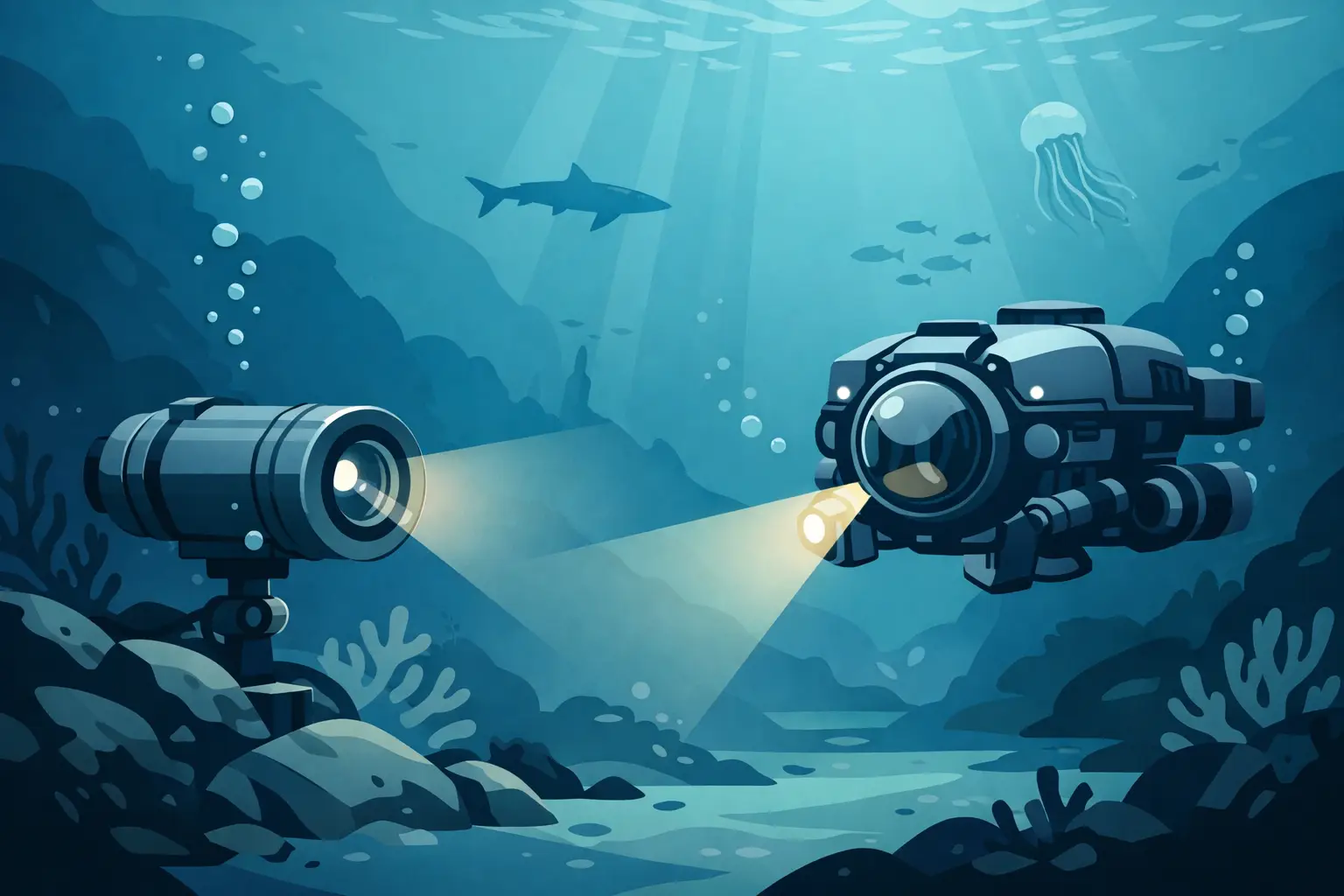
A blurred image at depth is not just a camera problem. It can delay an inspection, force an unnecessary recovery operation, leave corrosion unverified, or keep a vessel and crew waiting on a decision. For offshore operators, ship managers, and industrial asset owners, subsea cameras must provide usable visual evidence when access is difficult, conditions are hostile, and downtime carries a real cost.
The right system is therefore not selected on image resolution alone. It must match the water depth, visibility, lighting conditions, mounting position, cable route, recording requirements, and communication network already in place. A well-specified camera installation gives operations teams clear visibility below the waterline while reducing exposure, inspection time, and reliance on uncertain visual checks.
Why Subsea Cameras Are Operational Equipment
Subsea imaging supports far more than general observation. It gives crews and shore-side teams a direct view of structures, equipment, and conditions that cannot be safely or economically assessed by conventional means. Common applications include hull and sea-chest inspection, thruster monitoring, riser and pipeline observation, wet-mate connection checks, intake and outfall monitoring, and verification of underwater construction work.
In each case, the commercial value comes from faster, defensible decisions. If an engineer can confirm marine growth, a damaged guard, a blocked intake, or an issue around a submerged assembly before mobilizing additional resources, the operation moves with greater control. Recording also matters. Time-stamped footage can support maintenance planning, contractor verification, incident review, and communication between vessel, facility, and management teams.
A camera that works well in clear, shallow water may perform poorly on an offshore asset or working vessel. Sediment, low ambient light, backscatter, vibration, currents, biofouling, and pressure all affect the result. That is why industrial buyers should treat the camera, housing, illumination, cabling, recorder, and network connection as one surveillance system rather than separate purchases.
Specify Subsea Cameras by the Mission
The first question is simple: what decision must the video support? An inspection camera intended to identify fouling on an intake has different requirements from a unit used to monitor a high-value subsea connection continuously. Define the required field of view, the smallest feature that must be recognized, the normal and maximum operating depth, and whether live viewing, recorded evidence, or both are required.
Pressure rating and housing construction
Pressure capability is non-negotiable. The camera housing, lens window, seals, connectors, and cable termination must all be rated for the intended depth with an appropriate operating margin. A quoted depth figure has little value if it does not clearly apply to the complete assembled system.
Material selection also affects service life. Marine-grade stainless steel, titanium, and carefully selected engineering polymers each have a place, depending on depth, corrosion exposure, weight limits, and budget. Buyers should examine seal design, connector quality, service access, and resistance to galvanic corrosion where dissimilar metals are present. The lowest initial price can become the most expensive option if the unit requires frequent recovery or replacement.
Image quality that works in real water
High resolution is useful only when the lens, lighting, and water conditions allow the sensor to capture meaningful detail. In poor visibility, a properly positioned light and controlled viewing distance often matter more than chasing the largest resolution specification. Wide-angle lenses can show a broad area but may distort detail at the edges. Narrower fields of view can improve identification of a specific component but demand more precise mounting.
Low-light performance is especially important for permanent installations, deep-water work, enclosed structures, and nighttime operations. Color imaging can assist identification where lighting permits, while monochrome performance may be more useful in very low light. The correct choice depends on the inspection objective, not a generic feature comparison.
Lighting, backscatter, and mounting geometry
Underwater lighting must be planned with the camera. When lights sit too close to the lens axis, suspended particles reflect directly back into the image, creating a bright haze that obscures the target. Separating the lights from the camera and directing illumination across the viewing area can significantly improve contrast.
Mounting geometry should also allow for vessel movement, vibration, growth accumulation, and maintenance access. A fixed position may be ideal for repeated monitoring of a valve, intake, or subsea interface. A pan-tilt arrangement may offer broader coverage, but it adds mechanical complexity and requires a clear maintenance plan. More movement is not automatically better if the inspection target is stable and predictable.
Build the System Around Recording and Access
Live video is valuable during an active operation, but recorded footage is what makes the installation useful after the event. Select a recorder that supports the required camera count, retention period, playback quality, and export process. For critical assets, recording should continue through short network interruptions and provide clear timestamps that align with operational logs.
Network integration deserves early attention. A subsea camera can feed a local monitor, a vessel network, an offshore control room, or a remote operations center, depending on the available infrastructure and cybersecurity policy. Fiber may be preferred for longer transmission distances and high-bandwidth video, while copper-based solutions can be practical for shorter routes. The right architecture depends on cable distance, power requirements, existing switches, and the level of remote access required.
For multi-camera systems, organize video by location and asset function. Clear naming makes footage usable under pressure. “Port sea chest,” “thruster tunnel,” or “intake screen 2” is operationally better than default device labels. Access permissions should be assigned deliberately so that authorized engineers and operations personnel can view or retrieve evidence without exposing the wider network unnecessarily.
Installation Details That Protect Performance
Many subsea camera failures originate at the installation stage rather than in the camera body itself. Cable routes need protection from chafing, crush loads, sharp edges, and movement. Penetrations should be engineered for the structure and pressure environment, with proper strain relief at every termination. A high-quality camera cannot compensate for a poorly protected cable run.
Before deployment, verify the complete system on the surface. Check video output, lighting control, recording, time synchronization, network access, and image quality at the expected viewing distance. Confirm that operators know how to switch views, retrieve clips, and identify a loss of signal. Commissioning documentation should record the camera position, orientation, depth rating, cable path, network address, and maintenance requirements.
Biofouling is another practical consideration. In warm or nutrient-rich water, lens windows and lights can degrade quickly. Depending on the application, protective shutters, wipers, anti-fouling measures, or planned cleaning intervals may be justified. These features add cost, but they can protect the availability of a camera that supports a critical operation.
Compare Total Cost, Not Just Camera Price
Procurement teams should compare systems on operating value: expected service life, ease of replacement, warranty support, availability of spares, compatibility with existing recorders and networks, and the labor required to maintain the installation. A lower-cost unit that cannot be serviced efficiently may create higher vessel time, contractor, and recovery costs over its life.
It also helps to separate essential requirements from desirable enhancements. Permanent monitoring of a critical intake may justify redundant illumination, network failover, and extended recording retention. A short-term inspection point may need a simpler configuration. Matching the specification to the consequence of failure protects both budget and asset availability.
Revlight Security supports industrial buyers with subsea surveillance configurations designed around real operating conditions, from camera selection and video recording to marine network integration. The objective is clear: deliver reliable visual coverage that helps crews inspect faster, manage risk, and keep valuable assets under control.
The strongest installation is the one that gives an operator a clear answer when that answer is needed most. Specify for the water, the asset, and the decision at hand, then make recording, access, and maintenance part of the purchase from the beginning.
🛡️ Secure Your Home or Business Today
Protect your home, office, shop, or business with reliable CCTV security cameras. Explore our range of CCTV cameras and find the right security solution for your needs.
Explore CCTV Cameras ✉️ Email Us


 Singapore :
+65-6708-9302
Singapore :
+65-6708-9302