
A refinery flare stack goes into alarm at 2:13 a.m. The control room needs eyes on the area immediately, not after someone walks a patrol route. That is where the PTZ vs fixed cameras decision stops being a spec-sheet exercise and becomes an operational one. In industrial surveillance, the right camera type affects response time, verification accuracy, maintenance planning, and total system cost.
For procurement teams and operations leaders, the question is not which format is better in general. It is which format performs better for your site, your hazards, and your monitoring workflow. PTZ and fixed cameras solve different surveillance problems. The strongest systems usually use both, but the balance matters.
PTZ vs fixed cameras in real industrial use
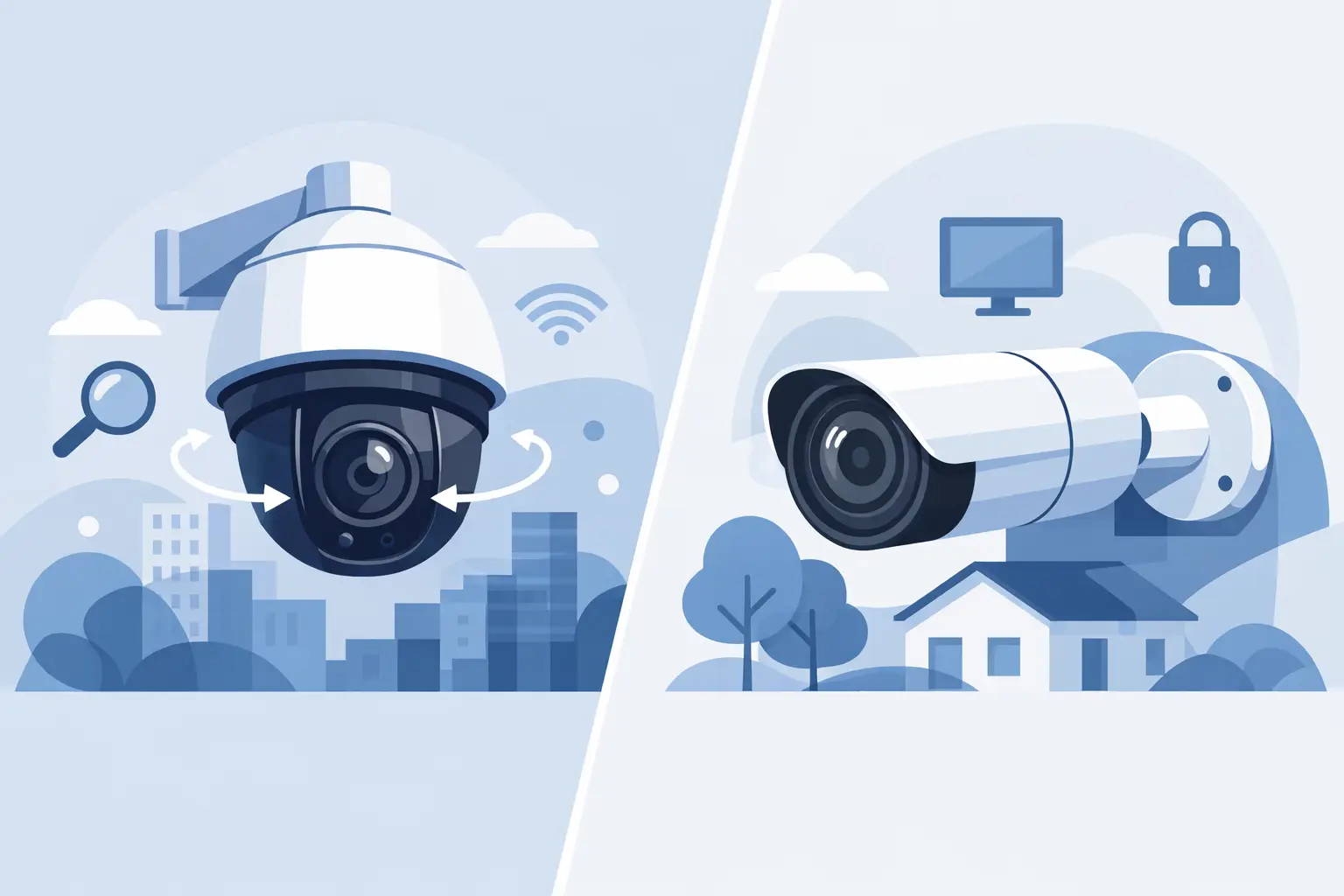
A fixed camera watches a defined scene all the time. It is set to cover a gate, berth, manifold, tank farm lane, perimeter stretch, or machinery area with continuous visibility. A PTZ camera can pan, tilt, and zoom on command or by preset, allowing operators to move the field of view and inspect details over a wider area.
That difference sounds simple, but it changes how incidents are detected and handled. Fixed cameras are excellent at constant observation. If something enters the frame, it is recorded. A PTZ camera gives active control and greater range, but it only records the direction it is facing at that moment. For a marine terminal, offshore platform, refinery, or power station, that trade-off has real consequences.
Where fixed cameras lead
Fixed cameras are the backbone of most serious surveillance deployments because they deliver consistent coverage. If you need uninterrupted recording of a fence line, loading bay, pump station, or engine room access point, fixed cameras are hard to beat. They do one job all day, every day, without relying on an operator to point them in the right direction.
This matters in investigations. When a safety breach, unauthorized entry, or process event occurs, continuous recorded footage from a fixed viewpoint gives clean evidence. There is no question about whether the camera was looking elsewhere when the event happened.
Fixed cameras also simplify design. You know exactly what area each unit covers, which makes placement, storage calculation, and network planning more predictable. In industrial environments, that predictability supports faster rollout and fewer surprises during commissioning.
From a cost standpoint, fixed models often provide a lower per-camera entry point than PTZ units. They can also reduce maintenance complexity because there are fewer moving parts. On offshore structures, marine vessels, and exposed industrial yards, that can be a major advantage. Salt, vibration, wind, dust, and corrosive atmospheres punish mechanical systems over time.
There is a performance benefit too. Because a fixed camera is optimized for a single scene, image quality can be very strong for that target area. You can choose focal length and mounting position specifically for identification at a gate, overview at a berth, or monitoring at a hazardous process zone.
Where PTZ cameras earn their place
PTZ cameras bring flexibility that fixed cameras cannot match. In large open spaces, they allow operators to follow movement, inspect suspicious activity, zoom in on equipment condition, and verify alarms across a broad zone. That makes them valuable in ports, tank farms, offshore decks, substations, and long perimeter sectors.
A well-positioned PTZ can act like a force multiplier. Instead of sending personnel into a potentially hazardous area immediately, operators can assess the situation remotely. For industrial sites with safety-critical zones, that is not just convenient. It can reduce exposure and improve decision-making.
PTZ cameras are especially useful when incidents are dynamic. A vessel approaching a restricted marine area, a truck moving through a terminal, or a person crossing multiple perimeter zones may need tracking across distance. A fixed camera captures pieces of the movement. A PTZ can follow it in real time.
They are also effective when detail matters. Reading markings on equipment, confirming status at height, or zooming toward a suspected intrusion point is where PTZ systems justify their premium. In control rooms where operators are actively monitoring, PTZ capability provides immediate tactical value.
The trade-offs that buyers should weigh
The biggest mistake in the PTZ vs fixed cameras discussion is assuming one PTZ can replace multiple fixed cameras without compromise. It can cover more area visually, but not continuously in every direction. If the camera is looking north when something happens south, you do not have the same record.
That is why fixed cameras remain the safer choice for always-on evidence collection. They create a dependable visual audit trail. PTZ cameras are stronger for investigation, response support, and flexible viewing.
Cost needs a wider lens as well. PTZ units typically cost more to purchase and may require stronger mounts, more careful installation, and more rigorous maintenance planning. If operators will actively control them, your site also needs the right monitoring procedures and trained personnel. Without active use or intelligent presets, the value of PTZ can be underused.
Bandwidth and storage should be considered too. High-resolution PTZ streams with aggressive zoom and motion can place a different load on recording infrastructure than static fixed views. On remote industrial sites, offshore assets, or marine networks where connectivity is constrained, that affects system design.
Reliability is another factor. In punishing environments, simplicity has value. Fixed cameras generally present fewer mechanical failure points. PTZ models built for industrial use can be highly dependable, but environmental rating, housing quality, and service support become more important.
PTZ vs fixed cameras for common industrial scenarios
At a refinery, fixed cameras are typically the stronger choice for gate control, process unit access, loading points, and defined safety zones. PTZ cameras add value for perimeter oversight, flare area assessment, and remote visual checks across large operational spaces.
On offshore platforms, fixed units are often preferred in exposed positions where continuous monitoring and mechanical simplicity matter most. PTZ cameras can still play a key role in deck monitoring, crane support visibility, and event verification, provided the units are engineered for harsh marine conditions.
In ports and marine terminals, a mixed approach usually delivers the best return. Fixed cameras lock down gates, berth access, and traffic lanes. PTZ cameras oversee open water approaches, quayside activity, and wide operational zones where zoom and tracking improve situational awareness.
For power stations and substations, fixed cameras are ideal for perimeter sectors, control building entrances, and transformer areas where constant recording is essential. PTZ units are valuable for large yards and remote inspections where operators need to investigate alarms without dispatching staff immediately.
How to choose the right mix
The right buying decision starts with the operational goal, not the camera category. If the goal is continuous evidence, fixed is usually the lead choice. If the goal is active monitoring over a broad area, PTZ deserves serious attention.
Ask a more practical question: what must never be missed, and what must be investigated quickly? The first answer points toward fixed coverage. The second points toward PTZ support.
It also helps to divide your site into surveillance layers. Critical access points, compliance-sensitive areas, and safety zones usually need fixed cameras because coverage cannot drift. Wide buffer zones, open yards, waterfronts, and elevated assets often benefit from PTZ reach.
For many industrial buyers, the strongest commercial outcome comes from not overbuying PTZ. A smaller number of well-placed PTZ cameras, combined with strategically deployed fixed units, often produces better coverage and lower lifetime cost than trying to make one format do everything.
This is where engineering-led planning matters. Camera placement, lens selection, environmental protection, recording requirements, and remote access all need to align with the site risk profile. Revlight Security works in sectors where equipment failure and blind spots carry real operational cost, so the specification has to be right from the start.
Which one is better?
If you need a single answer, fixed cameras are usually the better foundation for industrial surveillance because they deliver constant, reliable coverage. If you need a complete answer, PTZ cameras are the better complement when your site also demands active tracking, long-range inspection, and rapid visual response.
The smart purchase is rarely PTZ or fixed. It is fixed where coverage must be guaranteed, PTZ where flexibility creates measurable operational value. Buy for the risk, the environment, and the response model you actually run, and your system will work harder for every dollar spent.
Before you compare prices, compare consequences. The best camera choice is the one that keeps the right scene visible when your team needs answers fast.
🛡️ Secure Your Home or Business Today
Protect your home, office, shop, or business with reliable CCTV security cameras. Explore our range of CCTV cameras and find the right security solution for your needs.
Explore CCTV Cameras ✉️ Email Us



 Singapore :
+65-6708-9302
Singapore :
+65-6708-9302