
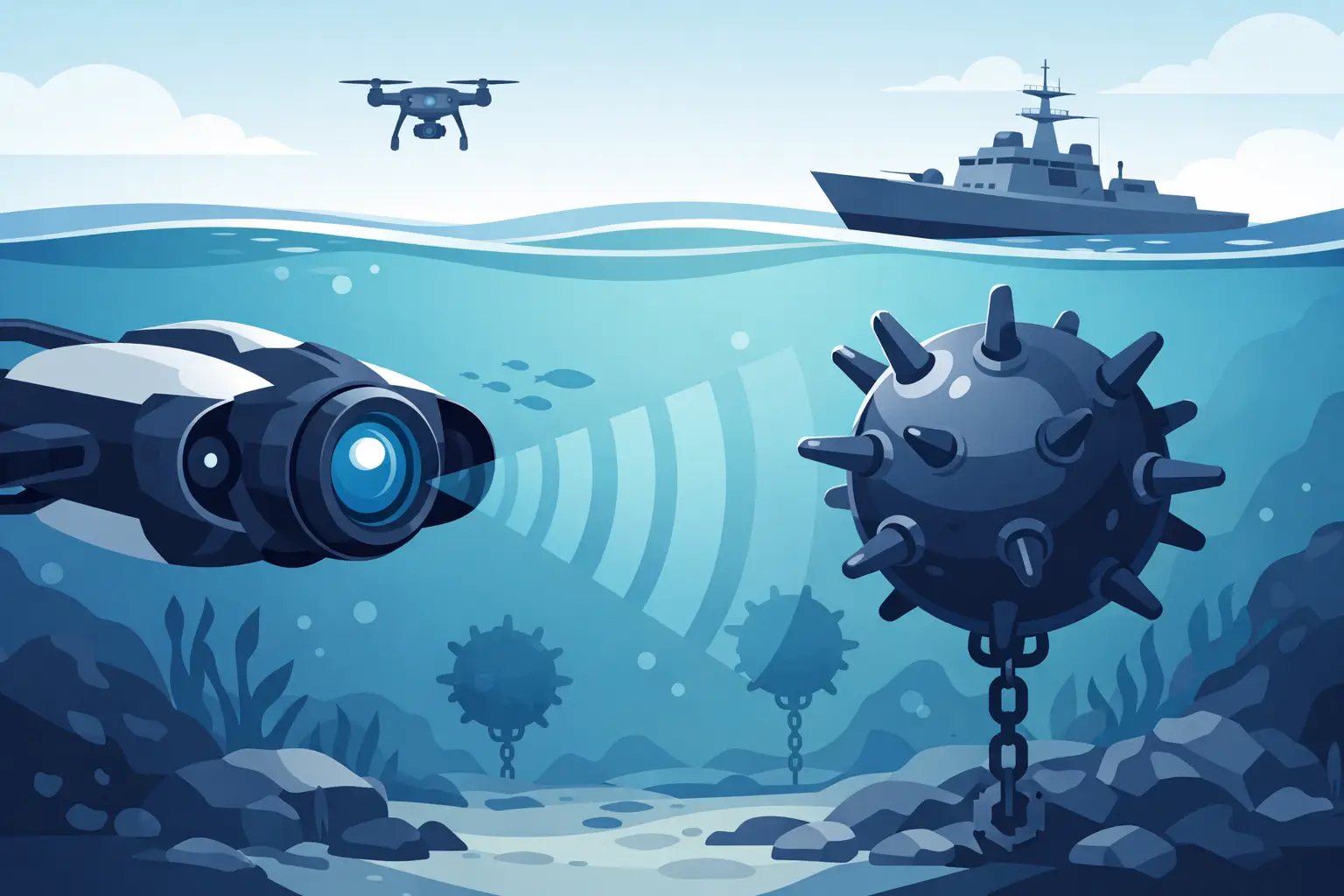
Mine risk offshore is not theoretical. It affects route clearance, subsea inspection planning, harbor access, and the safety of crews, vessels, and fixed assets. Choosing the right camera to detect underwater mines is less about buying a single device and more about specifying an imaging system that can perform in poor visibility, pressure, current, and low-light conditions without creating delays or false confidence.
For commercial buyers, the real question is straightforward: what kind of underwater visual system can support mine detection workflows with dependable results and manageable operating cost? That answer depends on water quality, deployment depth, platform type, and whether the camera is supporting divers, remotely operated vehicles, autonomous systems, or fixed subsea infrastructure.
What a camera to detect underwater mines actually needs to do
An underwater mine is rarely presented as a clean, obvious target. In real marine environments, objects are covered in growth, partially buried in silt, obscured by turbidity, and viewed at awkward angles. A camera system used in this setting must produce usable imagery in conditions that are far from ideal.
That starts with resolution, but resolution alone does not solve the problem. A high-definition sensor is valuable only when paired with the right optics, strong low-light sensitivity, controlled illumination, and stable transmission. Procurement teams that focus only on headline pixel count often end up with equipment that looks competitive on paper but struggles offshore.
A serious camera to detect underwater mines should help operators distinguish shape, surface texture, contour, and attachment features. In practice, that means the camera is serving confirmation and classification roles, often alongside sonar rather than replacing it. Sonar can identify anomalies over a wider area, while the camera provides the close visual detail needed to assess whether a target deserves escalation.
Why visual confirmation still matters
In subsea threat environments, visual confirmation reduces unnecessary intervention. Sending teams or equipment to inspect every sonar return is expensive and disruptive. When the imaging system is good enough to confirm whether an object is likely man-made, partially buried debris, or a genuine explosive hazard, operational decisions become faster and more accurate.
This matters in ports, offshore terminals, pipeline corridors, and around marine energy assets. A camera system that supports mine detection can shorten inspection cycles, improve incident documentation, and support remote review by command teams or security specialists. For operators managing uptime and vessel movement, that is a direct commercial benefit, not just a technical upgrade.
Key specifications buyers should prioritize
The strongest systems are engineered for underwater surveillance first and imaging quality second, not the other way around. That distinction matters because offshore reliability is usually the limiting factor.
Low-light and turbidity performance
Underwater light drops fast, and suspended particles make conditions worse. A camera intended for mine detection should perform in low ambient light and retain image clarity when backscatter becomes a problem. Wide dynamic range, strong sensor sensitivity, and carefully matched underwater lighting are essential.
The trade-off is that more lighting is not always better. Excessive illumination can reflect off particles and wash out the scene. In murky water, controlled beam angle and lamp placement often matter more than raw brightness.
Pressure rating and housing integrity
Depth rating must match the operating envelope with margin built in. Housings should be corrosion-resistant and suitable for long exposure to saltwater, pressure changes, and biofouling. In industrial settings, weak seals and connector failures create more downtime than sensor faults.
For procurement teams, this is where cost discipline matters. A lower-priced system can become the more expensive option if service intervals are short or if failures force vessel rescheduling.
Lens configuration and field of view
A wide field of view helps with general search work, but it can reduce target detail at distance. Narrower views improve inspection precision but slow coverage. The right choice depends on whether the camera is supporting search, confirmation, or close classification.
Many operators get better results from systems that can balance both modes through lens selection or platform movement. There is no universal best setting. The application defines the requirement.
Real-time transmission and recording
A camera to detect underwater mines is most valuable when live imagery can be viewed, recorded, and reviewed without signal instability. That requires dependable transmission over tethered systems or stable integration into the vehicle architecture. Recording quality matters for after-action review, compliance reporting, and security evidence.
For industrial buyers, playback and remote access are not luxury features. They are practical tools for decision support and documentation.
Camera-only detection is not the full answer
No technically honest supplier should present visual imaging as a standalone mine detection solution in every environment. In many search operations, sonar remains the primary detection tool because it covers larger areas and works better where visibility is poor. The camera becomes critical when the task shifts from broad-area detection to close inspection and confirmation.
That distinction helps buyers avoid the wrong investment. If the operational goal is wide-area seabed search across difficult water, a camera on its own will not deliver efficient coverage. If the goal is to confirm targets around assets, structures, hulls, berths, or subsea installations, then the right imaging package becomes highly effective.
The best commercial approach is a layered one: sonar for locating anomalies, underwater video for confirmation, and networked recording for command visibility. That structure supports better security outcomes and better budget control.
Deployment scenarios that shape the right choice
Harbor and port security
Ports need fast inspection around hulls, berths, pilings, and access channels. Here, the camera system must deal with murky water, marine growth, and frequent movement. Fixed underwater surveillance points may help monitor high-risk zones, while mobile vehicle-mounted cameras handle closer inspection.
Offshore platforms and subsea assets
Around offshore platforms, the challenge is usually structural complexity. Mines or suspicious objects may sit close to legs, moorings, risers, or seabed infrastructure. The camera must provide stable imagery in tight spaces and operate reliably under continuous industrial demand.
Vessel and hull inspection
Mine threats attached to hulls require close visual work. In this setting, image sharpness at short range, lighting control, and maneuverability matter more than broad search coverage. Buyers should prioritize systems that integrate cleanly with inspection vehicles and support clear recording for review ashore.
Integration matters more than many buyers expect
A high-spec camera can underperform if the full system is weak. Monitors, recording units, cable management, lighting arrays, control interfaces, and network compatibility all affect field performance. Commercial operators do not buy imaging in isolation. They buy uptime, evidence quality, and deployment confidence.
That is why engineering support and configuration guidance carry real value. A serious supplier should be able to discuss power requirements, housing material, connector type, depth range, transmission method, and maintenance expectations in practical terms. Revlight Security operates in exactly this performance-driven space, where underwater surveillance is treated as mission equipment rather than a catalog accessory.
Common buying mistakes
One common mistake is specifying for ideal water conditions. Clear water assumptions fail quickly in working ports and industrial marine zones. Another is overvaluing resolution while ignoring lighting geometry, housing quality, and transmission stability.
A third mistake is buying a camera without defining the actual mission. Search, confirmation, fixed monitoring, and vehicle-based inspection all place different demands on the system. Buyers who define the operating scenario first usually make better investments and avoid costly retrofits.
How to evaluate return on investment
For procurement managers and operations leaders, value comes from reduced risk, faster inspections, fewer false alarms, and better operational continuity. A capable underwater imaging system can reduce unnecessary diver exposure, support faster threat assessment, and minimize delays around berthing, asset access, or maintenance windows.
ROI also improves when the system is durable enough to stay in service with predictable maintenance. In industrial security, the cheapest purchase price rarely delivers the best lifecycle cost. Equipment that survives offshore conditions, records clearly, and integrates with existing monitoring infrastructure tends to pay back faster.
Choosing the right camera to detect underwater mines
The right camera to detect underwater mines is the one matched to your water conditions, operating depth, platform type, and inspection workflow. For close confirmation around ports, vessels, and offshore assets, strong low-light imaging, pressure-rated construction, stable live video, and properly designed illumination are the features that move the needle.
If your operation needs broad-area search, use visual imaging as part of a wider detection architecture rather than treating it as a standalone answer. Buyers who approach the problem this way usually get better security performance, fewer deployment issues, and a system that supports real operational decisions.
When the stakes include crew safety, asset protection, and uninterrupted marine operations, the best buying decision is not the most advertised unit. It is the system built to keep delivering when the water is dark, the conditions are poor, and the target is hard to verify.
🛡️ Secure Your Home or Business Today
Protect your home, office, shop, or business with reliable CCTV security cameras. Explore our range of CCTV cameras and find the right security solution for your needs.
Explore CCTV Cameras ✉️ Email Us

 Singapore :
+65-6708-9302
Singapore :
+65-6708-9302