
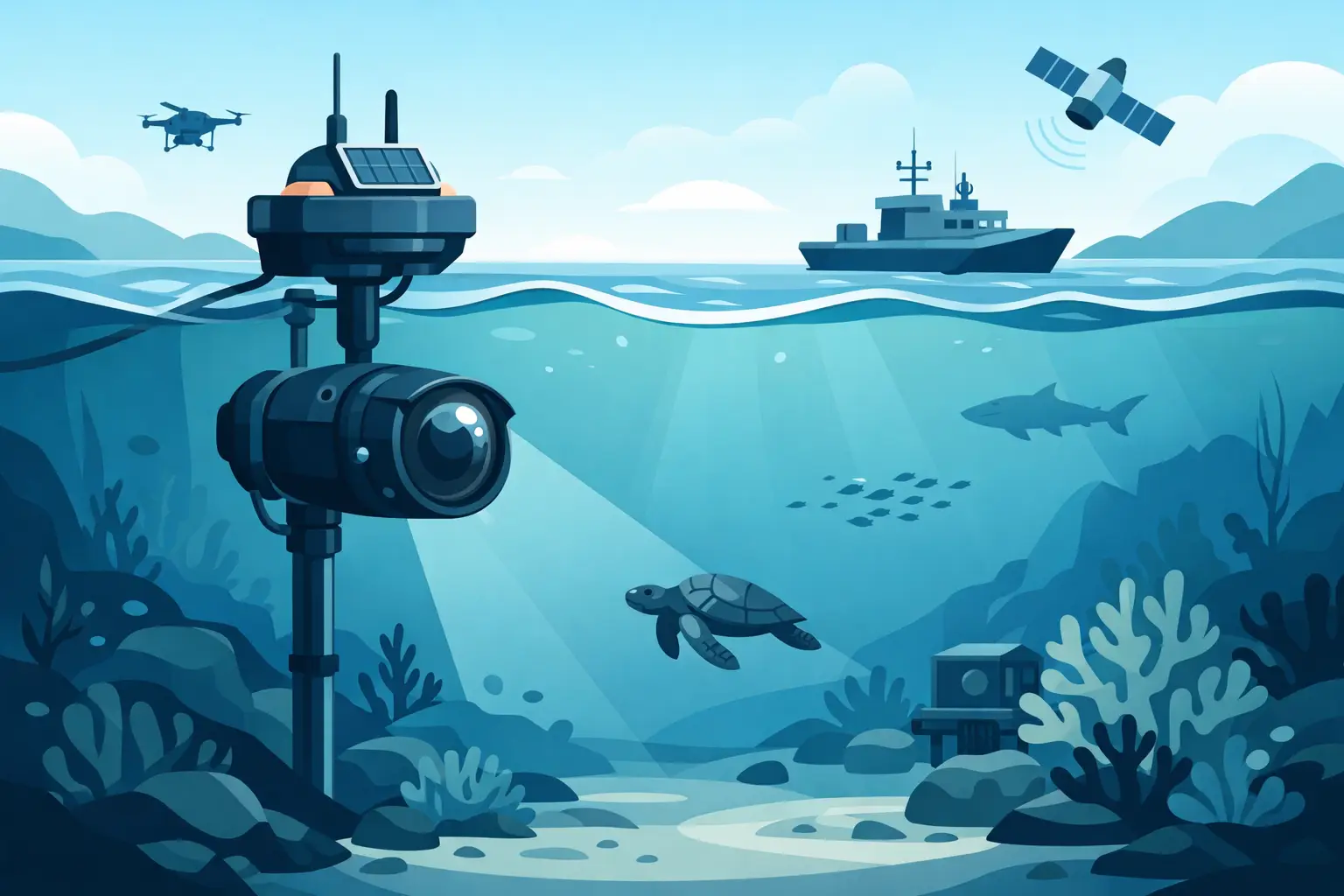
Saltwater, pressure, biofouling, and nonstop duty cycles ruin weak equipment fast. Choosing the best camera for long-term underwater monitoring is less about headline specs and more about survivability, image consistency, and network reliability over months or years in service.
For offshore operators, marine contractors, refineries with submerged assets, and industrial facilities managing critical water infrastructure, the buying decision is operational. A camera that performs for a week is not the same as one that delivers stable footage through changing visibility, marine growth, current, vibration, and limited maintenance windows. That distinction is where procurement teams either protect uptime or create recurring replacement costs.
What makes the best camera for long-term underwater monitoring?
The short answer is that the best system is the one designed for fixed deployment, not occasional submersion. In long-term monitoring, every component matters – the camera core, the pressure housing, connectors, cabling, power delivery, lighting, network path, and mounting arrangement.
A strong image sensor alone does not make a strong underwater monitoring system. In industrial use, reliability starts with corrosion resistance, ingress protection, pressure tolerance, and stable operation across temperature swings. If the housing material, seals, or penetrators are not rated for the site conditions, image quality becomes irrelevant because the camera will fail before it returns value.
The right specification also depends on what you need to observe. Inspecting quay walls, risers, cooling water intakes, submerged hull areas, or offshore structures each calls for a different optical approach. Some deployments need a wide field of view to monitor broad structural zones. Others need tighter optics to capture detail at a set distance. The best camera is not the one with the longest feature sheet. It is the one matched to your actual monitoring objective.
Fixed underwater monitoring is an engineering decision
Procurement teams often start with resolution, and that is understandable. Clear footage matters. But in long-term deployments, image quality is only one part of the commercial picture.
If your camera requires frequent retrieval for cleaning, seal checks, or restarts, the labor cost quickly overtakes the purchase price. Vessel time, diver support, crane access, and offshore work permits turn a low-cost camera into an expensive asset. That is why the best camera for long-term underwater monitoring usually comes from a system-first approach. Buyers should evaluate total deployment cost, maintenance interval, expected service life, and compatibility with existing video and network infrastructure.
This is especially true in oil and gas, power generation, and heavy marine operations where downtime has a direct financial impact. A dependable subsea camera system supports condition monitoring, security, environmental observation, and inspection planning. A poor one adds uncertainty where operators need proof.
Housing and materials matter more than most buyers expect
Underwater monitoring fails at the enclosure level more often than buyers like to admit. Marine-grade stainless steel, titanium, and specialist alloys can all be suitable, but the right choice depends on depth, salinity, galvanic exposure, and expected deployment duration.
Shallow harbor installations may tolerate one housing design, while deeper offshore projects require a much higher pressure rating and more conservative materials selection. Acrylic viewing ports can work in some conditions, while tougher alternatives may be better where scratching, sediment, or impact risk is higher. The point is simple: material selection should follow the site, not the catalog.
Cable entry is another weak point. Long-term installations need proven subsea connectors or hard-wired penetrations designed for the intended depth and maintenance strategy. A strong camera body with a weak connector is still a weak system.
Low-light performance is usually more valuable than extreme resolution
Water absorbs light quickly. Add suspended particles, nighttime operation, shaded structures, or depth, and imaging gets difficult fast. For that reason, low-light performance often delivers more operational value than chasing maximum resolution.
A camera with a well-tuned sensor, good dynamic range, and appropriate underwater lighting can outperform a higher-resolution unit that struggles in real conditions. Overly aggressive lighting can also create backscatter in turbid water, reducing usable detail. Buyers should ask how the camera performs with the site’s expected water clarity, not just how many pixels it can produce in ideal conditions.
For monitoring fixed assets over time, consistency beats peak performance. Operators need repeatable views that support comparison, fault detection, and evidence capture. That favors balanced imaging over specification extremes.
Power, data, and remote access decide long-term value
In many projects, the underwater camera gets the most attention while the transmission path gets too little. That is a mistake. A camera is only useful when operators can reliably access footage, review recordings, and integrate live views into the wider security or inspection workflow.
For industrial sites, the best camera for long-term underwater monitoring should fit into a dependable power and communications architecture. That may include Ethernet-based systems, fiber backbones, offshore network links, recording servers, or integration with control room displays. The exact setup depends on distance, bandwidth, and site risk profile.
Remote access is not just a convenience feature. It reduces unnecessary site visits and gives operations teams immediate visual confirmation when alarms, anomalies, or environmental events occur. Recording and playback are equally important. Long-term monitoring loses value if footage cannot be stored, retrieved, and reviewed without friction.
This is where experienced surveillance suppliers stand apart. The camera should never be treated as an isolated device. It should be part of a complete monitoring platform built for continuous industrial use.
Biofouling is the hidden cost in underwater monitoring
Many buyers focus on pressure rating and forget marine growth. In long-term submerged deployment, barnacles, algae, and biofilm can obscure the viewing window and reduce image value long before the electronics fail.
That does not mean every site needs the same anti-fouling strategy. Some installations can support scheduled cleaning based on easy access. Others need protective coatings, wipers, or mechanical design choices that reduce buildup on critical surfaces. Water temperature, nutrient levels, and current all influence fouling rates.
Ignoring this issue creates predictable service problems. Planning for it extends useful image life and improves return on investment. For operators managing offshore platforms, ports, ship assets, or intake structures, this is not a minor detail. It is a maintenance budget issue.
The best camera depends on the monitoring job
There is no single winner for every site. A nearshore security deployment watching submerged perimeter zones has different priorities from a deep fixed inspection point on offshore infrastructure.
If your main goal is asset condition monitoring, you may prioritize stable optics, fixed viewing geometry, and strong low-light performance. If the task is environmental compliance or debris tracking near intake systems, a broader field of view and dependable recording may matter more. If the site is remote and access is expensive, service interval and component reliability move to the top of the list.
That is why experienced buyers ask better questions. How long will the system stay deployed without retrieval? What visibility range is realistic in this water? What is the required evidence quality for maintenance or incident review? How will the video reach operators, and where will it be stored? Those answers define the right purchase.
How to evaluate suppliers for long-term underwater systems
A serious supplier should be able to discuss deployment depth, cable lengths, mounting options, corrosion exposure, lighting design, recording setup, and maintenance expectations without defaulting to generic product claims.
Buyers should also expect clarity on lead times, spares, compatibility, and support. Long-term underwater monitoring is not the place for vague specifications or lightly adapted equipment. Industrial users need top-of-the-line offers backed by application knowledge and practical system design.
Commercially, the strongest option is often the supplier that helps reduce lifecycle cost rather than simply offering the lowest entry price. That means fewer recoveries, fewer failures, easier integration, and cleaner footage over a longer operating window. For many marine and energy operators, that difference is what separates a purchase from a solution.
Revlight Security serves this market with an engineering-led focus on dependable surveillance infrastructure for marine and industrial environments. That matters when the camera is not just another device, but part of a wider security and operational monitoring system.
Final buying view on the best camera for long-term underwater monitoring
The best camera for long-term underwater monitoring is the one built for fixed industrial duty, matched to your depth, water conditions, maintenance access, and network architecture. Buyers who treat it as a complete surveillance system, not a standalone unit, usually get better footage, longer service life, and lower total cost. If your site is critical, buy for uptime first and specifications second.
🛡️ Secure Your Home or Business Today
Protect your home, office, shop, or business with reliable CCTV security cameras. Explore our range of CCTV cameras and find the right security solution for your needs.
Explore CCTV Cameras ✉️ Email Us

 Singapore :
+65-6708-9302
Singapore :
+65-6708-9302