
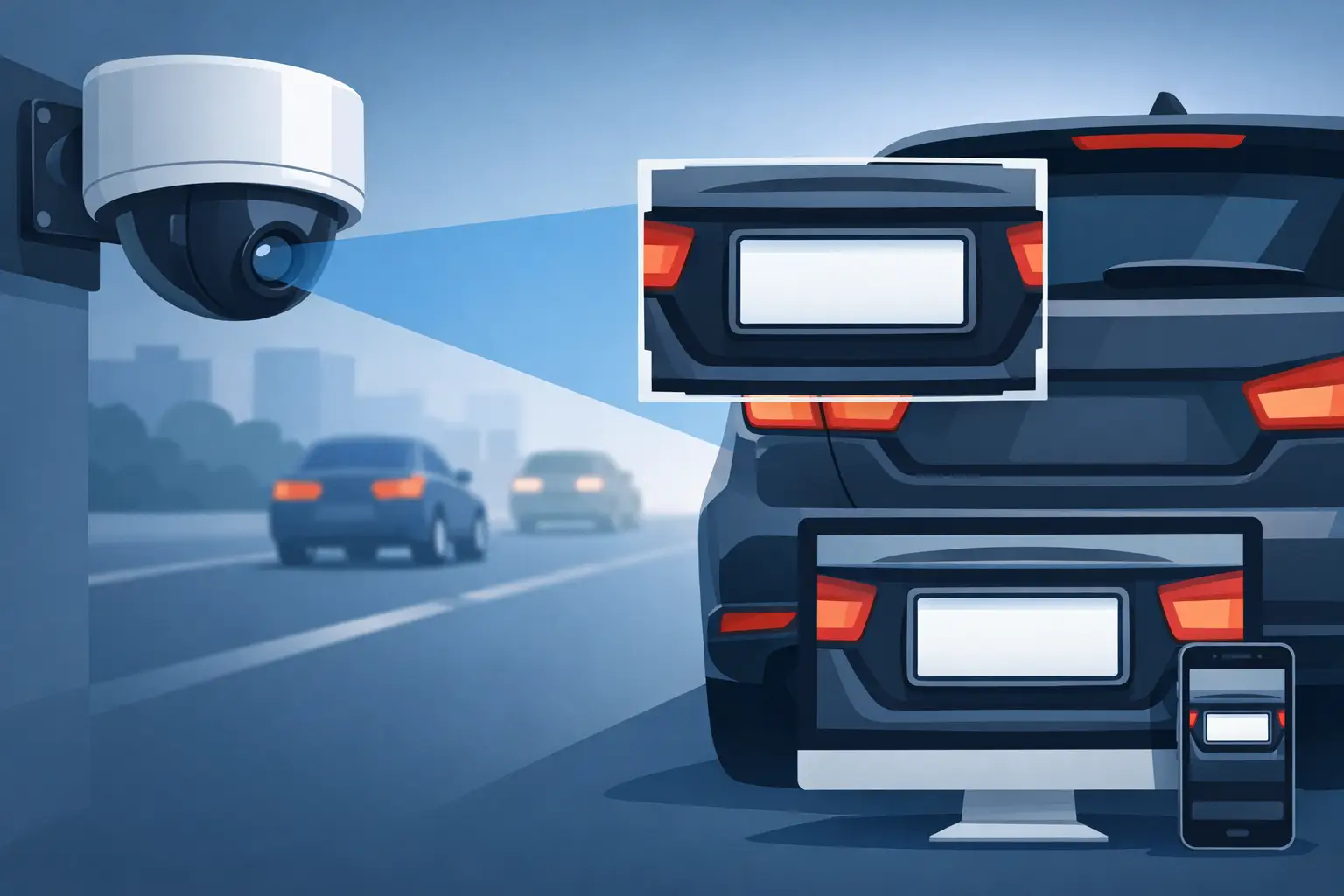
A truck rolls through a refinery gate at 18 mph, headlights flaring into the lens, and the question becomes immediate: can security cameras read plates well enough to support access control, incident review, or an insurance claim? The short answer is yes – but only when the camera, lens, angle, lighting, and recording settings are designed for license plate capture rather than general surveillance.
That distinction matters. Many sites assume a standard perimeter camera will also deliver readable plates. In practice, a camera that gives a good overall scene often fails when you need a sharp plate image at night, in rain, or on a moving vehicle. For industrial sites, ports, power facilities, and marine environments, that gap can turn into a security failure.
Can security cameras read plates in real-world conditions?
They can, but not every camera can do it consistently. Reading a license plate is a specialized task. Plates are small, reflective, and usually moving through a scene faster than a person on foot. Add glare, poor angles, vibration, long stand-off distances, or low light, and image quality drops fast.
A standard fixed camera may identify vehicle type, color, and direction of travel. That is useful, but it is not the same as plate recognition. If your requirement is to document vehicle access, verify contractor arrivals, investigate fuel theft, or support a security event, you need a setup tuned for plate detail.
For commercial buyers, the right question is not simply can security cameras read plates. It is under what conditions, at what distance, at what speed, and with what success rate. Those details determine whether the system is fit for operational use or just another camera feed that looks good until you need evidence.
What actually makes a plate readable
Plate capture depends on pixel density first. If the plate occupies too few pixels in the image, no amount of software will recover the missing detail. This is why wide-angle views across large yards rarely produce useful plate images. The scene may look comprehensive, but the plate itself is too small.
Lens choice is just as important. A tighter field of view places more image detail on the plate area. In industrial layouts, this often means dedicating one camera to overview coverage and another to plate capture at the choke point. Trying to make one camera do both jobs usually creates a compromise that does neither well.
Shutter speed also plays a major role. Moving vehicles introduce motion blur, especially at gates, service roads, and loading areas. A faster shutter can freeze the plate, but it also reduces available light. That means the camera needs enough sensor performance and controlled illumination to maintain image clarity.
Then there is contrast. Reflective license plates can blow out under headlights or direct infrared if the exposure is not managed correctly. This is one of the most common reasons plates appear as bright white rectangles at night. The camera may still be recording, but the image is not usable.
Why general surveillance cameras often miss the plate
A lot of installations are designed for deterrence and broad visibility. That is appropriate for perimeter awareness, berth activity, yard operations, and entry monitoring. But those objectives differ from plate capture.
General-purpose cameras are often mounted too high, too far away, or at too steep an angle. They may be set to cover multiple lanes, wide aprons, or large vehicle maneuvering areas. That creates situational awareness, not identification-grade detail.
Compression settings can hurt performance too. If storage policies are aggressive, fine plate detail gets softened or lost. Frame rate matters as well. Lower frame rates may be acceptable for static scenes, but they increase the chance of missing the exact moment when a moving plate is most readable.
For buyers comparing systems, this is where product specification and deployment planning have to align. A camera advertised as high resolution is not automatically a license plate solution. Resolution helps, but the full chain matters – optics, placement, exposure, recording, and environment.
Can security cameras read plates at night?
Yes, but nighttime is where weak designs get exposed. Plate capture after dark requires control over lighting and reflection. Headlights, wet pavement, fog, and darkness all work against clean imaging.
Infrared can help, but it must be balanced carefully. Too much reflected IR from a plate surface can wash out the numbers. Too little, and the plate lacks detail. In some locations, dedicated illumination and carefully tuned exposure settings outperform a basic built-in night mode.
Industrial and marine sites add more complications. Salt air, mist, spray, dust, vibration, and long cable runs can reduce image quality or stability over time. If a system is installed in these environments, hardware durability is not optional. The camera housing, lens protection, mounting strength, and network reliability all affect whether the plate remains readable month after month.
Placement is where performance is won or lost
If the camera is too high, the plate angle becomes shallow and characters distort. If the angle is too wide from the side, the plate stretches and becomes harder to read. If the vehicle path allows too much speed variation, capture consistency drops.
The best results usually come from controlling the scene. Place the camera at a known approach point. Limit the lane width. Reduce the vehicle speed if operationally possible. Keep the capture distance realistic. In high-value facilities, a dedicated entry setup with one overview camera and one plate-focused camera is often the strongest commercial choice.
This matters for procurement because it affects system count and budget. One premium camera in the correct position can outperform several badly placed units. Buyers often save money by narrowing the operational requirement and specifying the right equipment at the access point rather than overbuilding broad coverage and still missing the plate.
Software can help, but it cannot fix bad images
Automatic license plate recognition software is useful when the image quality is already strong. It speeds up vehicle logging, access validation, watchlist alerts, and event search. For large industrial sites, that can improve gate throughput and reduce manual review time.
But software is not a substitute for image capture. If the plate is blurred, overexposed, too small, or blocked by dirt and weather, recognition accuracy falls. That is why serious deployments start with optics and scene design, then layer analytics on top.
For operations teams, this has a practical implication. If you need court-defensible evidence or reliable access records, ask first for sample images from a similar environment, not just a software demonstration. Real performance in your conditions matters more than a polished feature list.
Where plate capture delivers the most value
In industrial security, readable plates support more than perimeter monitoring. They help document contractor access, verify delivery vehicles, investigate unauthorized entry, and cross-check incident timelines. At ports and marine terminals, they can strengthen gate control and support chain-of-custody procedures. At energy and chemical facilities, they add another identification layer where site access has operational and safety consequences.
This is also where a commercially focused system earns its keep. A camera that reads plates consistently can reduce guard workload, improve audit trails, and shorten investigations. The value is not just in recording an event. It is in giving operations teams usable evidence quickly.
For organizations managing multiple locations, standardizing the capture approach can also simplify system expansion. Once the right lane design, camera specification, and recording settings are proven, replication becomes faster and more cost-effective.
What buyers should ask before specifying a system
The first question is operational: do you need to read plates live, review them later, or automate recognition? Each use case drives different performance requirements.
The next is environmental: what happens at night, in rain, in glare, in spray, or with dirty vehicles? Industrial buyers should push suppliers on these scenarios because they are where many installations fail.
Then ask about vehicle speed, lane width, stand-off distance, and mounting height. These are not secondary details. They determine whether the system will perform as promised. A serious supplier should be able to explain the trade-offs clearly and recommend a capture design based on your traffic flow and site constraints.
This is where an engineering-backed provider adds value. Revlight Security works in demanding surveillance environments where performance under pressure matters more than brochure claims. For facilities that need dependable results, that practical mindset is the difference between a camera system and a security solution.
So, can security cameras read plates? Yes – when plate capture is treated as a specific operational requirement, not an assumed extra. If you want reliable results, build the system around the plate, the lane, and the environment, and the footage will work when the decision, dispute, or incident lands on your desk.
🛡️ Secure Your Home or Business Today
Protect your home, office, shop, or business with reliable CCTV security cameras. Explore our range of CCTV cameras and find the right security solution for your needs.
Explore CCTV Cameras ✉️ Email Us


 Singapore :
+65-6708-9302
Singapore :
+65-6708-9302