
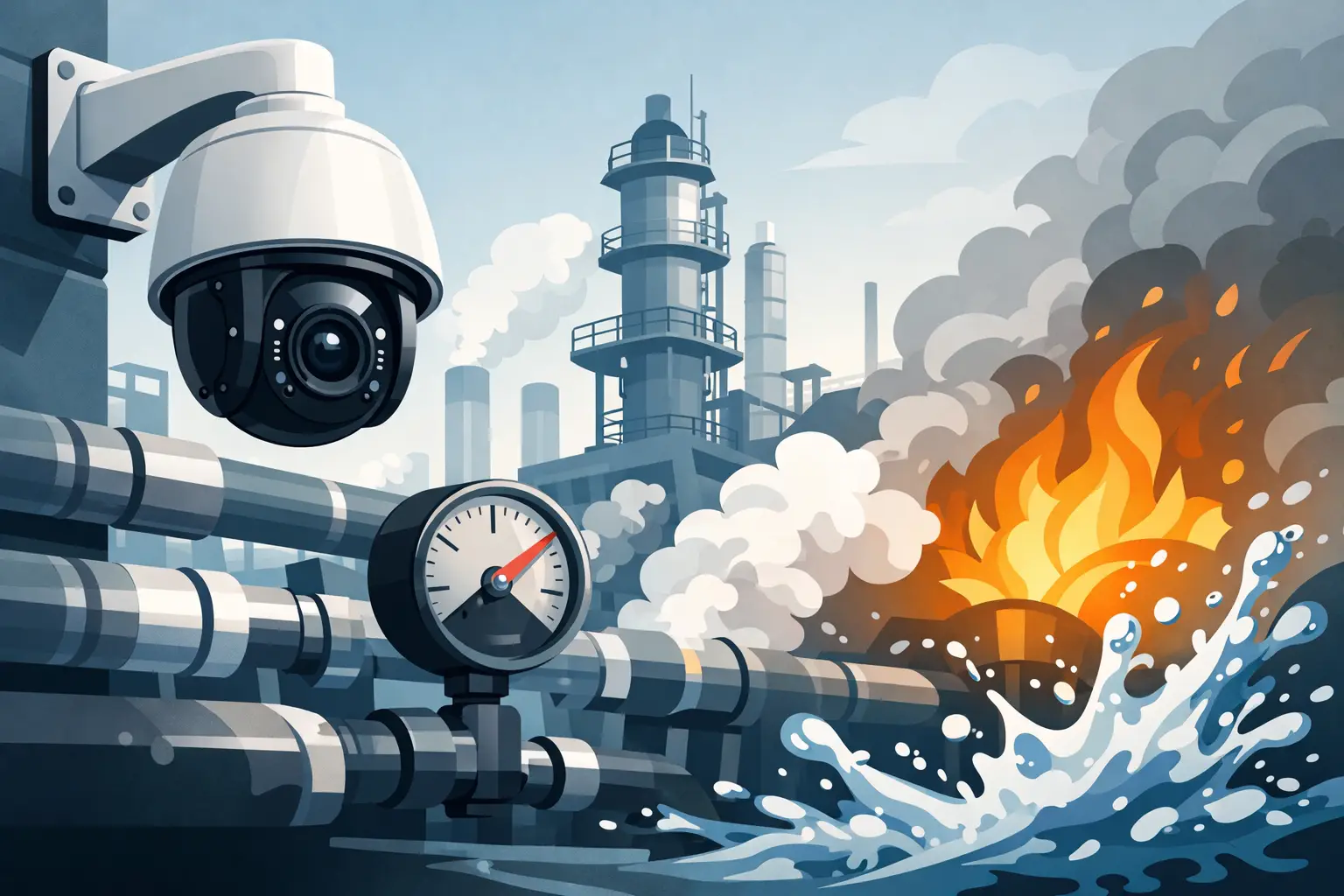
A camera that works perfectly in a clean warehouse can fail quickly on a refinery unit, offshore deck, or power station perimeter. Industrial CCTV is built for the conditions that stop ordinary surveillance systems: corrosive salt spray, hazardous gases, vibration, extreme heat, low light, long cable routes, and sites where a missed event can become an operational, environmental, or safety issue.
For procurement teams and operations leaders, the objective is not simply to add more cameras. It is to install a surveillance architecture that gives operators usable visual evidence, supports incident response, protects critical assets, and remains serviceable over its operating life. The best system is the one that delivers clear images when conditions are poor and decisions have to be made quickly.
What Makes Industrial CCTV Different?
Industrial CCTV is engineered around operational risk rather than consumer convenience. Its cameras, housings, network components, recording platforms, and control-room interfaces must function as a complete system in environments that are often remote, regulated, and difficult to access.
At an oil and gas facility, that may mean explosion-protected equipment installed in classified zones. On a vessel, it can mean marine-grade housings that resist corrosion and remain stable under constant movement. At a chemical plant or power station, the priority may be thermal monitoring, long-range perimeter coverage, or clear identification at gates, substations, and process areas.
This is why specification matters. A low initial equipment cost can become expensive when a camera requires repeated replacement, produces unusable footage at night, or cannot integrate with the existing network and recording platform. Industrial buyers need performance data that relates directly to their operating environment.
Start With the Operational Problem, Not the Camera Count
A camera schedule should follow the site risk assessment. Before selecting lenses, housings, or recorders, define what personnel need to see, detect, verify, and investigate.
For example, a loading berth may require broad situational coverage alongside close views of transfer connections and access points. A refinery tank farm may need perimeter detection, gate identification, and monitoring of high-consequence valves or manifolds. An offshore platform may require visual oversight of landing areas, crane activity, sea-facing assets, and equipment below the waterline.
Each requirement has a different imaging demand. Detecting that a person is present at a distant perimeter is not the same as identifying that person. Monitoring a process condition is different again from collecting evidence suitable for a post-incident review. A professional design separates these tasks instead of expecting one camera position to do everything.
Coverage Is Not the Same as Useful Detail
Wide-angle coverage gives operators context, but it can reduce detail over distance. Telephoto views provide identification capability, yet they cover a narrower scene and can be affected by vibration, heat haze, fog, or vessel movement. Pan-tilt-zoom units provide active inspection capability, but they should not be treated as a replacement for fixed coverage because they can only look in one direction at a time.
The strongest installations use the right combination: fixed cameras for continuous observation, specialized long-range or low-light imaging where distance demands it, and controllable units where operators need to inspect changing activity. Placement, lens selection, mounting height, lighting, and network capacity should be assessed as one decision.
Specify for the Environment
Industrial environments are unforgiving. Equipment must be selected for the actual exposure, not the best-case weather forecast or the conditions inside a control room.
For marine and offshore sites, corrosion resistance is central. Saltwater exposure, wind-driven spray, humidity, and UV degradation can compromise connectors, housings, mounts, and cable entries. Marine-rated materials, properly sealed glands, appropriate ingress protection, and planned maintenance access protect the investment.
Hazardous-area applications demand another level of discipline. Equipment installed where flammable gases, vapors, dust, or combustible materials may be present must meet the required area classification and certification standard for that location. The camera is only one part of the compliance picture. Mounting hardware, cable systems, power arrangements, and installation practices must also support a safe, approved deployment.
Temperature is equally important. A housing that performs well in a moderate climate may struggle in desert heat, arctic cold, or near high-temperature process equipment. Heaters, blowers, sunshields, wipers, and environmental enclosures can improve uptime, but they also add power, maintenance, and integration requirements. The right solution depends on the site, not a generic product checklist.
Build Detection Into the Surveillance Strategy
Video is highly valuable, but it becomes more powerful when paired with event detection. A camera can show what happened. Detection technology can help identify where attention is needed before a developing issue becomes a major event.
For refinery, chemical, and gas-processing operations, specialized optical gas imaging can support visual detection of methane and certain hydrocarbon gas leaks. This technology is not a replacement for fixed gas detection, process instrumentation, or safety procedures. It is a high-value visual layer that can help teams locate emissions, investigate suspected releases, and improve inspection efficiency across complex assets.
Thermal imaging serves a different purpose. It can reveal heat patterns in darkness, smoke, haze, or challenging weather, making it useful for perimeter applications, equipment monitoring, and incident awareness. Thermal images do not provide the same identification detail as visible-light cameras, so a combined thermal and visible imaging strategy often delivers the best operational result.
Underwater surveillance is another specialist requirement. Offshore structures, ports, intake zones, hull areas, and subsea infrastructure can require visual access where conventional surface cameras provide no answer. Underwater systems must account for depth rating, water clarity, lighting, cable length, mounting method, pressure protection, and the practical need to retrieve or service equipment.
Network and Recording Design Determine Real Reliability
A high-performance camera is only as useful as the network and recording system behind it. Industrial sites commonly face long transmission distances, limited bandwidth, unreliable communications paths, and the need to connect several remote zones to a central control room.
A proper design considers power delivery, fiber or copper transmission, wireless links where suitable, network segmentation, switch capacity, cybersecurity, and failover. Marine WiFi and industrial network solutions can extend operational visibility across vessels, terminals, and dispersed facilities, but they must be engineered around interference, line of sight, physical obstructions, and changing weather conditions.
Recording capacity should be calculated from actual camera resolution, frame rate, compression settings, retention period, and event activity. Higher image quality consumes more storage and bandwidth. Reducing frame rate or increasing compression can save capacity, but it may also remove the detail needed during a fast-moving incident. There is no universal setting. Critical areas deserve the recording quality required to support investigation and operational review.
Remote access is equally valuable when it is controlled. Operations directors, vessel managers, and authorized security teams may need live views and playback from offsite locations. Role-based permissions, encrypted access, audit trails, secure passwords, and network separation help protect the surveillance system from becoming another point of exposure.
Plan for Maintenance Before Installation
The strongest industrial CCTV deployment includes a maintenance plan from day one. Cameras mounted high on structures, over water, in hazardous zones, or near continuous process equipment are not simple to reach. A poor mounting decision can turn a routine lens clean into a costly access operation.
Maintenance requirements vary by environment. Coastal and offshore cameras may need regular cleaning for salt deposits. Cameras near dusty processes may require inspection of windows and seals. Equipment exposed to vibration needs periodic checks of mounts and connections. Recording systems need health monitoring, storage review, firmware management, and tested recovery procedures.
This is where an experienced specialist supplier adds commercial value. Revlight Security supports industrial buyers with surveillance and detection solutions designed around demanding site conditions, not generic camera packages. The right partner should be able to discuss environmental ratings, coverage objectives, integration limits, lifecycle requirements, and the trade-offs behind each recommendation.
Questions That Improve an Industrial CCTV Specification
Before issuing a purchase order, decision-makers should be able to answer four practical questions. What specific risk or operational task does each camera address? Will the equipment survive its installed environment for the required lifecycle? Can the network and recording platform preserve usable footage at the needed quality? And can the system be safely maintained without disrupting production?
If those answers are unclear, more equipment is not the solution. A site survey, coverage plan, network assessment, and environmental review will usually prevent costly changes later. This approach also gives procurement teams a stronger basis for comparing quotations, because they can evaluate capabilities rather than simply comparing camera quantities.
Industrial surveillance earns its value during the difficult moments: a suspected release, an unauthorized approach, a transfer operation, a safety investigation, or a fault in an area personnel cannot immediately enter. Specify for that moment, install for the real environment, and demand footage and detection capability your team can act on.
🛡️ Secure Your Home or Business Today
Protect your home, office, shop, or business with reliable CCTV security cameras. Explore our range of CCTV cameras and find the right security solution for your needs.
Explore CCTV Cameras ✉️ Email Us

 Singapore :
+65-6708-9302
Singapore :
+65-6708-9302