
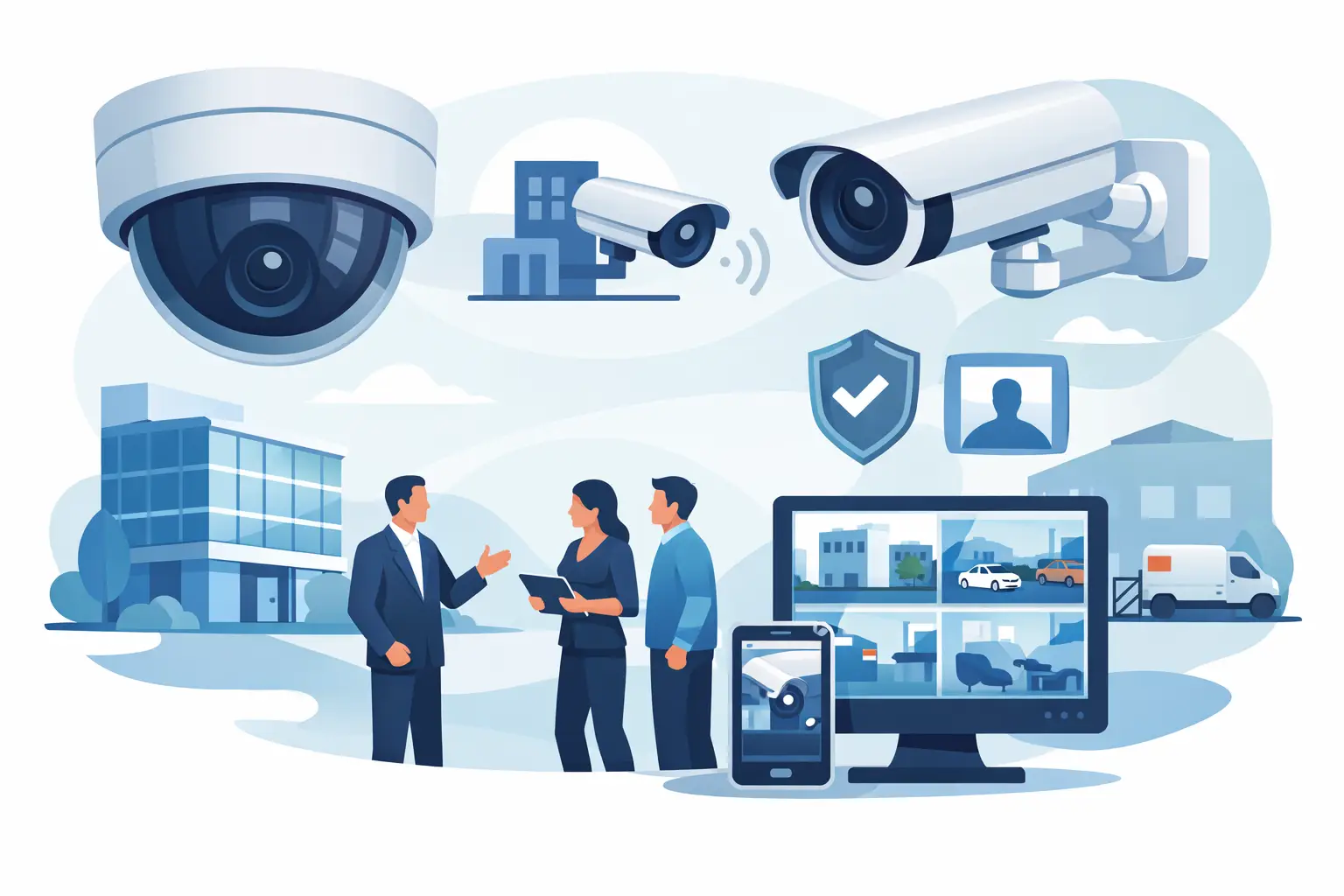
A refinery blind spot, a dark jetty approach, or a machinery deck with heavy vibration can turn a basic camera package into an expensive mistake. That is why knowing how to choose commercial CCTV systems starts with the site itself, not the catalog. For industrial buyers, marine operators, and plant managers, the right system is less about getting more cameras and more about getting dependable coverage where failure is not acceptable.
Commercial CCTV decisions usually break down when buyers treat every site like an office or retail store. Industrial and marine environments are different. Salt exposure, explosive atmospheres, heat, washdown, long cable runs, network constraints, and 24-hour operations all change what a camera system needs to do. A lower-cost setup may look competitive on paper, but if it cannot hold image quality, survive the environment, or support incident review, it will cost more in replacements, downtime, and missed evidence.
How to Choose Commercial CCTV Systems for Real Conditions
The first step is to define the operational purpose of the system. Some sites need perimeter deterrence. Others need evidential recording for investigations, process monitoring, vessel approach awareness, loading supervision, or remote visual verification before sending personnel into a hazardous zone. These are not the same job, and they should not be specified the same way.
A camera covering a gate from 200 feet away has different lens, resolution, and lighting requirements than a camera confirming valve activity in a process area. If your objective is too vague, such as “general coverage,” you will end up with wide images that show movement but not detail. Strong commercial systems are built around scene-by-scene intent. Ask what each camera must prove, who will view it, and how fast footage needs to be retrieved.
The next decision is environmental suitability. This is where many commercial buyers either protect the investment or shorten its life. Indoor-rated hardware has no place on offshore structures, exposed docks, tank farms, power stations, or washdown-heavy industrial lines. Housing material, ingress protection, anti-corrosion properties, heater and blower support, and temperature rating matter because they directly affect uptime.
In marine and energy settings, corrosion resistance is not a premium feature. It is a minimum requirement. The same applies to hazardous areas. If a location may involve flammable gas or combustible risk, the camera and enclosure specification must match the site classification. That choice is not optional, and it should never be treated as a late-stage accessory.
Camera Type, Placement, and Coverage Strategy
Choosing the right camera format is usually a balance between coverage area, image detail, and operating conditions. Fixed cameras are often the best value for consistent monitoring points because they stay focused on defined risk areas such as gates, manifolds, loading stations, corridors, stairwells, and access points. PTZ cameras add flexibility for large perimeters, jetties, decks, and yard spaces where operators may need to track movement live.
The trade-off is simple. PTZ cameras can look anywhere, but only one direction at a time. Fixed cameras never move away from the scene they are assigned to protect. In many industrial deployments, the best result comes from using fixed cameras for critical evidence positions and PTZ units for situational awareness across broader zones.
Placement matters as much as camera choice. A poorly mounted high-resolution camera will still underperform if it faces glare, vibration, direct spray, or constant backlight. Height also changes usefulness. Mounted too high, a camera may give excellent overview footage but poor facial or task detail. Mounted too low, it may be vulnerable to tampering, impact, or obstruction.
At this stage, buyers should think in layers. Cover the perimeter, cover the approach routes, cover the critical assets, and cover the operational pinch points. That produces stronger evidence than installing cameras only where mounting is easy.
Image Quality Is More Than Resolution
Resolution gets attention because it is easy to compare, but it is only one part of image performance. A 4MP or 8MP camera can still deliver weak footage if the lens is wrong, the scene is underlit, or compression is too aggressive. Industrial buyers should look at full image conditions: low-light performance, dynamic range for mixed bright and dark scenes, frame rate for moving vehicles or machinery, and the ability to maintain detail during playback.
This is especially important at facilities operating around the clock. Night performance often decides whether the system actually supports security investigations. Infrared can help, but it is not always enough in wide outdoor areas, reflective marine surfaces, or zones with smoke, steam, and mist. In these cases, additional lighting or specialized imaging options may be necessary.
Recording, Storage, and Retrieval
One of the most common specification gaps in commercial CCTV is storage planning. Buyers focus on camera count and forget retention time, recording mode, bitrate, and playback access. A system with 32 cameras recording continuously at high resolution will consume storage very differently from a 32-camera setup using event-based recording for low-traffic areas.
Retention targets should be set early. Some sites need 30 days, others 60 or 90, depending on compliance, insurance, operational review needs, and incident reporting timelines. Once retention is clear, the recorder and storage architecture can be sized properly. Undersized storage leads to overwritten footage before a claim, theft review, or safety event is even identified.
Retrieval speed matters too. If operators cannot quickly search by time, camera, event, or location, valuable footage becomes harder to use when pressure is high. Commercial CCTV should not only record. It should support fast review, export, and evidence handling without tying up operations.
Network and Remote Access Requirements
Modern industrial CCTV is often part of a wider networked infrastructure. That creates clear advantages, especially for multi-site operations, vessels, remote compounds, offshore assets, and unmanned facilities. Live viewing, remote playback, alarm verification, and centralized management can reduce travel, improve response time, and support leaner security staffing.
But remote access only works if the network can support it. Bandwidth limits, satellite links, marine communications, segmented OT and IT environments, and cybersecurity controls all affect design. A strong supplier will ask where footage is viewed, how many users access it, and whether remote video must be full-time or event-driven.
This is one area where cheaper systems often create hidden cost. They may offer remote viewing, but performance degrades badly under limited bandwidth, or integration becomes difficult once the site expands. Buyers planning for growth should make sure the system can scale in camera count, storage, and user management without a full replacement.
Reliability, Maintenance, and Whole-Life Cost
If you are comparing quotes, do not stop at upfront hardware pricing. The better commercial question is what the system will cost over its service life. A lower initial price can disappear quickly if cameras fail in harsh weather, housings corrode, connectors loosen under vibration, or replacement parts are difficult to source.
This is where engineered suitability has real commercial value. Equipment built for industrial duty typically reduces maintenance calls, premature failures, and avoidable outages. For operations with limited shutdown windows or offshore access restrictions, that difference is significant.
Service support also matters. Procurement teams should ask about commissioning, compatibility checks, spare availability, and post-installation support. The best service provider is not simply the one with stock on hand. It is the one that understands the risk profile of the site and supplies a system that performs under those exact conditions.
How to Evaluate a Supplier
If you want to know how to choose commercial CCTV systems with confidence, evaluate the supplier as closely as the product. A capable provider should be able to discuss hazardous areas, marine exposure, industrial networking, recording strategy, and environment-specific housing options without defaulting to generic package deals.
Look for specificity. Can they explain why one camera is better for a loading bay and another for a corrosive deck edge? Can they justify storage calculations? Can they advise on remote access for low-bandwidth sites? Those details separate a serious surveillance partner from a box mover.
At Revlight Security, this product-first, application-led approach is exactly what industrial buyers should expect. When the system is matched to the operating environment from the start, performance improves, replacement cycles are reduced, and the investment holds its value longer.
The right CCTV system should give your team more than video. It should give operations clearer visibility, security staff faster evidence, and management fewer weak points across the site. If the system fits the environment, the network, and the job each camera must do, you are not just buying coverage – you are buying working surveillance that stands up when it counts.
🛡️ Secure Your Home or Business Today
Protect your home, office, shop, or business with reliable CCTV security cameras. Explore our range of CCTV cameras and find the right security solution for your needs.
Explore CCTV Cameras ✉️ Email Us



 Singapore :
+65-6708-9302
Singapore :
+65-6708-9302