
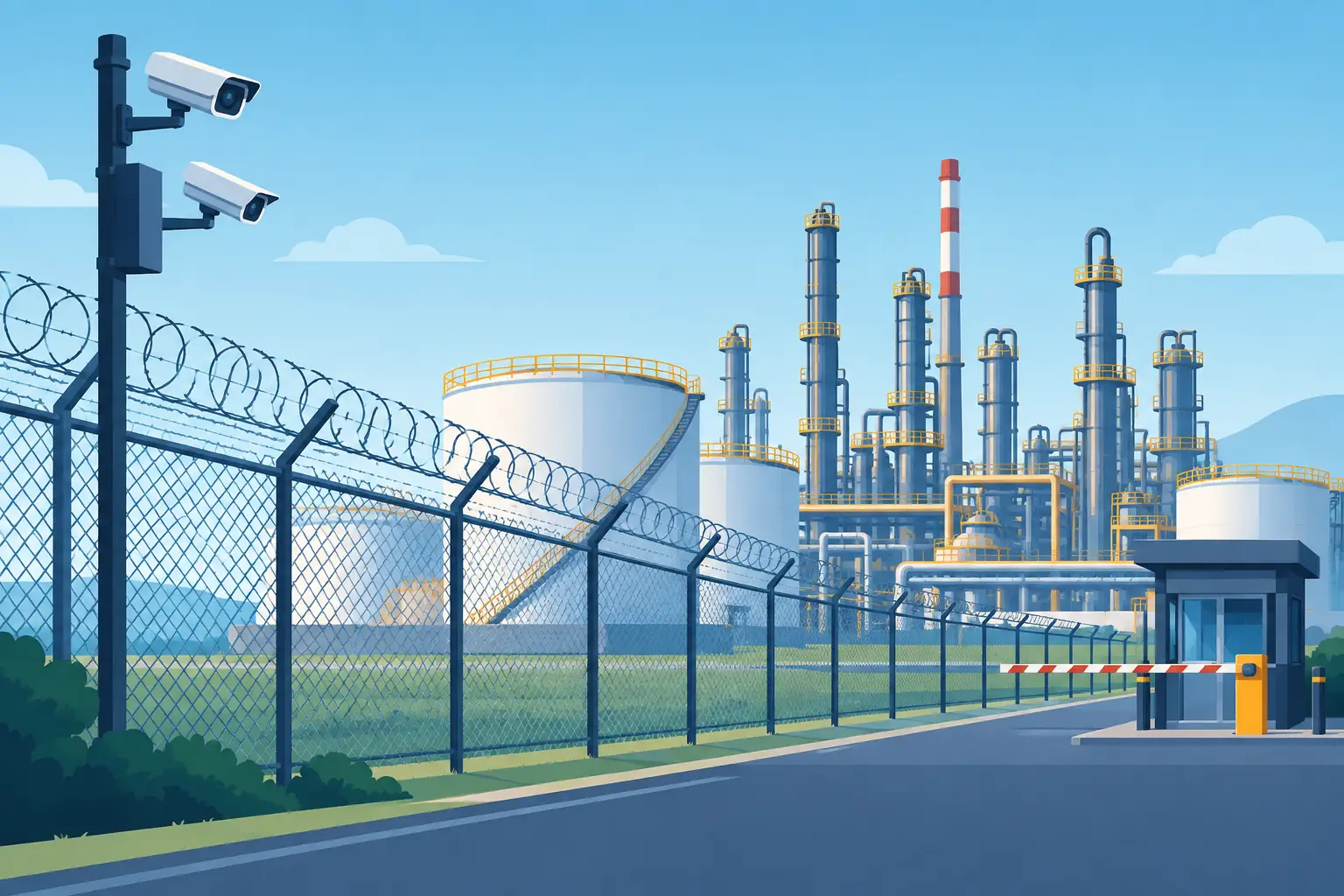
A refinery perimeter is not a fence line to be watched casually. It is the first controlled boundary around process units, tank farms, substations, pipelines, loading areas, and operational personnel. The best refinery perimeter security combines early detection, rapid verification, reliable communications, and a response process that works during heat, dust, rain, darkness, and network disruption.
For procurement and operations teams, the decision is not simply which camera or sensor to buy. The real question is how to create a layered system that identifies a genuine threat before it reaches a critical asset, without overloading the control room with nuisance alarms. That requires equipment selected for the site, engineered around the threat model, and supported by dependable recording and remote access.
What Makes Refinery Perimeter Security Effective?
The strongest perimeter systems are designed around time and distance. A detected intrusion at the outer boundary gives the security team time to assess video, notify site personnel, and direct a response. A system that only sees someone after they have crossed into a process area has already lost much of that advantage.
A well-designed deployment typically has four connected functions: detection, assessment, communication, and response. Detection devices identify movement or attempted entry. Surveillance equipment gives operators visual confirmation. The network moves video and alarm data to the right people. Procedures determine what happens next.
Each layer must be matched to the environment. A fence bordering an open desert, a waterfront terminal, and a refinery boundary beside a public roadway present very different challenges. The best solution is rarely one technology installed everywhere. It is a controlled combination of technologies deployed where each performs best.
Start With a Site-Specific Threat Assessment
Before specifying equipment, define what the perimeter must detect. Unauthorized access is only one concern. Refineries may also need to address theft, sabotage, vandalism, tampering at remote infrastructure, vehicle approach, drone activity, and access through waterfront or pipeline corridors.
The assessment should account for terrain, fence construction, lighting, vegetation, weather patterns, nearby public activity, and available response time. It should also identify high-consequence zones. A remote service gate may need a different level of coverage than a tank farm, control building, utility corridor, or product loading rack.
False alarms deserve the same attention as detection range. Loose fencing, blowing vegetation, wildlife, standing water, vehicle headlights, and thermal variation can undermine a poorly selected system. If operators stop trusting alerts, even premium equipment loses value. The objective is high-probability detection with alarms that can be quickly verified.
Best Refinery Perimeter Security Uses Layered Detection
Fence-mounted detection can be highly effective where the physical boundary is stable and access points are clearly defined. Vibration-based systems can identify climbing, cutting, lifting, or force applied to a fence, while buried or fence-line sensing can protect longer stretches that are difficult to patrol. These systems should be calibrated to distinguish credible activity from normal environmental movement.
For open areas, radar detection provides wide-area coverage and can track people or vehicles before they reach the fence. Radar is particularly valuable where lighting is limited or visual conditions change throughout the day. It can also cue pan-tilt-zoom surveillance systems toward the source of an alarm, reducing the time needed for operator assessment.
Thermal surveillance adds another critical layer. Unlike conventional visible-light imaging, thermal systems detect heat contrast and remain effective when there is no ambient light. They are well suited to long fence lines, undeveloped property edges, and areas where glare, haze, or inconsistent lighting affects standard video performance. Thermal imaging is not a replacement for all surveillance, however. Operators often need visible-light detail to identify clothing, vehicles, markings, or activity after a thermal alert.
Video analytics can improve coverage when applied carefully. Rules such as line crossing, intrusion zones, loitering, direction of travel, and vehicle classification help security teams focus on meaningful events. Analytics need proper camera placement, stable mounting, a realistic field of view, and testing against actual site conditions. An analytic configured from a desk without field validation is likely to create unnecessary alarms.
Cover Gates and Vehicle Approaches Differently
Vehicle gates are high-traffic areas, not simple gaps in a fence. They need positive access control, clear surveillance of drivers and passengers, coverage of approach lanes, and recording that supports investigations. License plate recognition may be appropriate where vehicle flow and lighting allow it, but it should be treated as one layer in a controlled entry process rather than the sole decision point.
Barrier status, gate position, intercom activity, badge events, and surveillance should be brought together in the security workflow. When an alarm occurs at a gate, operators need to see what happened, not search through separate systems while a vehicle waits at the entry point.
Surveillance Equipment Must Survive Industrial Conditions
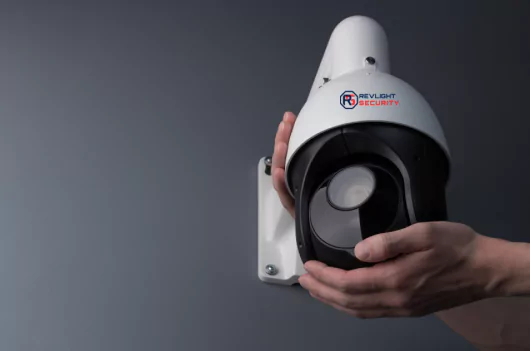
Refineries place unusual demands on surveillance hardware. Equipment may be exposed to corrosive atmospheres, extreme temperature swings, vibration, wind, airborne contaminants, washdown, and electromagnetic interference. In certain locations, hazardous-area requirements will dictate the enclosure, certification, mounting method, cable entry, and power design.
Selecting a device based only on resolution is a common procurement error. A high-resolution unit that cannot maintain a clear image in heat, rain, or contamination does not provide dependable security. Buyers should examine environmental ratings, lens selection, low-light or thermal performance, housing materials, ingress protection, maintenance access, and integration capability.
Placement matters just as much as specification. Cameras positioned too high may provide wide coverage but poor identification detail. Units mounted too low are vulnerable to tampering and may suffer from vehicle glare or obstructions. A professional design calculates detection, recognition, and identification needs for each zone rather than applying one mounting height across the entire facility.
For process-adjacent areas, surveillance can also support operational awareness. The same infrastructure may assist with monitoring restricted work zones, observing perimeter-adjacent equipment, and verifying abnormal activity during an incident. Security and operations should coordinate early so coverage supports the wider facility without compromising either mission.
Build the Network for Continuity, Not Convenience
Perimeter security is only as effective as the network carrying alarms and video. Long refinery boundaries often require a mix of fiber, industrial wireless links, managed switches, and protected network cabinets. The correct design depends on distance, line of sight, bandwidth demand, power availability, and the consequences of a communications failure.
Fiber is usually the preferred backbone for high-bandwidth, long-distance video transport where installation is practical. Industrial wireless can extend coverage to remote zones, temporary work areas, or locations where trenching is costly. It must be engineered for interference, throughput, antenna alignment, weather exposure, and redundancy. Consumer-grade network equipment is not a serious option for a high-consequence industrial perimeter.
Recording architecture also needs deliberate planning. Local recording can preserve evidence when a link is interrupted, while centralized recording simplifies oversight and investigation. Retention periods, frame rates, alarm recording rules, and storage capacity should reflect risk and regulatory requirements. Continuous high-resolution recording everywhere may be unnecessary and expensive; alarm-based recording may be appropriate in lower-risk zones. The right balance depends on the site.
Cybersecurity cannot be treated as a separate project after installation. Surveillance endpoints, wireless bridges, network video recorders, and remote access pathways must be segmented, credentialed, updated, and monitored according to facility policy. Remote access is valuable for supervisors and incident response teams, but it should be controlled with the same discipline applied to other operational systems.
Specify Around Response Time and Total Cost of Ownership
The least expensive perimeter package can become the most costly choice if it produces constant alarms, fails in harsh conditions, or requires frequent field intervention. Procurement teams should compare more than initial equipment pricing. Consider installation complexity, hazardous-area compliance, power requirements, network expansion, maintenance intervals, spare parts, warranty support, operator training, and integration with existing systems.
Ask suppliers to demonstrate performance against realistic site conditions. Detection claims should be supported by expected coverage maps, environmental assumptions, and a clear explanation of how the system handles nuisance activity. Video should be evaluated at the actual distance and angle required, not only through a close-range demonstration.
A capable supplier will also discuss limitations directly. Thermal coverage may require visible-light confirmation. Radar may need careful zoning near active roads. Fence detection depends on fence condition. Wireless may require redundant paths in difficult terrain. This is not a weakness in the solution. It is the engineering discipline that turns security equipment into dependable infrastructure.
Revlight Security supports industrial buyers with specialist surveillance, detection, and network solutions designed for demanding energy and marine environments. The priority is not adding equipment for its own sake. It is building coverage that detects sooner, verifies faster, and remains available when the site needs it most.
The right next step is to walk the perimeter with operations, security, maintenance, and network stakeholders together. The weak points are rarely hidden once the people responsible for the site examine them as one system.
🛡️ Secure Your Home or Business Today
Protect your home, office, shop, or business with reliable CCTV security cameras. Explore our range of CCTV cameras and find the right security solution for your needs.
Explore CCTV Cameras ✉️ Email Us

 Singapore :
+65-6708-9302
Singapore :
+65-6708-9302