
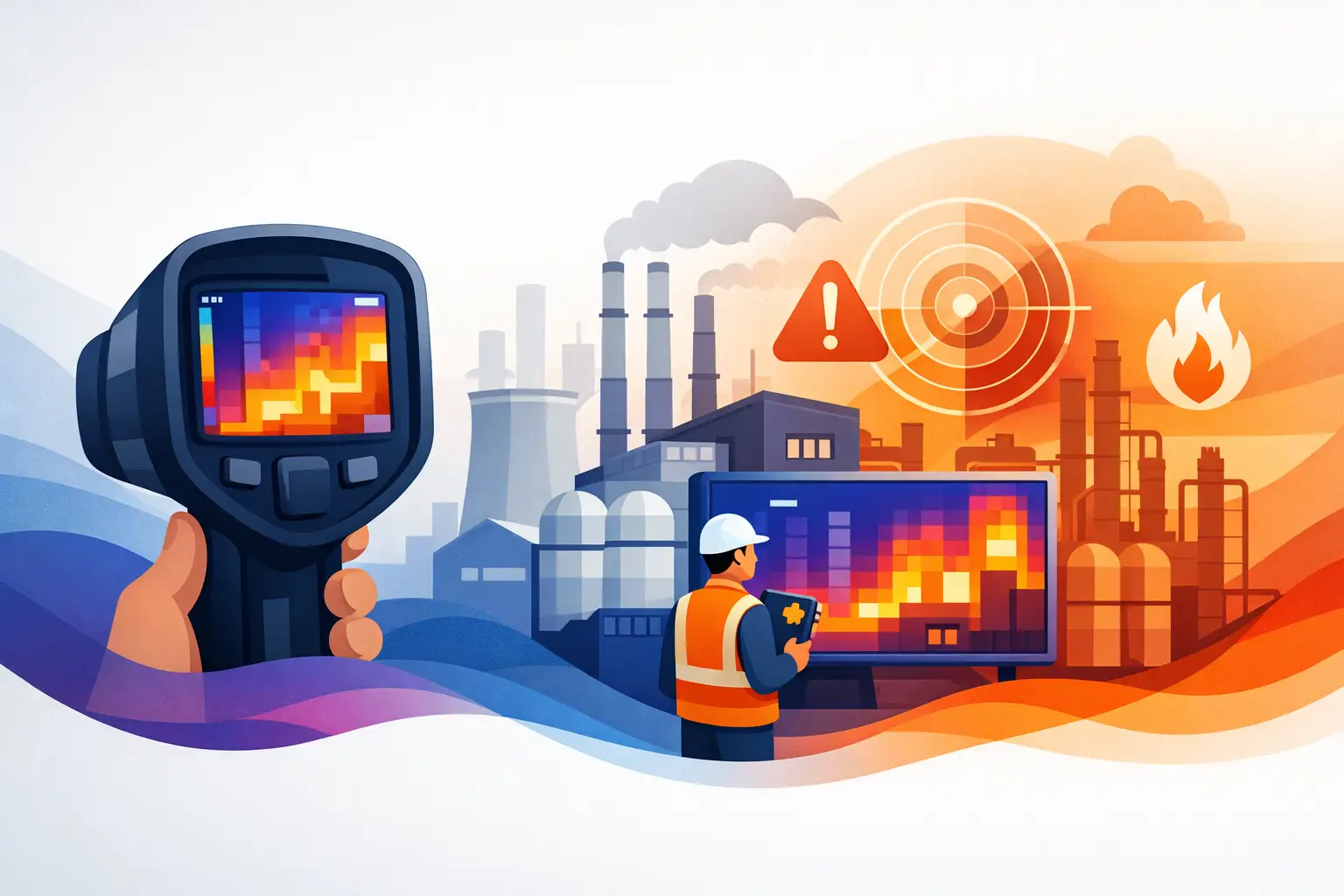
A bearing can begin failing long before it stops a production line. A corroded electrical connection can build dangerous resistance without visible damage. A heat source on a tank farm perimeter can appear after dark when conventional cameras deliver little usable detail. Thermal imaging gives operations teams a practical way to identify these conditions early, using heat patterns rather than visible light.
For oil and gas sites, refineries, vessels, power stations, and chemical facilities, this is not a novelty feature. It is a detection layer that supports maintenance planning, fire prevention, perimeter protection, and remote operational oversight. The strongest results come from selecting the right thermal technology for the risk, then integrating it into the surveillance and response process already used on site.
What Thermal Imaging Detects
Thermal cameras convert infrared energy emitted by objects into a visible temperature-based image. Warmer and cooler areas appear as contrasting tones or assigned colors, allowing operators to spot abnormal heat signatures in darkness, smoke, haze, or difficult lighting conditions.
That capability is especially valuable where visible-light surveillance has a predictable limitation: it depends on illumination and contrast. A thermal system does not need floodlighting to identify a person crossing a restricted boundary, a vehicle approaching a remote gate, or an overheating component in an outdoor electrical enclosure.
In industrial environments, the value is in the temperature difference, not simply the fact that an object is warm. A pump motor may run hot by design. The concern is whether one bearing is materially hotter than comparable bearings, whether the temperature is rising over time, or whether a connection exceeds the facility’s operating threshold. Thermal imaging turns those differences into evidence that can be reviewed, recorded, and acted on.
Where Thermal Imaging Delivers the Highest Return
The best deployment starts with a defined operational question. “We need thermal coverage” is too broad for a procurement decision. “We need to detect unauthorized approach along an unlit marine berth” or “we need early warning of abnormal heat at critical electrical assets” gives the system a clear job.
Perimeter and marine security
Offshore platforms, terminals, shipyards, coastal facilities, and remote energy sites face long sightlines, poor nighttime visibility, salt exposure, and constantly changing weather. Thermal surveillance can identify people, vessels, and vehicles without relying on visible illumination that may create glare, reveal security positions, or disturb nearby operations.
Detection range matters, but it should not be confused with identification range. A system may detect a heat signature at a substantial distance while providing insufficient pixel detail to identify a person or read vessel markings. Procurement teams should define whether the requirement is detection, recognition, or identification, then match lens selection, sensor resolution, mounting height, and scene coverage to that requirement.
For marine installations, housing and integration are equally important. The camera, mounts, connectors, and network path must withstand vibration, salt spray, wind loading, and sustained exposure. A high-spec sensor will not protect an operation if the installation is poorly sealed or the image cannot reach the control room reliably.
Electrical and mechanical condition monitoring
Switchgear, transformers, motors, pumps, conveyor drives, generator components, and process equipment often show thermal symptoms before a failure becomes obvious. Loose terminals, phase imbalance, overloaded circuits, misalignment, friction, and degraded bearings can all create recognizable heat anomalies.
A fixed thermal camera is particularly valuable at high-risk or hard-to-access assets where periodic inspection alone may leave long gaps between observations. It can provide continuous monitoring, alarms based on configured temperature rules, recorded video for review, and remote visibility for supervisors and engineers.
Thermal data should still be interpreted in context. Surface temperature is affected by load, ambient conditions, emissivity, viewing angle, and reflections from nearby hot equipment. A temperature alert is a prompt for inspection, not automatic proof of a specific failure. Used correctly, it reduces unnecessary emergency callouts while helping teams prioritize the faults that require immediate attention.
Fire prevention and process safety
Coal handling areas, waste storage, cable routes, battery rooms, storage yards, and certain process zones can develop heat buildup before smoke or flame is visible. Thermal monitoring can identify a developing hot spot and trigger escalation before the event becomes a shutdown, fire response, or reportable incident.
The trade-off is sensitivity versus nuisance alarms. Set thresholds too low and ordinary operating variation creates constant alerts. Set them too high and early warning is lost. A properly commissioned system uses alarm zones, temperature differentials, persistence rules, and operational baselines to distinguish normal heat from a genuine exception.
Optical gas imaging applications
Not all gases are visible to standard thermal sensors. Methane and other hydrocarbon gases require purpose-built optical gas imaging technology operating in the correct infrared spectral band. These systems are designed to visualize gas plumes under suitable conditions, supporting faster investigation of suspected emissions and leaks.
This distinction matters during specification. A general thermal security camera may be excellent for perimeter detection and hot-spot monitoring but unsuitable for methane leak visualization. Gas detection performance depends on the gas type, camera spectral response, scene temperature contrast, wind, distance, humidity, and operator technique. Buyers should insist on technology matched to the target gas and the intended inspection or continuous-monitoring workflow.
Specifying a System That Works on Site
Thermal performance is not determined by one headline number. Resolution, lens focal length, field of view, frame rate, thermal sensitivity, analytics, environmental rating, and network design all affect real-world results.
Resolution influences the amount of detail available across a scene, while the lens determines how that detail is distributed over distance. A wide field of view covers more area but places fewer pixels on a distant target. A narrow lens reaches farther but may leave gaps in coverage. In many critical installations, a combination of overview coverage and targeted views provides better protection than trying to force one camera to do every job.
Thermal sensitivity, often expressed as NETD, affects how well a sensor distinguishes small temperature differences. This can be meaningful for condition monitoring and subtle heat anomalies. However, the lowest specification on paper is not automatically the right commercial choice. The operating environment, target size, range, alarm objective, and required evidence quality should drive the selection.
Integration should be defined before equipment is ordered. Consider how alarms will be delivered, where video will be recorded, how long footage must be retained, which users need remote access, and whether the camera must connect to an existing video management platform. Network resilience is particularly important offshore and at remote industrial sites. Limited bandwidth, unstable links, and isolated infrastructure can undermine surveillance unless recording and failover are planned from the start.
Common Mistakes That Reduce Thermal Value
The first mistake is treating thermal cameras as a universal replacement for visible cameras. Thermal is outstanding for heat contrast and low-light detection, but visible imaging often provides better facial detail, color information, labels, and scene context. Dual-sensor coverage can be the stronger solution where operators need both detection and visual verification.
The second is ignoring installation geometry. Reflections from metal surfaces, direct solar heating, exhaust plumes, moving backgrounds, and obstructed sightlines can affect the image and alarm performance. A site survey should assess the scene at the times and conditions that matter most, including nighttime operations, weather exposure, and peak process loads.
The third is buying equipment without defining response ownership. An alarm only improves safety or security when someone receives it, understands it, and has authority to respond. Build escalation procedures around the system, whether that means a control room review, a maintenance work order, a security patrol, or an emergency response protocol.
Making Thermal Surveillance a Commercial Advantage
The commercial case for thermal imaging is strongest when it protects critical uptime or reduces high-consequence exposure. Finding one overheating connection before an electrical failure, detecting a perimeter intrusion before access is gained, or locating a suspected gas plume sooner can outweigh the cost of a properly engineered system.
That does not mean every site needs the same configuration. A marine terminal may prioritize long-range detection and corrosion-resistant installation. A refinery may require targeted optical gas imaging alongside process-area thermal monitoring. A power station may focus on switchgear, transformers, and remote substations. The right solution is the one that produces useful alerts in the actual operating environment, not the one with the longest feature list.
Revlight Security helps industrial buyers specify surveillance and detection infrastructure around those real operating risks. Start with the failure, intrusion, fire, or emission scenario that would cause the greatest disruption, then build thermal coverage that gives your team time to act before it becomes an incident.
🛡️ Secure Your Home or Business Today
Protect your home, office, shop, or business with reliable CCTV security cameras. Explore our range of CCTV cameras and find the right security solution for your needs.
Explore CCTV Cameras ✉️ Email Us

 Singapore :
+65-6708-9302
Singapore :
+65-6708-9302