
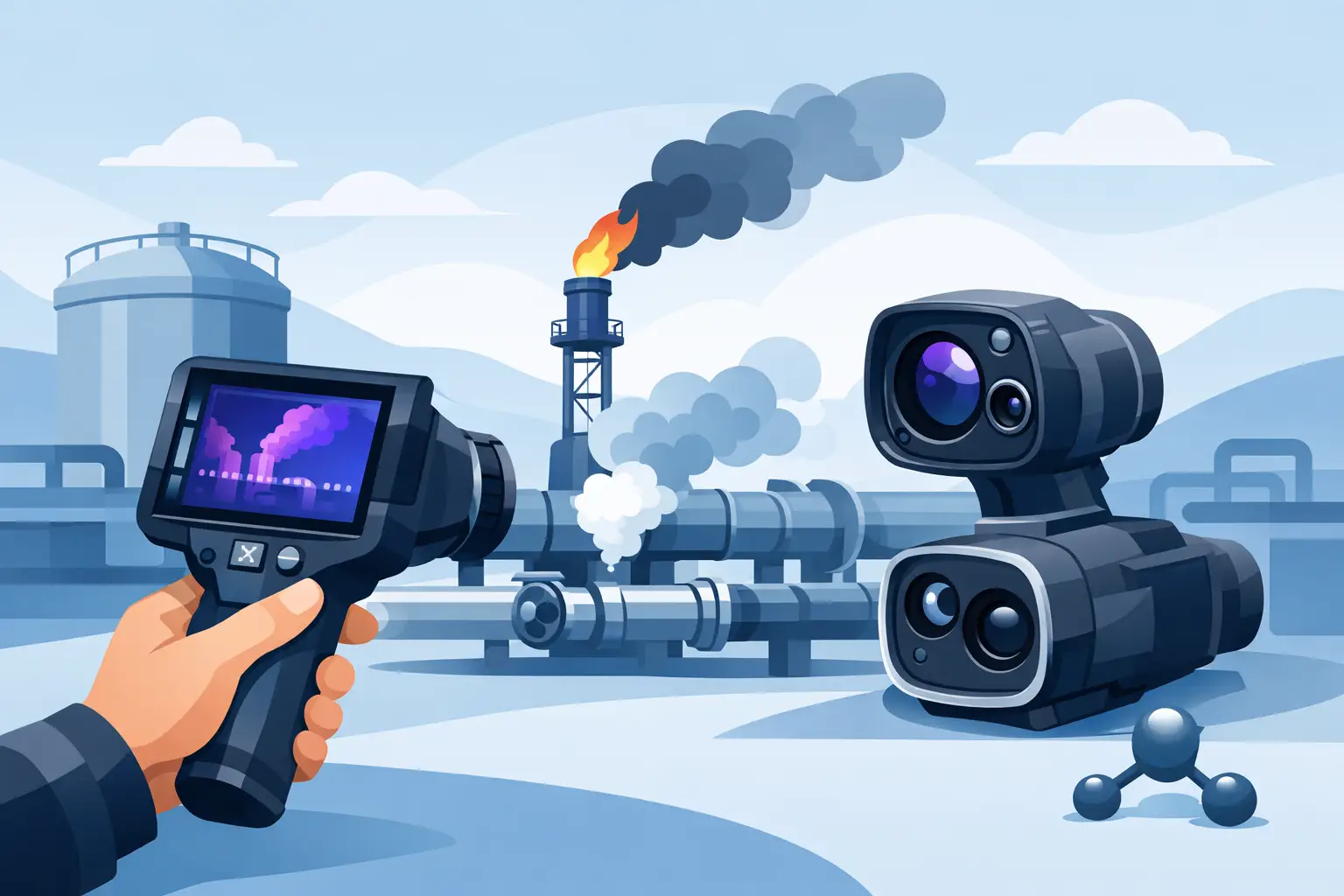
A methane gas leak camera earns its value the moment a suspected leak stops being guesswork. In a refinery, on a vessel, or across a power generation site, delays cost money fast. Lost product, unplanned shutdowns, environmental exposure, and safety risk all build at the same time. Buyers do not need another generic imaging device. They need equipment that identifies methane leaks clearly, works in demanding conditions, and supports faster decisions in the field.
For procurement teams and operations leaders, the buying question is not simply whether a system can detect gas. The real question is whether it can perform reliably in your environment, integrate into your inspection process, and reduce the cost of every leak event over time. That is where the difference between a basic specification sheet and a serious industrial solution becomes obvious.
What a methane gas leak camera actually does
A methane gas leak camera is designed to visualize methane emissions that are otherwise invisible to the eye. Instead of relying only on point sensors or manual inspection routines, these systems allow operators to scan equipment, piping, valves, flanges, tanks, and transfer points in real time. That changes the speed of detection and, just as importantly, the confidence behind maintenance decisions.
In practical terms, this means inspectors can locate likely leak sources without shutting down broad sections of a facility just to narrow the problem. In oil and gas operations, that shortens troubleshooting time. In chemical and power environments, it helps maintenance teams prioritize repairs based on visible evidence rather than suspicion alone. In marine settings, where access can be restricted and conditions can change quickly, visual gas detection adds another layer of operational control.
The strongest commercial case is simple. Faster leak identification reduces product loss, limits exposure, and cuts labor hours tied to prolonged inspection cycles. For large industrial operators, those savings are not marginal. They can materially affect maintenance budgets and compliance costs.
Why buyers are moving beyond traditional gas detection alone
Fixed detectors and handheld measurement tools still have an important role, but they are not enough in every scenario. Point sensors tell you what is happening at a specific location. A methane gas leak camera helps show where the problem is forming across a broader area. That distinction matters on complex sites with dense infrastructure and multiple potential leak paths.
There is also a workflow advantage. Maintenance teams often spend valuable time isolating the source after an alarm or suspected loss. Visual confirmation can shorten that process. Instead of checking one component after another, crews can focus on the most probable source immediately. The result is less wasted time and a more efficient maintenance response.
That said, performance always depends on application. Imaging results can vary with distance, background conditions, gas concentration, weather, and line of sight. No buyer should expect one device to replace every other detection method. The better approach is to treat visual methane imaging as a force multiplier within a broader gas monitoring strategy.
What to look for in a methane gas leak camera
The first priority is detection performance under real operating conditions, not ideal lab conditions. Industrial buyers should ask how the system performs around hot equipment, reflective surfaces, moving backgrounds, offshore exposure, and long inspection distances. A camera that looks good in marketing material but struggles on an active site creates more delays than value.
Image clarity matters because the operator needs to distinguish a true emission event from visual noise. Sensitivity matters because smaller leaks can still become expensive if they persist. Response speed matters because slow visualization can interrupt inspections and reduce operator confidence. These three factors work together, and weakness in one can limit the practical value of the whole system.
Environmental durability is just as important. Refineries, offshore assets, marine terminals, and power stations do not offer controlled conditions. Equipment may face salt exposure, vibration, temperature swings, humidity, and hazardous area requirements. Buyers should verify whether the unit is built for continuous industrial use and whether enclosure ratings and certifications align with the installation environment.
Another major factor is system usability. A high-spec camera that is difficult to deploy, difficult to interpret, or difficult to maintain will slow adoption. Procurement decisions should include operator workflow, training requirements, recording capability, playback support, and whether the system can support remote review when management or technical teams are offsite.
The importance of hazardous area suitability
For oil and gas, chemical processing, and energy infrastructure, hazardous area suitability is not a side detail. It is a core requirement. If the inspection environment involves explosive atmospheres or classified zones, the methane imaging system must be appropriate for that use case. This affects not only safety but also deployment flexibility and long-term compliance.
Serious buyers should look beyond broad claims and review the exact certification status, operating limitations, and installation requirements. A product may be technically capable of detection while still being a poor fit for the area classification on site. That mismatch creates procurement risk and can delay project approval.
This is where working with a specialist supplier has a clear advantage. Engineering-backed guidance helps buyers avoid overbuying in some areas and under-specifying in others. The right fit protects both the operation and the capital budget.
Where these systems deliver the strongest return
In refineries and petrochemical facilities, methane imaging supports leak detection around valves, compressor stations, pipelines, and storage systems. These are environments where one unresolved leak can escalate from a maintenance issue to a production, safety, and regulatory problem.
In marine and offshore operations, visibility and access are constant challenges. Equipment must work in exposed conditions and support inspection routines without adding unnecessary complexity. A dependable methane gas leak camera can help crews identify issues earlier, especially where a delayed response is costly and operational windows are tight.
Power plants, industrial processing facilities, and energy terminals also benefit when leak detection becomes more targeted. Instead of broad inspection sweeps that consume labor and still leave uncertainty, teams can direct maintenance resources where they are needed most. That is a direct operational advantage, not just a technical one.
Procurement mistakes that cost more later
One common mistake is buying on headline sensitivity alone. Sensitivity is important, but if the unit is difficult to interpret in your environment, the operational value drops quickly. Another mistake is ignoring recording, storage, and review functions. Inspection evidence matters, especially when maintenance scheduling, contractor coordination, or compliance documentation is involved.
Some buyers also underestimate lifecycle costs. Initial price is only part of the decision. Service support, calibration needs, environmental durability, operator training, and downtime risk all affect total ownership cost. A cheaper unit that fails under site conditions is not a saving. It is a repeat purchase waiting to happen.
There is also the issue of application fit. Some sites need fixed-position monitoring support, while others benefit more from inspection-based deployment. Some require long-range viewing, while others need high confidence in tighter plant areas. A product-centric buying process works best when it starts with the site problem, not the catalog page.
How to evaluate suppliers, not just equipment
The quality of the supplier often determines the success of the deployment. Industrial buyers should expect clear technical answers, practical recommendations, and a direct understanding of sector-specific conditions. If a supplier cannot discuss marine corrosion, refinery hazards, remote access requirements, or maintenance workflows in detail, the support gap will likely show up after purchase.
Strong suppliers also help define the right configuration. That may include recording options, network compatibility, mounting considerations, and environmental protection choices. For operators managing multiple sites or vessels, standardization can be a major benefit, but only if the chosen system is adaptable enough to perform consistently across those locations.
Revlight Security operates in this specialist category, where detection performance and site reality need to match. For buyers comparing options, that expertise matters because the wrong recommendation can create delays in commissioning, weak field performance, and poor return on investment.
Making the case internally
When operations teams request a methane imaging system, internal approval often depends on business language, not just safety language. The strongest case combines product loss reduction, faster inspections, lower troubleshooting time, and improved incident response. Add the value of visible evidence for maintenance planning, and the investment becomes easier to justify.
This is especially true for larger industrial sites where small recurring leaks can create significant annual losses. A methane gas leak camera is not only about spotting a problem once. It is about building a faster, more credible detection process across the life of the asset.
The best buying decisions come from matching technical capability to operating conditions, not chasing broad claims. If the system fits the site, the team, and the inspection process, it stops being an equipment purchase and starts becoming a measurable operational advantage.
The right camera does more than show gas on a screen. It gives your team proof, speed, and control when those three things matter most.
🛡️ Secure Your Home or Business Today
Protect your home, office, shop, or business with reliable CCTV security cameras. Explore our range of CCTV cameras and find the right security solution for your needs.
Explore CCTV Cameras ✉️ Email Us

 Singapore :
+65-6708-9302
Singapore :
+65-6708-9302