
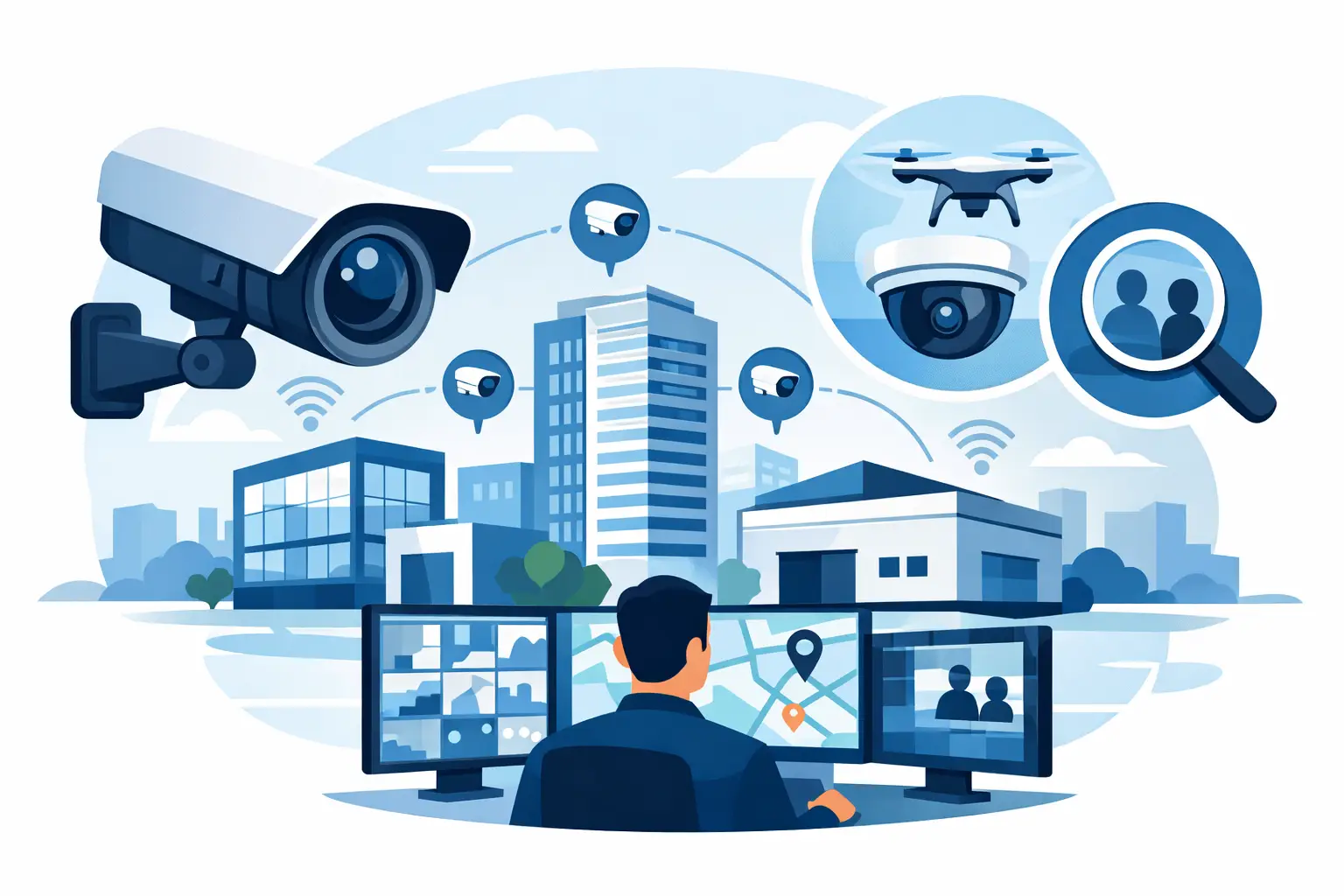
A refinery with six structures, a tank farm, a dock edge, and one control room does not need more cameras. It needs a surveillance plan that understands risk, distance, bandwidth, and uptime. That is the real starting point for how to plan multi building surveillance in industrial environments where one blind spot can mean theft, downtime, safety exposure, or missed incident evidence.
Multi-building surveillance is not the same as scaling up a single-site system. The problem changes as soon as buildings sit far apart, network paths cross outdoor areas, and some zones demand hazardous-area equipment while others need standard IP coverage. Procurement teams and operations leaders usually find that camera count is the easy part. The harder part is deciding what each building must see, how footage moves back to the control point, and what level of resilience the site can afford.
How to plan multi building surveillance from the risk outward
The strongest plans begin with operational risk, not a catalog. Start by separating the site into surveillance priorities. Entry and exit control, perimeter lines, loading points, process zones, storage areas, waterfront edges, and remote utility buildings all behave differently. An administration building may need clear face capture and visitor tracking. A compressor area may need fixed thermal or gas detection support, rugged housings, and long-range views focused on process safety and restricted access.
This matters because the same camera format should not be copied across every structure. In oil and gas, marine, energy, and chemical operations, each building has its own threat profile and environmental burden. Wind, salt, vibration, heat, explosive atmospheres, and poor light can quickly expose weak system planning. A cheaper design often looks acceptable on paper and then fails where the site needs performance most.
A practical first step is to classify every building by purpose, criticality, and response requirement. Ask what event must be detected, what evidence must be recorded, and who must respond. If a substation only needs event verification, coverage strategy can be leaner than for a control room entrance or marine transfer point. If an offshore or dockside structure supports night operations, low-light performance and network resilience become non-negotiable.
Map the site before you choose equipment
A site map should do more than show building footprints. It should show line of sight, mounting heights, fence lines, roadways, cable routes, power availability, control room location, and dead ground between structures. In multi-building deployments, those gaps between buildings often create the biggest vulnerabilities.
Outdoor transit corridors deserve special attention. People and vehicles move between facilities, and incidents rarely stay neatly inside one wall line. If Building A is fully covered and Building B is fully covered, but the route between them is not, the system still has a serious weakness. The same is true for pipe racks, bridgeways, jetty approaches, and isolated maintenance zones.
This mapping stage is also where planners should identify environmental classes. Standard industrial housings may be acceptable in one section of a site but inadequate near corrosive marine air, washdown areas, or classified hazardous zones. Matching equipment to exposure conditions early prevents expensive redesign later.
Choose coverage goals, not just camera positions
A common planning mistake is placing cameras to “see the area” without defining what useful seeing actually means. Surveillance goals should be tied to outcomes such as detecting movement at a perimeter, identifying a person at a controlled entry, reading vehicle activity at a gate, monitoring a flare or loading operation, or verifying an alarm in real time.
That distinction affects lens choice, mounting height, scene width, and storage requirements. Wide views are useful for context, but they often fail at identification. Narrow views can deliver detail, but they leave blind spots if overused. Most industrial sites need a layered approach where overview cameras provide movement and situational awareness while dedicated units capture operational detail at decision points.
For larger compounds, pan-tilt-zoom coverage can support active monitoring, but it should not replace fixed coverage in critical zones. A PTZ can only look in one direction at a time. If no operator is watching when an event starts, recorded evidence may be incomplete. Fixed coverage remains the backbone of dependable multi-building surveillance.
Build the network as carefully as the camera plan
When buyers ask how to plan multi building surveillance, the network design is usually where cost, performance, and reliability collide. Separate buildings create longer cable runs, more switch locations, more lightning exposure, and more bandwidth pressure. If the network is treated as an afterthought, the entire system suffers.
Fiber is often the right answer between buildings where distance, electromagnetic interference, and uptime matter. In marine and industrial environments, it gives stronger long-term stability than trying to stretch copper beyond sensible limits. Wireless bridges can work well in the right conditions, especially where trenching is difficult, but they depend on clear line of sight, stable mounting, and careful throughput planning. They are not a universal shortcut.
The right design also depends on traffic load. High-resolution cameras, thermal devices, analytics, and extended retention all increase bandwidth and storage demand. A site with remote access for security teams or central monitoring across regions needs additional headroom. Under-specifying switching, uplinks, or recording throughput creates the kind of hidden weakness that only appears after the system is live.
Redundancy deserves a business decision, not a technical guess. Some sites can tolerate a building going offline for a short period. Others cannot. If surveillance supports safety verification, critical asset protection, or compliance expectations, redundant network paths, backup power, and failover recording are worth serious consideration.
Recording, retention, and remote access need clear rules
In a multi-building estate, footage is only valuable if teams can retrieve it quickly and trust its continuity. That means deciding whether recording is centralized, distributed by building, or hybrid. Centralized recording simplifies management, but it increases backbone dependency. Distributed recording can reduce network strain and preserve footage if one link drops, but it introduces more devices to maintain.
A hybrid approach often suits industrial sites best. Critical buildings can retain local recording while forwarding streams or events to a central platform for live monitoring and investigation. This balances resilience with operational control.
Retention policy should match actual risk and compliance expectations. More days of storage sounds attractive, but it comes at a cost in hardware, management, and retrieval time. The better question is how long footage remains operationally useful and legally relevant. Sites with hazardous processes, vessel traffic, or high-value materials may justify longer retention in selected zones rather than across every stream.
Remote access should be designed around role-based need. Operations managers, marine superintendents, and security teams may all require visibility, but not the same level of control. Strong permissions, stable remote viewing performance, and a clear audit trail matter more than simply making every feed visible to every user.
Plan for industrial realities, not ideal conditions
Industrial surveillance fails when planners assume buildings behave like office blocks. They do not. Heat shimmer can distort long-range views. Salt exposure shortens hardware life. Machinery vibration affects image stability. Hazardous areas may require certified enclosures and installation methods. Night scenes near water or flare activity create difficult contrast conditions.
This is where specialist product selection pays for itself. Thermal surveillance, marine-grade wireless links, corrosion-resistant housings, and detection cameras built for gas and process environments are not extras for demanding sites. They are often the difference between a system that produces dependable evidence and one that just adds hardware count.
The same goes for maintenance access. A camera mounted in the perfect visual position is still a poor choice if servicing it requires repeated shutdowns, permits, or vessel support. Long-term serviceability should shape the initial design.
Commissioning is part of the plan
A multi-building system should not go live after a simple power-on check. Commissioning must verify image quality by day and night, latency across buildings, recording integrity, playback speed, user permissions, and alarm response. It should also confirm real-world performance in weather, glare, and operational traffic.
For procurement teams, this stage protects investment. For operations leaders, it turns a specification into a working security asset. The best service provider will treat commissioning as proof of performance, not a handover formality.
At Revlight Security, the strongest projects are the ones built around site conditions, operational risk, and dependable network infrastructure rather than camera count alone. That is how industrial buyers get the ultimate in security surveillance systems without paying twice through redesign, outages, or weak coverage.
If you are planning surveillance across multiple buildings, the right question is not how many devices to install. It is how each part of the site should be protected, connected, and managed so the system still performs when the environment is at its hardest.
🛡️ Secure Your Home or Business Today
Protect your home, office, shop, or business with reliable CCTV security cameras. Explore our range of CCTV cameras and find the right security solution for your needs.
Explore CCTV Cameras ✉️ Email Us


 Singapore :
+65-6708-9302
Singapore :
+65-6708-9302