
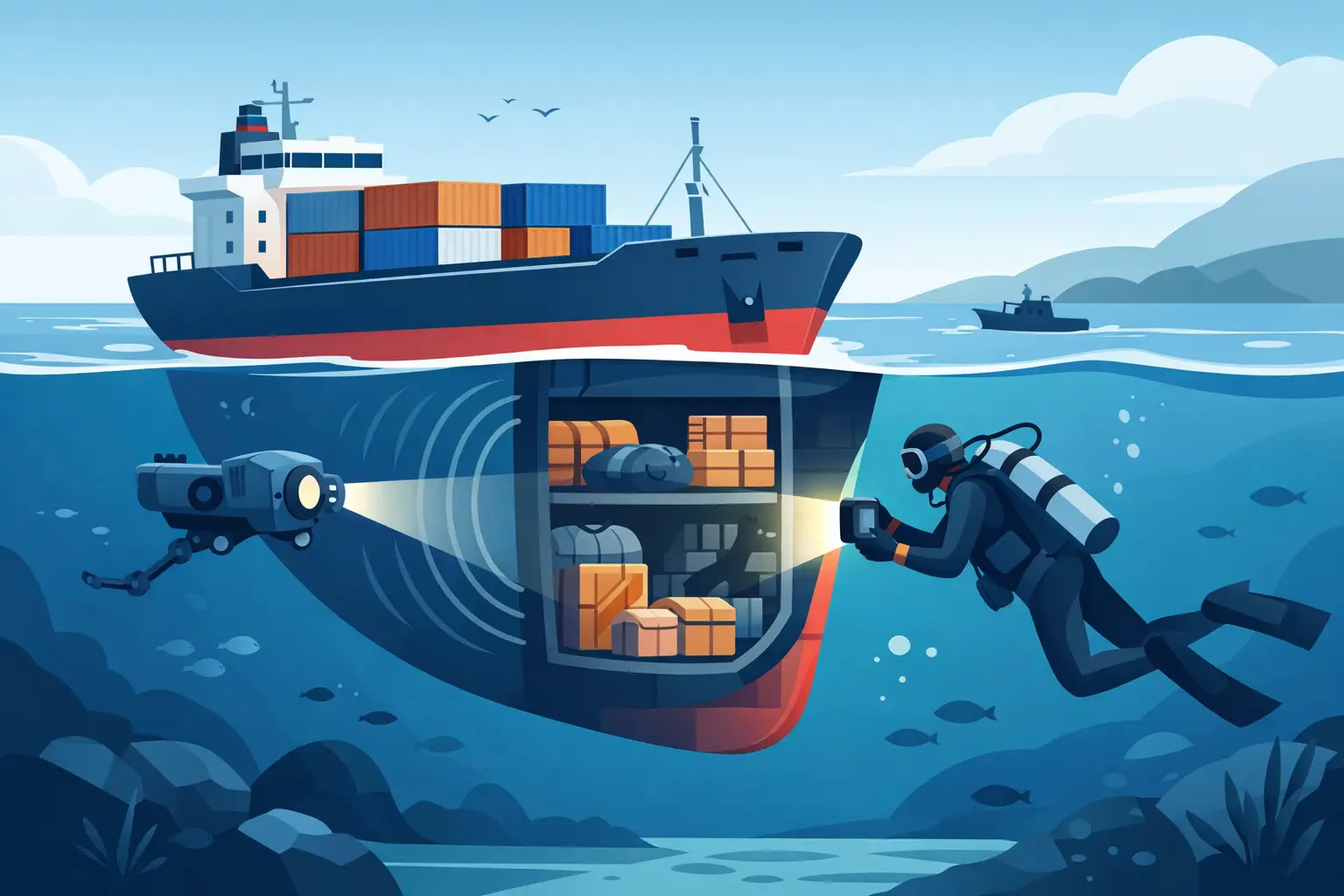
A vessel can clear paperwork, pass visual checks, and still carry risk below the waterline. That is why hidden hull contraband detection has become a serious operational priority for ports, ship managers, offshore operators, and security teams that cannot afford blind spots around sea chests, thruster tunnels, rudders, and other submerged structures.
For commercial fleets and industrial marine operators, this is not just a customs issue. It is a security, compliance, and downtime issue. If contraband is attached to a hull and found late, the result can be delayed departures, extended berth time, higher inspection costs, legal exposure, and reputational damage. The right surveillance approach reduces uncertainty and gives decision-makers a clearer basis for action.
Why hidden hull contraband detection is harder than it looks
The challenge starts with the hull itself. Large commercial vessels present broad underwater surfaces, layered geometry, and multiple attachment points where illicit packages can be concealed. Sea chests, intake grilles, stabilizer recesses, propeller shafts, and weld seams create natural hiding areas that are difficult to inspect thoroughly from the quay.
Water conditions add another layer of complexity. Visibility changes with turbidity, light, current, marine growth, and berth location. A method that performs well in clear, controlled conditions may deliver poor results in a working port with suspended sediment and inconsistent ambient light. Buyers evaluating inspection systems need to think beyond headline specifications and focus on real deployment conditions.
Human factors matter too. Diver-led inspections can be effective, but they are slower to scale and depend heavily on individual visibility, experience, and reporting consistency. In higher-risk environments, operators want inspection records, live viewing, and image capture that can be reviewed by multiple stakeholders. That shifts the requirement from simple checking to documented underwater surveillance.
What an effective hidden hull contraband detection system needs
A workable system is built around visibility, control, and evidence. Underwater imaging is the core requirement, but image quality alone is not enough. Security teams need stable viewing around complex structures, reliable performance in low-light water, and enough coverage to reduce missed areas.
This is where fixed and deployable underwater camera systems have a clear advantage. They support close inspection of submerged hull sections while also giving control rooms or onboard teams the ability to monitor, record, and review findings in real time. For industrial buyers, that means a stronger chain of evidence and less dependence on verbal reporting.
Remote access also matters. On many marine and offshore sites, the people authorizing action are not standing dockside. Operation managers, superintendents, and security coordinators need live video and recorded playback across networked systems so they can make decisions quickly. That is especially valuable when a vessel schedule is tight and there is pressure to confirm clearance or escalate inspection without delay.
Durability is another buying factor that should not be treated as optional. Saltwater exposure, fouling, vibration, and continuous deployment put serious stress on equipment. A camera system for hidden hull contraband detection must be rated for marine conditions and selected with cable management, mounting location, housing strength, and maintenance cycles in mind. A lower-cost system that fails in service creates more expense than it saves.
Hidden hull contraband detection in real operating environments
In theory, every hull inspection follows a neat process. In practice, conditions vary by berth, vessel type, risk level, and port procedure. Tankers, support vessels, bulk carriers, and service craft all present different underwater layouts. Some need targeted checks around known concealment points. Others need broader sweeps supported by recording and review.
Ports and terminals with repeat traffic often benefit from a standardized surveillance setup that can be used across multiple vessel calls. This creates consistency in inspection quality and gives procurement teams a better return on equipment investment. Temporary or ad hoc inspection methods may appear cheaper at first, but they tend to produce uneven results and weaker records.
There is also a trade-off between speed and certainty. A rapid underwater scan may be enough for low-risk arrivals, while higher-risk scenarios require slower, closer inspection with image capture from multiple angles. The best systems support both. They allow operators to perform efficient first-pass checks and then move into detailed confirmation when something looks irregular.
For offshore assets and industrial marine facilities, the same principle applies. Security risk is not limited to cargo vessels entering a port. Any submerged access point or hull-adjacent structure can become a concealment opportunity if surveillance is weak. A commercially focused detection strategy treats underwater visibility as part of total perimeter security, not a separate specialty issue.
The role of underwater cameras and networked surveillance
Underwater cameras are central to serious hidden hull contraband detection because they turn a difficult, low-visibility task into a controlled inspection process. High-performance systems give operators the ability to examine vulnerable hull areas with stronger image clarity, dependable lighting integration, and recording functions that support incident review.
For buyers in oil and gas, marine transport, and industrial energy, the value goes beyond simple detection. Networked camera infrastructure supports centralized oversight. Inspection teams can transmit live footage to security personnel, operations leadership, or vessel representatives without interrupting the task. That improves coordination and reduces wasted time between detection, verification, and response.
Playback is equally important. If a suspicious object is found, teams need to review footage frame by frame, confirm location, and document the finding. If nothing is found, recorded inspection footage can still help demonstrate that checks were completed properly. In regulated or commercially sensitive environments, that record has real value.
This is where engineering-backed system design makes a difference. Camera count, viewing angle, lighting performance, recording format, cable distance, and network compatibility all affect whether the system performs as expected in the field. Buyers should not treat underwater inspection as a simple add-on. It is a specialist surveillance requirement that needs proper configuration from the start.
What procurement teams should evaluate before buying
The best purchase decision comes from operational fit, not generic feature comparison. Procurement managers should start by identifying the actual inspection scenario. Is the requirement for berth-side vessel screening, continuous underwater monitoring, offshore structure inspection, or rapid-response deployment after a security alert? The answer shapes the right hardware and network design.
Image performance in low visibility should be tested carefully. A specification sheet may look strong, but real results depend on lighting, water quality, and mounting distance from the inspection target. Recording and storage capacity should also be reviewed early, especially when multiple inspections must be archived and accessed later.
Integration is another practical issue. Many operators already run security networks, marine communications, and control room displays. An underwater surveillance solution should fit that infrastructure without creating avoidable complexity. Systems that support remote viewing and straightforward playback deliver stronger value because they support both field inspection and management oversight.
Service support should be part of the decision, not an afterthought. Marine security equipment works in demanding conditions, and buyers need confidence in maintenance guidance, replacement planning, and system uptime. That is why many industrial operators prefer specialist suppliers over general electronics vendors. They want equipment selected for the environment and backed by people who understand the consequences of failure.
At Revlight Security, that commercial reality is central. Buyers are not looking for novelty. They are looking for dependable underwater surveillance that improves security outcomes, supports inspection efficiency, and protects operations from preventable disruption.
Why hidden hull contraband detection is now a strategic investment
For many organizations, underwater inspection used to be reactive. A concern was raised, an inspection was arranged, and the process ended there. That approach is no longer enough where security threats, vessel turnaround pressure, and compliance scrutiny are increasing at the same time.
Hidden hull contraband detection is now part of a broader risk-control model. It helps reduce exposure to smuggling incidents, strengthens port and vessel security procedures, and gives operators a more defensible inspection standard. It also supports better scheduling by reducing uncertainty around hull status before departure or berth release.
There is no single setup that fits every port or fleet. Some operators need permanent underwater coverage. Others need deployable systems with strong recording and remote review capabilities. The key is choosing surveillance equipment that matches the operating environment and delivers clear, usable results under real conditions.
When underwater blind spots are removed, decisions get faster, inspections get stronger, and security teams work with evidence instead of assumptions. That is the standard serious marine operators should expect from any hidden hull inspection strategy.


 Singapore :
+65-6708-9302
Singapore :
+65-6708-9302