
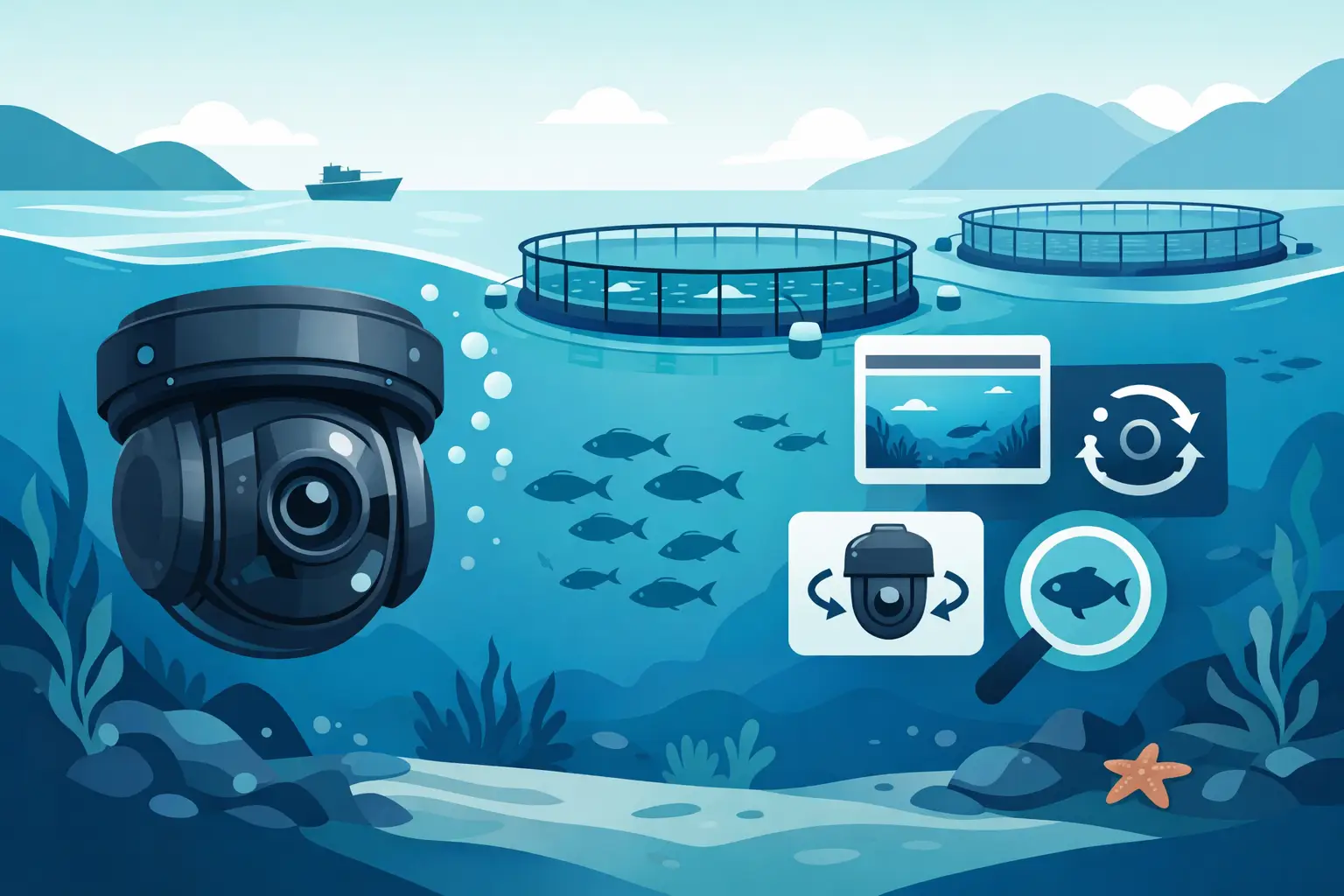
A feeding event can look normal from the surface while uneaten feed collects below, fish crowd around a damaged net panel, or oxygen-related behavior develops along the pen edge. An underwater PTZ camera for aquaculture gives operators the ability to inspect these conditions in real time, from a single installed observation point, without sending personnel into the water or relying on fixed camera angles.
For commercial farms, the purchase decision is not simply about image quality. The right system must operate at the required depth, withstand continuous immersion, deliver useful visibility in low-light water, and connect reliably to the monitoring and recording infrastructure already used on site. A camera that looks impressive in a product demonstration but cannot maintain a clean image, stable control, or dependable network connection becomes an operational cost instead of a management tool.
What an Underwater PTZ Camera for Aquaculture Must Deliver
PTZ means pan, tilt, and zoom. In aquaculture, those functions have practical value when they are engineered for underwater service. Operators can follow feeding distribution, inspect mooring lines, examine net walls, check fish movement near cameras, and review areas of concern without depending on one fixed field of view.
The value is especially clear in large pens, recirculating aquaculture systems, hatcheries, and offshore installations where access takes time and safety controls are strict. A remotely controlled camera can be positioned toward a feed spreader, a net opening, a discharge point, or a section where fish behavior has changed. Recorded footage also gives operations teams evidence to compare events across shifts rather than relying only on verbal reports.
However, not every installation needs full pan, tilt, and zoom capability. A fixed underwater camera may be the better commercial choice when one area requires continuous monitoring, such as a feeding zone or gate. PTZ systems earn their higher cost where operators need wider inspection coverage, remote investigation, or preset views for repeated checks.
Start With the Water, Not the Camera Spec Sheet
Water conditions determine camera performance more than headline resolution alone. Clear offshore water, turbid pond water, land-based tanks, and high-biomass pens all create different visibility challenges. Suspended solids, plankton, bubbles, algae, glare, and biological growth can reduce a high-resolution image to a poor operational view.
A procurement specification should state the actual visibility objective. Is the camera needed to confirm feed response? Inspect fish welfare indicators? Identify net damage? Monitor cleaning work? Verify that a valve, intake, or subsea structure is clear? Each task affects lens selection, lighting requirements, mounting position, and control range.
Low-light performance matters because many sites monitor before sunrise, after sunset, and during weather conditions that reduce surface light. Integrated illumination can be valuable, but placement is critical. Light mounted too close to the lens may reflect off particles in the water and create a bright snowstorm effect on screen. Separate lighting, angled lighting, or adjustable intensity often delivers a cleaner image in turbid environments.
Color reproduction also deserves attention. Operators need enough detail to assess feeding behavior, fish distribution, visible injuries, fouling, and equipment condition. But resolution should be matched to transmission capacity. Sending high-bitrate video across a weak marine wireless link or overloaded network can produce delay, dropped frames, and poor PTZ response exactly when an operator needs control.
Pressure Rating and Housing Construction Are Non-Negotiable
An underwater camera system is only as dependable as its housing, seals, connectors, and cable entry points. Buyers should match the pressure rating to the planned deployment depth with a sensible engineering margin. A shallow-water housing is not a substitute for a system designed for sustained offshore or deep-pen service.
Housing material also affects service life. Marine-grade stainless steel, titanium, and purpose-built engineering polymers each have a place, depending on depth, corrosion exposure, mounting hardware, and budget. The lowest purchase price can become expensive when corrosion, galvanic interaction, or seal degradation causes repeated retrieval and repair work.
Ask how the PTZ mechanism is protected. Some systems keep moving components inside a pressure housing, while others use specialized subsea actuator arrangements. The design must be intended for immersion, not adapted from an above-water surveillance platform. Pan and tilt movement should remain accurate after extended operation, and the cable arrangement must not create a twist-related failure point during repeated movement.
Connector choice is another overlooked issue. Wet-mateable connectors can simplify service in some installations, while hardwired penetrators may offer a more permanent solution. The correct approach depends on whether the unit will be routinely recovered for maintenance, positioned on a removable frame, or installed as a long-term asset.
Specify Optical Control That Supports Real Decisions
Zoom is useful only when water clarity supports it. In clear water, optical zoom can help operators inspect a net seam, fish behavior, or an item lodged against infrastructure. In murky water, excessive zoom magnifies suspended particles and can reduce context. For this reason, an effective aquaculture PTZ system needs a practical wide-angle starting view, smooth movement, and presets that return the camera to known inspection points.
Digital zoom should not be confused with optical zoom. Digital enlargement may make an image appear closer, but it does not create additional image detail. Procurement teams should prioritize lens quality, sensor performance, and usable optical zoom over inflated marketing specifications.
PTZ presets are highly valuable for disciplined operating procedures. A supervisor can establish views for the feeder, lower net zone, anchor connection, biomass concentration area, and service access point. Operators can then complete repeatable visual checks in a few minutes and save recordings against the correct time and location.
Control latency should be tested before final acceptance. A delayed pan command makes precise inspection frustrating and can cause operators to overshoot a target. The combined performance of camera processor, encoder, cable run, network switch, wireless bridge, and viewing workstation determines the experience, not the camera alone.
Build the Network and Recording System Around the Deployment
Video has limited value if it cannot reach the people responsible for decisions. A complete design should consider power delivery, data transport, recording retention, user access, cybersecurity, and fault monitoring from the beginning.
For nearby installations, a protected Ethernet connection may be appropriate. For longer marine distances, fiber can provide strong immunity to electrical interference and support high-quality video transmission. In other cases, a marine wireless system may provide the practical route back to a control room or shore-based network. The right selection depends on distance, line of sight, vessel movement, available power, and the criticality of live viewing.
Recording requirements should be based on incidents and operations, not just storage capacity. Continuous recording supports post-event review, while motion-triggered recording can reduce storage use in areas with limited activity. In active fish pens, however, constant movement may make motion analytics less useful than scheduled recording or operator-driven event marking.
Remote access should be role-based. Farm managers may need live review and playback from an operations center, while maintenance contractors may require restricted temporary access. Strong passwords, segmented networks, controlled user permissions, and documented update procedures protect both surveillance assets and operational technology networks.
Plan for Fouling, Cleaning, and Recovery
Biofouling is a normal operating condition, not an unexpected exception. Algae, marine growth, and sediment can cover a lens window and steadily reduce image quality. Any long-term deployment needs a maintenance plan that identifies who will inspect the camera, how often it will be cleaned, and how the unit will be safely recovered.
Wipers, water-jet cleaning arrangements, protective lens windows, and anti-fouling treatments can extend useful operation, but none removes the need for scheduled inspection. The correct maintenance interval depends on location, season, water temperature, nutrient load, and camera position. A unit near feed activity may require attention more frequently than a camera installed in a cleaner intake channel.
Mounting is equally important. The camera must remain stable enough to provide useful footage but accessible enough for service. A poorly positioned unit can suffer vibration, cable abrasion, collision damage, or an obstructed view from net movement. Specify the mounting frame, cable protection, retrieval method, and spare-part strategy at the same time as the camera.
A Practical Procurement Checklist
Before approving an underwater PTZ camera for aquaculture, confirm four operational points: the required depth and pressure rating, the expected water clarity and lighting plan, the cable and network route, and the maintenance method. Then validate image quality and PTZ response in conditions that resemble the actual farm, not a clean indoor tank.
Commercial buyers should also request clear information on warranty coverage, availability of replacement seals and cables, service turnaround, control protocol compatibility, and recording integration. A top-of-the-line camera head is not enough if a failed connector or unavailable spare part keeps the system offline during a critical period.
The strongest installations treat underwater visibility as part of farm control, not as an isolated camera purchase. When the camera, lighting, mounting, network, recording, and service plan are specified together, operators gain a dependable view of conditions that surface inspections cannot show. That is where better surveillance turns into faster decisions, reduced intervention costs, and more confident aquaculture operations.
🛡️ Secure Your Home or Business Today
Protect your home, office, shop, or business with reliable CCTV security cameras. Explore our range of CCTV cameras and find the right security solution for your needs.
Explore CCTV Cameras ✉️ Email Us


 Singapore :
+65-6708-9302
Singapore :
+65-6708-9302