
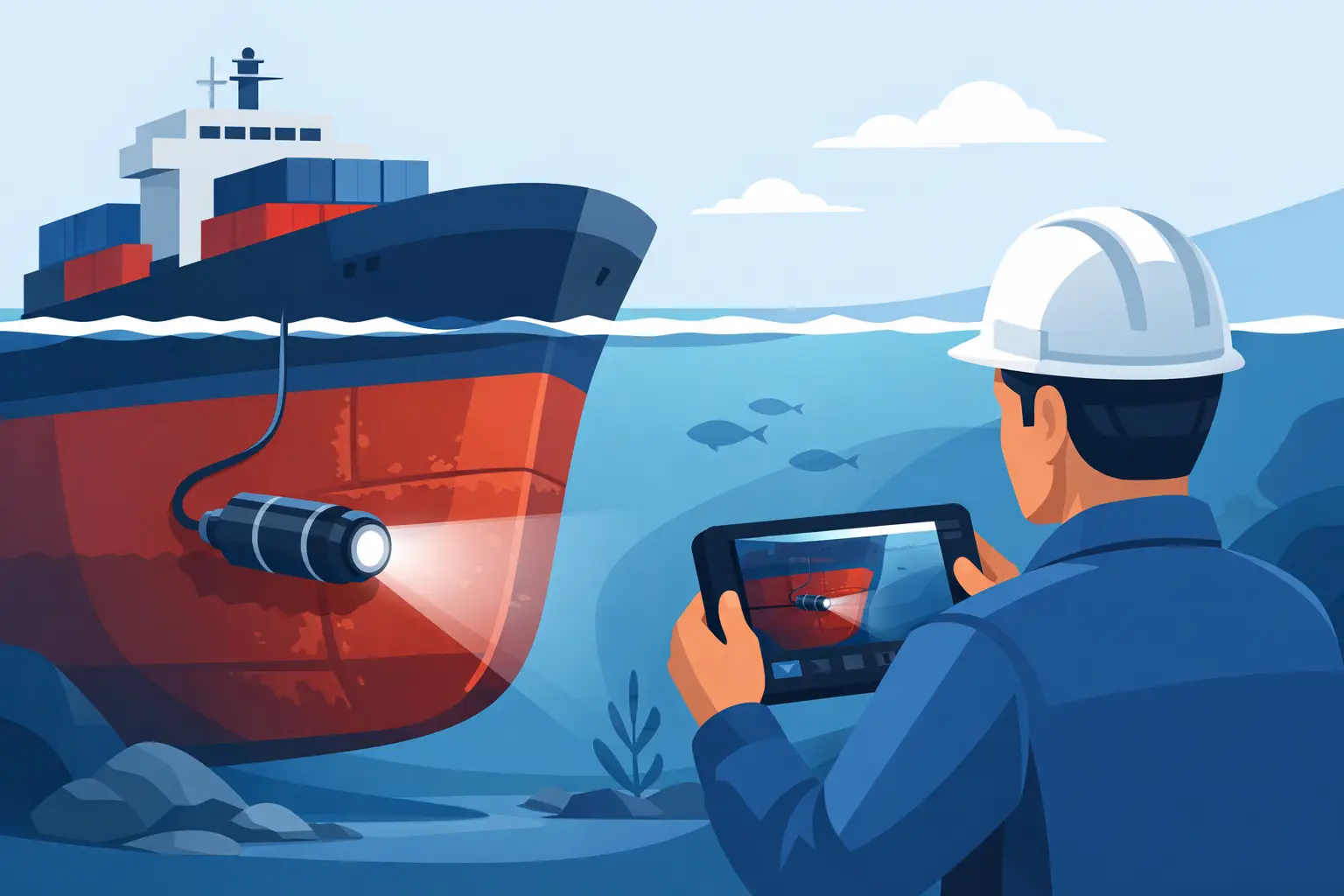
A vessel arriving alongside with suspected hull damage creates an immediate operational decision: wait for a dive team, schedule an expensive dry-dock review, or obtain clear subsea evidence first. This ship hull inspection camera example shows how a properly specified underwater surveillance system can give captains, superintendents, and technical managers the visual intelligence needed to act with confidence.
The value is not simply seeing below the waterline. It is producing stable, recorded, usable footage of the hull condition, then making that footage available to the people responsible for safety, maintenance, charter commitments, and repair budgets. For marine operators, that can mean a faster go/no-go decision and fewer costly assumptions.
A Ship Hull Inspection Camera Example at Berth
Consider a 180-meter product tanker alongside after a suspected contact incident during maneuvering. The master reports abnormal vibration after departure from a restricted channel. There is no visible issue above the waterline, but the technical team needs to verify the propeller, rudder, stern tube area, and nearby plating before authorizing the next voyage.
A subsea inspection camera system is lowered and positioned to survey the affected areas. It delivers high-resolution, low-light video to a topside monitoring point, where the crew can view live images and record the inspection. Integrated lighting is directed across the hull surface rather than straight at it, helping reveal dents, coating loss, marine growth, cracks, and deformation that a flat front-facing light can conceal.
The inspection begins at the stern. The operator records the propeller blades from several angles, checks for edge damage and fouling, and follows the shaft line toward the rudder. The camera then tracks the hull plating around the reported contact zone. Footage is time-stamped, retained for review, and sent to the shore-side superintendent through the vessel’s approved network connection.
In this example, the video identifies a localized scrape in the coating but no apparent structural distortion, propeller damage, or rudder obstruction. The operator can plan coating repair at the next suitable maintenance window rather than immediately taking the vessel out of service. If the images had shown a bent blade, deep gouge, loose anode, or hull breach indicator, the same footage would support a faster escalation to class, insurers, divers, and repair contractors.
That is the commercial purpose of hull imaging: establish condition early, document what is found, and avoid paying for emergency work when evidence does not justify it.
What Makes Hull Footage Useful Rather Than Merely Visible
Marine inspection systems operate in a difficult visual environment. Turbidity, suspended sediment, low light, biofouling, current, glare, and vessel movement can all reduce image quality. A camera that performs well in clear demonstration water may produce poor evidence around working ports, offshore assets, or industrial berths.
For hull inspection, low-light performance matters because critical areas are naturally dark. Strong, controllable illumination matters because reflective paint, curved plating, and metallic propeller surfaces can create glare. The housing must also be rated for the intended depth, saltwater exposure, pressure, and operating duration. Weak sealing, poor cable protection, or unsuitable connectors can turn a routine inspection into an equipment failure at the worst possible time.
Image stability is equally important. A system should provide a consistent view while the operator moves along welds, bilge keels, sea chests, thrusters, stabilizers, and appendages. Where currents or vessel motion are expected, the deployment arrangement must keep the imaging head controlled. This may involve a guided frame, a tethered subsea platform, or a fixed underwater installation depending on the operating requirement.
Recording quality should be specified before purchase. If footage will be reviewed by a superintendent, surveyor, insurer, or repair yard, compressed and poorly lit video can create more questions than answers. The system should capture sufficient detail for post-event playback, with reliable storage and a clear method of exporting relevant clips. Live viewing helps operational decisions, but retained evidence protects the operator after the vessel has sailed.
Lighting Reveals the Defect
Hull defects are often easier to see when light reaches them from an angle. Side lighting can reveal the depth of a dent, the edge of a crack, or separation around a damaged coating area. Direct lighting can wash out the same surface.
This is why the camera and lighting package must be considered as one inspection tool. A high-specification imaging sensor cannot compensate for uncontrolled glare or inadequate illumination. For vessels working in silty harbors, lighting placement and output are frequently the difference between an actionable survey and unusable footage.
Network Access Extends the Inspection Team
A recorded hull check is valuable. A live feed viewed by the vessel, fleet manager, technical office, and approved specialist at the same time can be more valuable still. Networked marine surveillance systems allow decision-makers ashore to see what the operator sees without waiting for files to be transferred after the event.
The connection must be engineered for shipboard conditions. Bandwidth, storage retention, access permissions, cybersecurity, and integration with existing vessel network infrastructure all affect whether remote viewing works when needed. For some fleets, local recording with later transfer is the sensible choice. For high-consequence operations or offshore support activity, secure real-time access may justify the additional system investment.
Where Operators Use Hull Inspection Systems
A hull inspection camera is not limited to collision investigations. Operators use subsea visual coverage before and after dry-docking, during propeller and rudder checks, when assessing marine growth, and when investigating unexplained vibration or reduced speed. It can also support checks around intakes, discharge points, thrusters, stabilizers, and offshore mooring interfaces.
For oil and gas operators, the same approach can support inspections around service vessels, floating assets, jetties, and subsea structures where visibility and documentation are operational priorities. Chemical plants, power stations, and port facilities may use underwater imaging around seawater intakes, cooling infrastructure, quay walls, and berth-side assets.
The best application depends on what must be seen, how often it must be seen, and who must review the result. A system intended for occasional berth-side verification does not require the same design as permanent monitoring at an offshore platform or industrial water intake. Procurement teams should avoid buying on image resolution alone. Environmental rating, lighting, cable length, mounting method, display and recording capability, and service support deserve equal attention.
Fixed Coverage or Inspection Deployment?
A fixed underwater camera installation is suitable when the same area requires frequent observation. Examples include berth approaches, seawater intake channels, critical offshore structures, and underwater access points. It can provide regular visual coverage, remote access, and recorded activity without setting up the system for each event.
A deployment-based inspection configuration is better suited to surveying multiple areas of a vessel or asset. It gives the operator the ability to follow a hull contour, inspect a propeller from several perspectives, and investigate a specific concern at short notice. However, it requires trained personnel, controlled handling, and a planned operating procedure.
Many operations benefit from both. Fixed coverage protects known high-risk areas, while a purpose-built subsea inspection system handles changing vessel and maintenance needs. The correct choice is based on inspection frequency and consequence of failure, not on a one-size-fits-all equipment specification.
Questions Procurement Teams Should Ask Before Ordering
A supplier should be able to define how the system performs in the water conditions where it will be used. Ask for the operating depth rating, housing material, cable construction, lighting configuration, low-light capability, recording format, and expected service life. Confirm whether the footage can be viewed locally, transmitted to shore, or integrated into the vessel’s existing monitoring environment.
It is also essential to define the inspection objective. Are operators looking for broad condition awareness, close examination of coatings and welds, propeller damage confirmation, or continuous security surveillance? Each requirement changes the appropriate lens, lighting, positioning, and network design.
Do not treat underwater imaging as a replacement for every formal survey, diver inspection, or class requirement. Where regulations, class rules, or a suspected structural issue demand a certified inspection process, the system should support that process with earlier evidence and better documentation. It can reduce uncertainty, but the acceptance standard remains with the relevant authority and technical procedure.
Revlight Security supplies underwater surveillance and network solutions designed around demanding marine and industrial environments. The strongest specification is the one that delivers clear evidence under real operating conditions, not just impressive images in ideal water.
Before the next unexplained vibration, berth incident, or maintenance decision forces an urgent response, define the hull areas that matter most and build the inspection capability around them. Clear subsea evidence gives operations teams more than visibility – it gives them a defensible basis for action.
🛡️ Secure Your Home or Business Today
Protect your home, office, shop, or business with reliable CCTV security cameras. Explore our range of CCTV cameras and find the right security solution for your needs.
Explore CCTV Cameras ✉️ Email Us



 Singapore :
+65-6708-9302
Singapore :
+65-6708-9302