
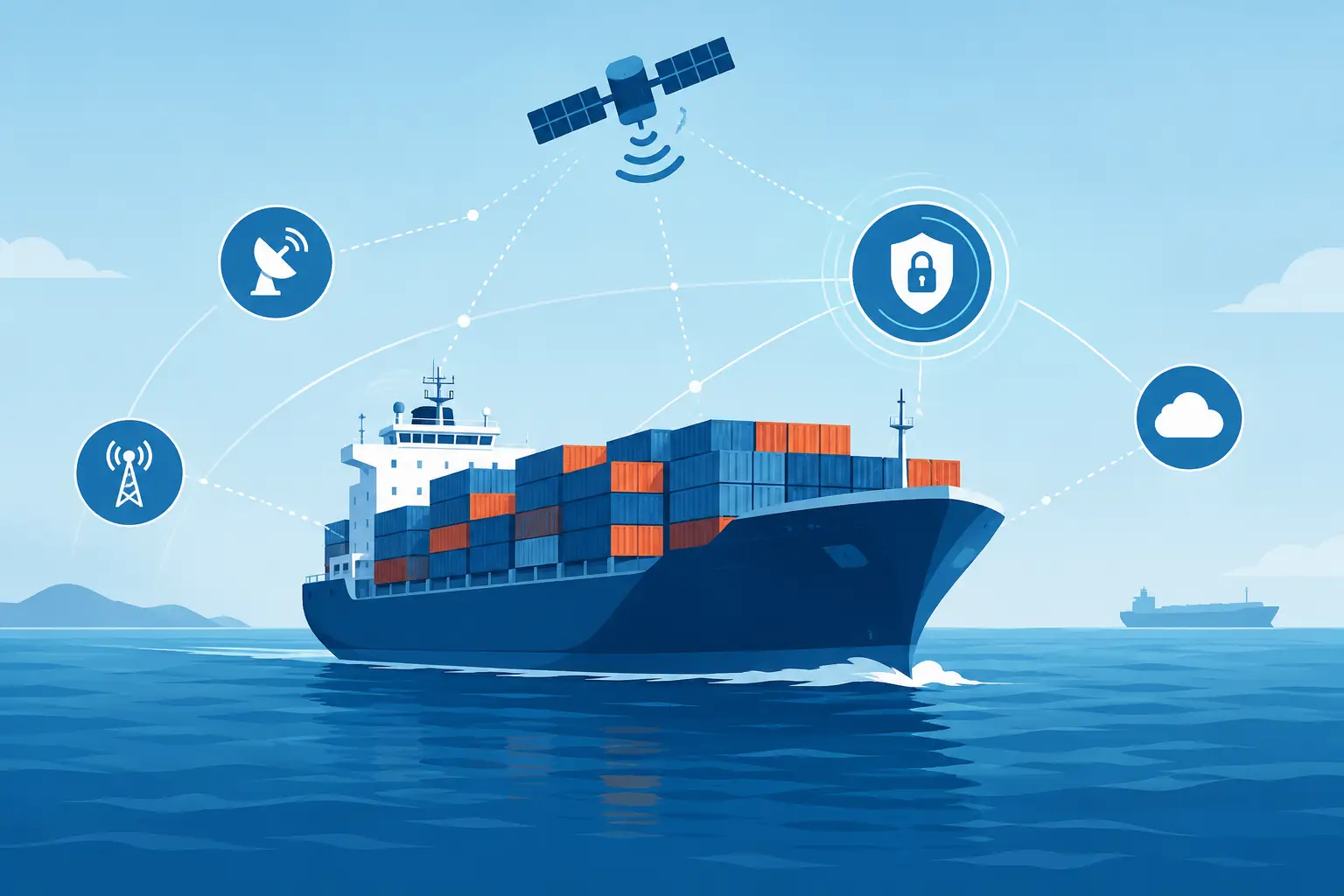
A dropped camera feed during cargo transfer is not a minor IT issue. It can delay decisions, reduce situational awareness, and leave the bridge, engine room, and shore team working from incomplete information. Marine connectivity trends are changing how operators prevent that exposure, with faster satellite services, hybrid network designs, and better edge systems moving from optional upgrades to operational infrastructure.
For ship managers, offshore operators, and industrial procurement teams, the question is no longer whether to connect vessels and remote assets. The commercial question is which connectivity architecture delivers dependable surveillance access, controlled bandwidth costs, and meaningful cyber protection in harsh operating conditions.
Marine Connectivity Trends Are Becoming Operational Requirements
Connectivity at sea once centered on crew communications, basic reporting, and periodic system updates. That model does not meet the needs of a modern vessel fleet, offshore platform, or marine terminal. Operations teams now expect access to live video, alarms, maintenance data, positioning information, and incident records without waiting for the vessel to reach port.
The strongest trend is the move toward hybrid connectivity. Instead of depending on one satellite path, operators combine low-Earth-orbit satellite capacity, geostationary satellite services, cellular coverage near shore, and port-based connections. A managed router selects the best available path according to availability, cost, application priority, and operational policy.
This approach has clear advantages, but it is not a simple matter of adding more bandwidth. Each link has different latency, coverage, contention, weather sensitivity, and commercial terms. A vessel operating on a transoceanic route needs a different design from a harbor tug, survey vessel, or fixed offshore installation. The right network starts with the mission, not the advertised download speed.
Low-Latency Satellite Changes What Can Be Monitored
New satellite services are raising expectations for real-time applications offshore. Lower latency supports faster remote troubleshooting, clearer video review, and more practical collaboration between shipboard personnel and shore-based specialists. For security teams, it can make the difference between seeing an event as it develops and reviewing it after the fact.
That does not mean every camera stream should be sent continuously to shore at maximum quality. High-resolution video can consume capacity quickly, especially where multiple cameras cover decks, access points, machinery spaces, cargo areas, or offshore perimeters. The strongest installations use local recording and intelligent event handling. Video remains available onboard at full quality, while selected streams, alarms, thumbnails, or lower-bandwidth views are sent remotely when needed.
This edge-first model protects evidence when satellite capacity is constrained or temporarily unavailable. It also gives operators more predictable monthly data use. Remote access remains a priority, but the vessel does not depend on a single outside connection to retain critical footage.
Network Segmentation Protects Surveillance Availability
More connectivity also creates more exposure. A vessel network may carry navigation-related systems, operational technology, crew welfare traffic, contractor devices, business applications, and IP surveillance. Treating all of that traffic as one shared environment is an avoidable risk.
Segmentation is becoming a core marine connectivity requirement. Separate network zones and VLANs help contain faults, limit unauthorized movement across the network, and preserve bandwidth for priority services. Surveillance equipment should have a defined network environment with controlled access rules, rather than being placed on the same unrestricted network used by personal devices or general office traffic.
A practical design typically prioritizes safety and security traffic over routine browsing and nonessential downloads. Quality-of-service policies can reserve capacity for alarm notifications, remote video access, recorder health alerts, and secure management sessions. When bandwidth is limited, the system should reduce noncritical traffic before it affects operational visibility.
Cybersecurity must also be built into equipment selection. Marine cameras, recorders, switches, wireless access points, and routers need managed credentials, current firmware support, encrypted administration, audit logs, and clear user permissions. Procurement teams should ask suppliers how devices are updated, how remote access is protected, and what happens if a component loses connection. A low purchase price has limited value if the equipment becomes difficult to manage or introduces a weak point into the vessel network.
Wi-Fi Coverage Is Now a Working-System Issue
Marine Wi-Fi has evolved beyond providing internet access in accommodation areas. Properly designed wireless coverage supports crew communications, onboard mobility, maintenance workflows, remote device access, and operational use cases across large steel structures. It must also handle conditions that are rarely seen in ordinary commercial buildings: vibration, salt exposure, compartment separation, machinery interference, and restricted cable routes.
Coverage planning matters. An access point installed in a convenient location may provide poor performance behind bulkheads, around equipment, or on open decks. Site surveys, antenna selection, cable routing, power protection, and enclosure ratings determine whether the system performs when it is needed. For offshore platforms and industrial marine facilities, hazardous-area requirements may also shape the complete design.
There is a trade-off between coverage density and complexity. More access points can improve capacity and reduce dead zones, but they also increase the number of devices requiring power, configuration, monitoring, and maintenance. The best service provider will recommend a measured system based on vessel layout, user count, critical applications, and environmental demands – not a generic package.
Surveillance Is Driving Network Investment
Security video is one of the clearest reasons marine operators are upgrading connectivity. Cameras can support access control verification, perimeter monitoring, cargo oversight, machinery-area visibility, incident investigation, and remote management. On offshore assets, underwater camera systems can extend inspection visibility below the waterline, while fixed surface cameras help operators monitor critical zones from a protected control location.
However, surveillance performance depends on more than the camera specification. The network must provide stable power, adequate switching capacity, protected cabling, recorder storage, and a reliable path for authorized remote users. A top-of-the-line camera cannot compensate for an undersized PoE switch, poor wireless backhaul, or an unplanned bandwidth bottleneck.
Operators are also adopting smarter event-based workflows. Instead of asking shore teams to watch every feed, systems can flag motion in restricted areas, loss of video, recorder faults, device tampering, or unauthorized access attempts. This creates a more usable alarm environment, provided the detection settings are calibrated carefully. Excessive false alarms cause alarm fatigue; settings that are too restrictive can miss meaningful activity. Commissioning should include real operating conditions, including changing light, vessel movement, weather, and expected deck activity.
What Procurement Teams Should Specify Now
Marine connectivity projects often fail because specifications focus on a single component rather than the entire operating chain. A satellite terminal, Wi-Fi access point, camera, or recorder should be evaluated as part of a complete security and communications system.
Procurement teams should require clear answers on these areas:
- Network topology, including primary and backup communications paths.
- Bandwidth management for surveillance, operational traffic, and crew use.
- Environmental ratings, corrosion protection, vibration tolerance, and power requirements.
- Local recording capacity and remote playback performance during restricted bandwidth conditions.
- Cybersecurity controls, firmware support, user access, and remote administration.
- Commissioning, documentation, spares, and support coverage across the operating region.
These requirements reduce costly surprises after installation. They also make it easier to compare suppliers on total operational value rather than device price alone. For multinational fleets and offshore operators, standardizing approved equipment and configurations can simplify training, spare holding, remote diagnostics, and compliance reporting.
Build for Degraded Conditions, Not Best-Case Conditions
The most dependable marine network is not designed around perfect satellite coverage and unlimited throughput. It is designed to degrade intelligently. If capacity falls, local recording continues. If the primary link fails, priority traffic moves to a backup path. If remote access is unavailable, onboard operators retain control of critical surveillance functions.
Revlight Security supports this practical approach with marine Wi-Fi, network solutions, and specialist surveillance equipment selected for demanding industrial environments. The objective is direct: give operators reliable visibility, protected communications, and equipment that remains serviceable under real offshore conditions.
Before approving the next connectivity upgrade, ask one operational question: when the vessel is far from shore, bandwidth is constrained, and an incident occurs, will the team still have the video, alarms, and access they need to act? That answer should guide the specification.
🛡️ Secure Your Home or Business Today
Protect your home, office, shop, or business with reliable CCTV security cameras. Explore our range of CCTV cameras and find the right security solution for your needs.
Explore CCTV Cameras ✉️ Email Us

 Singapore :
+65-6708-9302