
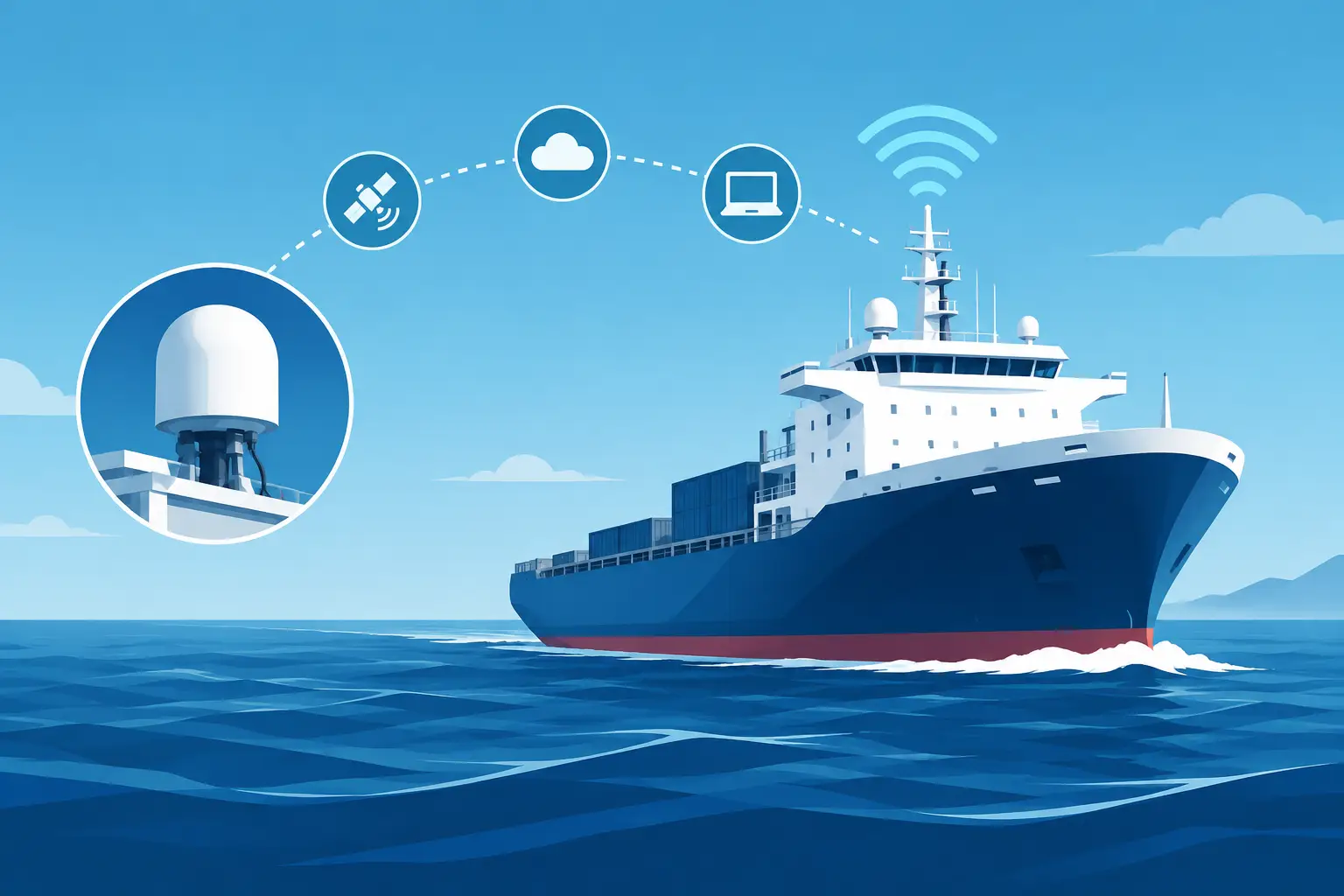
A shipboard connectivity upgrade is no longer limited to giving crew members stronger Wi-Fi in their cabins. It is an operational infrastructure decision that affects bridge communications, engineering workflows, remote surveillance, vendor support, welfare services, and cyber exposure. For vessel operators working under tight schedules and costly downtime, the right system must perform reliably through steel bulkheads, changing satellite links, port congestion, harsh weather, and constant movement.
The commercial question is simple: can the vessel network support essential operations without allowing nonessential traffic, unmanaged devices, or a single equipment failure to interrupt critical services? A properly designed upgrade answers yes, while giving operators greater visibility and control over every connected system on board.
Why a shipboard connectivity upgrade needs an operational design
Marine connectivity is different from an office-network refresh. A vessel has multiple user groups, competing priorities, and limited backhaul capacity. The bridge, engine room, security system, crew welfare network, business applications, and maintenance contractors may all need access, but they should not all receive the same service or share the same network path.
This is where many upgrades fail. An operator installs higher-capacity satellite service or new onboard Wi-Fi equipment, then leaves legacy switching, flat network design, weak access control, and uncontrolled bandwidth consumption in place. Internet speed may improve temporarily, but critical traffic remains vulnerable to congestion and unauthorized access.
A serious upgrade starts with the vessel’s mission. A tanker on extended voyages, an offshore support vessel, a workboat serving a platform, and a passenger vessel all have different traffic profiles. The solution depends on crew numbers, sailing routes, available backhaul services, connected operational technology, remote-access requirements, and the cost of losing communications during a critical task.
Start with network separation, not bandwidth claims
More bandwidth is valuable, but it is not the foundation of a secure marine network. Network segmentation is. Critical operational systems should be separated from crew internet access, guest services, security devices, and contractor connections. This limits the effect of malware, excessive streaming traffic, compromised credentials, or a poorly configured third-party device.
A practical vessel design commonly separates bridge and navigation traffic, engineering and machinery data, surveillance equipment, corporate applications, and crew welfare access. These segments can be managed through VLANs, controlled firewall rules, and quality-of-service policies that assign capacity according to operational priority.
For example, an IP surveillance system may need consistent local network performance for live monitoring and recording, even when the vessel’s satellite connection is under pressure. The cameras and recorder should continue working on the onboard network, while remote viewing is governed by defined bandwidth limits and user permissions. That approach protects evidence quality and avoids sacrificing vessel safety functions to uncontrolled internet traffic.
The same principle applies to remote maintenance. Vendors may require approved access to diagnose equipment, but permanent unrestricted access is not acceptable. Use authenticated, logged, time-limited connections that can be enabled when needed and reviewed afterward. This is a controlled service model, not an open doorway into vessel operations.
Build Wi-Fi coverage for steel, movement, and real use
Shipboard Wi-Fi should be engineered around coverage testing, not assumptions. Steel structures, machinery spaces, watertight doors, accommodation layouts, cargo areas, and deck equipment all affect radio performance. An access point that appears sufficient on a floor plan may produce dead zones or unstable handoffs in actual use.
A site survey should identify where personnel need reliable access: accommodation areas, offices, mess rooms, bridge-adjacent workspaces, workshops, control rooms, and designated deck locations. It should also identify where wireless access should be limited or prohibited. The goal is not to blanket every surface with signal. The goal is to deliver predictable service where operational and crew needs justify it.
Access point placement, antenna selection, channel planning, and power settings must be matched to the vessel environment. Marine-rated equipment and protected installation methods matter because vibration, humidity, salt exposure, and temperature swings shorten the life of poorly specified hardware. A lower upfront equipment price is not a saving if replacement requires a port call, onboard labor, reconfiguration, and interrupted service.
Capacity planning matters as much as coverage. A crew network designed for a handful of devices can become overloaded when every person carries multiple phones, tablets, and laptops. Add smart TVs, printers, maintenance tools, access-control devices, and networked surveillance equipment, and the traffic load grows quickly. The network should be sized for realistic peak use, not average use during quiet periods.
Protect satellite capacity with traffic control
Satellite and hybrid maritime links remain expensive relative to shore-based internet, and their available capacity can vary by route and service conditions. A top-of-the-line onboard network must therefore manage traffic intelligently rather than treating all usage as equal.
Quality-of-service policies can prioritize bridge communications, operational applications, approved remote support, and security traffic ahead of crew browsing or high-volume personal use. Application controls can restrict bandwidth-intensive services during defined periods, while crew portals can provide fair-use limits, usage visibility, and paid access options where appropriate.
This does not mean crew welfare should be treated as an afterthought. Reliable personal connectivity supports morale and retention, particularly on long rotations. The commercial advantage comes from setting clear policies that protect mission-critical services while delivering a consistent crew experience. Operators can offer scheduled access levels or bandwidth packages without allowing a small number of users to consume the vessel’s entire connection.
A multi-WAN design can also improve continuity. Where available, the network can use satellite, cellular service near shore, and port connectivity under defined failover rules. The design must account for session behavior, security policies, and the cost of each link. Automatic failover is useful only when it has been tested under realistic operating conditions.
Treat cyber protection as part of the equipment specification
Every added connection expands the attack surface. That includes Wi-Fi access points, switches, firewalls, surveillance recorders, remote-support tools, and connected sensors. Procurement teams should require more than a product data sheet. They should require a supportable security model.
At minimum, the system should provide managed user accounts, strong administrator controls, encrypted remote access, firewall policy management, firmware update procedures, event logging, and configuration backups. Default credentials must be eliminated before commissioning. Equipment that cannot be updated or supported over its expected service life creates an avoidable long-term risk.
Visibility is equally valuable. Vessel operators need to know what devices are connected, which network segment they use, how much traffic they generate, and whether unusual behavior requires investigation. This information supports faster troubleshooting and gives shore teams a clearer picture of fleet-wide exposure.
For surveillance installations, cybersecurity and physical security work together. Remote access should be authorized by role, recorded where necessary, and limited to the systems a user genuinely needs. High-quality video is valuable for incident review, perimeter monitoring, and operational oversight, but it must not become a weak point in the vessel network.
Commission for failure, not just normal operation
A connectivity installation is not complete when devices power on and users can browse the internet. Commissioning should prove that the system behaves correctly when the link degrades, an access point fails, a switch is restarted, or a user attempts to access a restricted network.
Test coverage in real work areas and accommodation spaces. Test network segmentation between operational, surveillance, and welfare networks. Test failover behavior, remote-access approval, bandwidth priority rules, and local video recording during a backhaul outage. Document the final configuration, equipment locations, IP plan, spare parts requirements, and support escalation process.
Crew and technical staff also need a usable handover. The best service provider does not leave operators with a complex installation and no practical way to administer it. Clear dashboards, labeled equipment, defined support contacts, and straightforward operating procedures reduce unnecessary service calls and shorten recovery time when an issue occurs.
Revlight Security supports marine operators with security-focused network and Wi-Fi solutions designed around real vessel conditions, not generic office assumptions. The right specification protects communications, supports surveillance performance, and gives decision-makers a clearer return on every connectivity dollar.
When planning the next upgrade, prioritize the systems that must remain available when capacity is limited or conditions deteriorate. A vessel network built around those priorities will deliver better security, better crew service, and fewer costly surprises at sea.
🛡️ Secure Your Home or Business Today
Protect your home, office, shop, or business with reliable CCTV security cameras. Explore our range of CCTV cameras and find the right security solution for your needs.
Explore CCTV Cameras ✉️ Email Us




 Singapore :
+65-6708-9302