
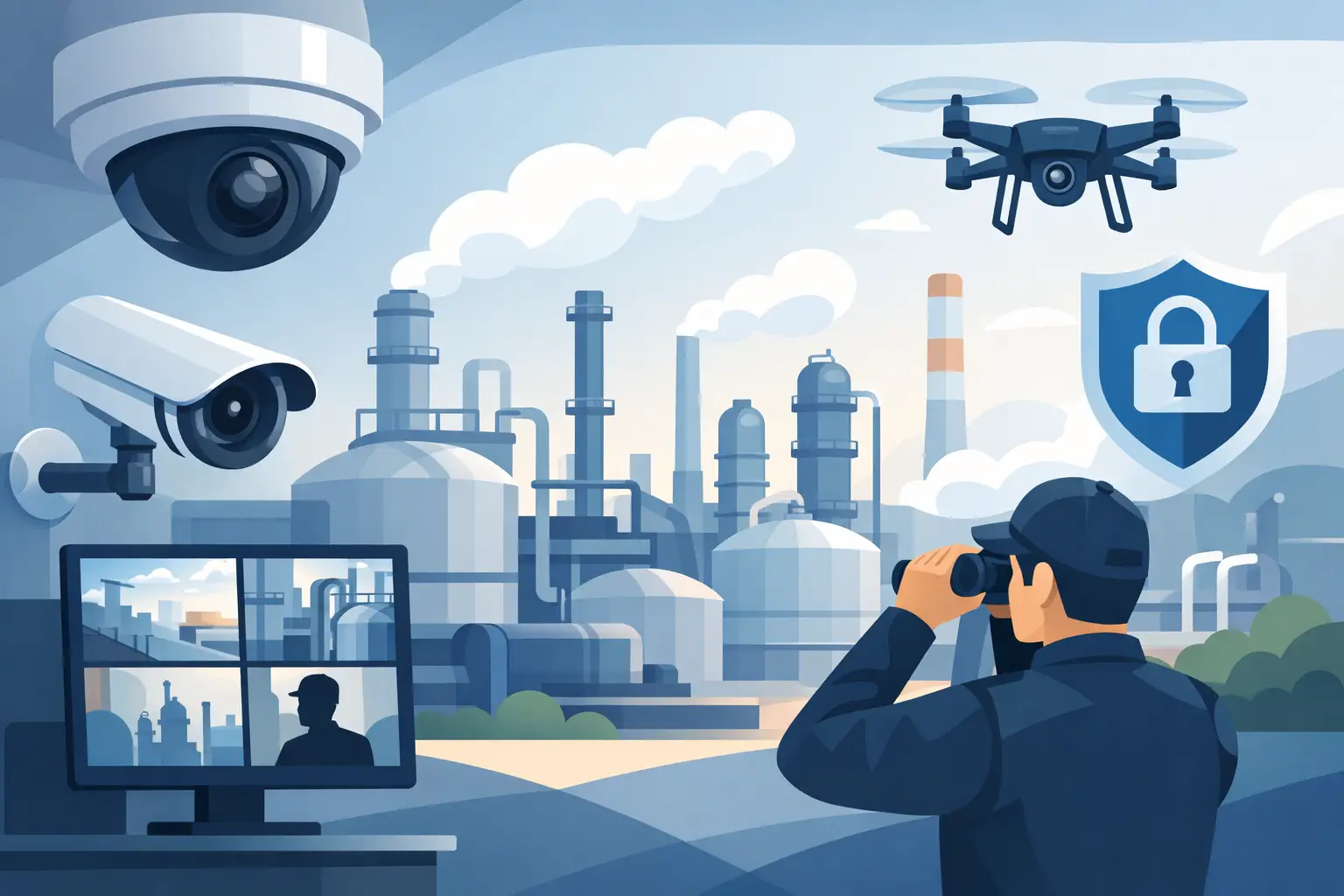
A blind spot in a chemical plant is not a minor inconvenience. It can mean a missed leak, an unverified alarm, a delayed shutdown decision, or a dispute you cannot resolve because the footage failed when conditions turned harsh. That is why the best surveillance for chemical plants is never just about adding more cameras. It is about building a system that keeps recording, stays visible in difficult environments, and gives operations teams usable evidence when pressure is high.
Procurement teams and plant managers usually face the same challenge: standard commercial security products look acceptable on paper, then fall short in corrosive atmospheres, high heat zones, washdown areas, hazardous process units, and large perimeter layouts. Chemical sites need surveillance that is specified for risk, not for a lobby or warehouse. The right design protects people, process continuity, compliance, and asset value at the same time.
What the best surveillance for chemical plants must do
In a chemical facility, surveillance has to serve operations as much as security. It needs to confirm what happened at a transfer point, monitor restricted process areas, support emergency response, and maintain visibility across loading bays, tank farms, control room approaches, fences, and utility corridors. If the system only records basic video, it is underperforming.
A strong plant surveillance setup starts with image quality, but image quality alone is not enough. Cameras need to hold performance in glare, darkness, steam, vibration, and weather. They need housings that tolerate corrosive environments and installation options that fit hazardous or hard-to-reach locations. On the backend, operators need dependable recording, playback, and remote access without losing control of bandwidth or storage costs.
This is where many buying decisions go wrong. Teams compare resolution, count channels, and unit cost, but fail to assess the environment where the equipment must survive. In chemical processing, durability is not an upgrade. It is part of baseline performance.
The core system: fixed coverage, thermal visibility, and detection layers
The best results usually come from a layered system rather than a single camera type. Fixed network cameras remain the foundation because they provide continuous visual coverage at gates, process lines, storage areas, flare zones, and access routes. They are the workhorses of recording and investigation.
But visible-light cameras have limits. Smoke, low light, and heat shimmer can reduce usable detail, especially around process equipment and wide outdoor spaces. Thermal imaging fills that gap by showing temperature contrast rather than depending on ambient light. For perimeter monitoring, tank farms, and night operations, thermal coverage can be a major upgrade in real detection performance.
Chemical facilities should also consider gas detection imaging where leak risk is part of daily operations. In certain use cases, specialized optical gas imaging adds a different level of situational awareness by helping teams identify hydrocarbon or chemical gas leaks that standard surveillance cannot see. This is not a replacement for fixed gas safety systems, but it can be a valuable visual verification tool for inspection, incident response, and process oversight.
The right combination depends on the plant. A bulk chemical terminal has different priorities than a specialty chemical manufacturing site. One may need stronger perimeter analytics and vehicle monitoring, while the other may place more value on process-area visibility and leak verification.
Environmental hardening matters more than headline specs
A camera that performs well in a clean indoor test does not automatically belong in a chemical plant. Procurement decisions should focus on enclosure quality, temperature tolerance, ingress protection, corrosion resistance, and long-term stability under constant exposure.
Some plants need stainless housings because coatings alone will not last. Others need explosion-protected or hazardous-area-rated equipment in classified zones. In washdown areas, lens contamination and housing integrity become practical daily issues, not technical footnotes. Near reactors, boilers, or hot pipe racks, heat management can affect uptime just as much as electronics quality.
This is why the best surveillance for chemical plants often costs more upfront than generic security packages. The trade-off is straightforward: lower-grade devices may reduce initial spend, but the savings disappear quickly when replacement cycles shorten, images degrade, and maintenance teams keep revisiting failed points. For industrial buyers, whole-life cost is the number that matters.
Network design is part of surveillance performance
Chemical plants are large, layered, and often operational around the clock. That makes the network just as important as the camera. Remote substations, tank farms, jetty areas, utility buildings, and long perimeter stretches can create serious transmission and power challenges.
A well-designed system accounts for bandwidth, latency, redundancy, and secure remote access from the start. If operators cannot pull up live video quickly during an alarm, the surveillance system is slowing the response instead of supporting it. If recording architecture cannot handle multi-site retention requirements, investigations become harder than they should be.
This is also where buyers should think beyond the camera count. More devices are not automatically better if the network cannot support clean streams, synchronized playback, and stable remote viewing. The strongest industrial systems are balanced systems. Cameras, recorders, transmission, storage, and operator access all need to be matched properly.
Where surveillance creates the most value in a chemical plant
The return on investment is usually highest where surveillance reduces uncertainty. Loading and unloading operations are a good example. Video helps verify driver behavior, hose connection procedures, spill events, and timing disputes. The same applies to tank farms, where remote visual confirmation can support safer monitoring of access and conditions.
Restricted process zones are another high-value area. When maintenance contractors, operators, and supervisors all move through critical spaces, clear recording supports both security and accountability. In emergency situations, visual confirmation can also help incident teams make faster, better decisions.
Perimeter protection matters too, especially for sites with large boundaries, remote sections, or high-consequence materials. Thermal cameras and long-range surveillance can reduce nuisance alarms and improve detection in low-light conditions where standard systems often underperform.
Then there is business continuity. When an incident occurs, playback quality and retention reliability become commercially important. Claims, audits, internal reviews, and regulatory scrutiny all move faster when the video record is clear and available.
How buyers should compare surveillance options
The fastest way to make a weak decision is to buy on price per camera. Industrial surveillance should be evaluated on fitness for the exact operating environment, expected service life, and the quality of the recorded result under real plant conditions.
Start with the risk map. Identify the zones where surveillance must deliver the highest certainty: hazardous process areas, perimeter lines, transfer points, utility nodes, control room approaches, and storage assets. Then match the camera and housing type to those conditions rather than trying to force one format across the whole site.
Next, assess the recording and access requirements. How many days of retention are needed? Who needs playback rights? Will operations teams require mobile or remote access? Is integration with existing plant networks realistic, or does the project need a segmented architecture? These questions affect system value more than cosmetic feature lists.
Finally, look closely at supplier capability. Chemical plants benefit from vendors that understand industrial deployment, not just security catalogs. Application knowledge matters because product selection, positioning, protection ratings, and network planning all affect final performance. A supplier with experience in oil and gas, marine, energy, and industrial surveillance environments will usually make stronger recommendations than one selling office-grade equipment at industrial prices.
Best surveillance for chemical plants is never one-size-fits-all
There is no single camera that qualifies as the best answer for every plant. Some sites need a heavy focus on explosion-protected devices. Others need thermal coverage across wide outdoor areas. Others gain the most from combining fixed video with gas leak detection imaging and reliable remote network access.
That is the practical reality for industrial buyers: the best system is the one that matches the hazards, layout, environmental stress, and operational goals of the facility. A small specialty plant may need a tightly controlled, high-durability network video system with strong playback and restricted-area coverage. A major chemical complex may require a broader mix of thermal, fixed, and detection technologies tied together across multiple zones and control points.
At Revlight Security, that is the standard worth aiming for – surveillance specified for the site you run, not for a generic building. When the environment is harsh and the stakes are commercial as well as operational, dependable visibility is not a luxury purchase. It is part of how serious plants stay secure, accountable, and ready to act when something changes.
🛡️ Secure Your Home or Business Today
Protect your home, office, shop, or business with reliable CCTV security cameras. Explore our range of CCTV cameras and find the right security solution for your needs.
Explore CCTV Cameras ✉️ Email Us



 Singapore :
+65-6708-9302
Singapore :
+65-6708-9302