
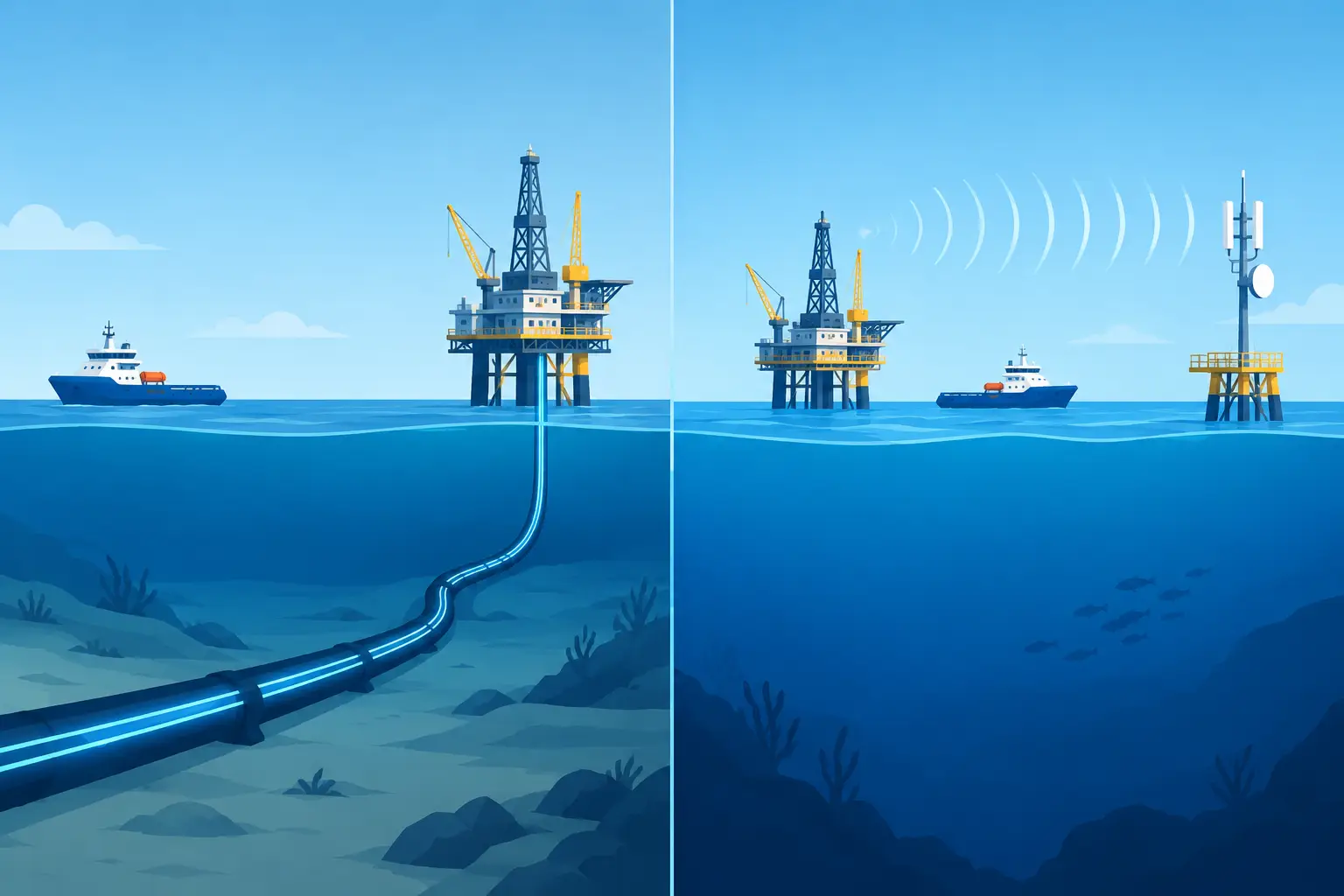
A surveillance network that drops during a transfer operation, gas alarm, or perimeter event is not a minor IT problem. It is an operational exposure. The decision between fiber versus wireless offshore networks determines how reliably live video, detection alarms, access-control data, crew communications, and remote diagnostics reach the people who need them. For fixed offshore assets, fiber often sets the performance standard. For vessels, temporary work sites, and fast-changing layouts, wireless can be the smarter commercial choice. The right answer is rarely one transport method used everywhere.
Fiber versus wireless offshore networks: the real decision
Procurement teams should not treat fiber and wireless as interchangeable ways to connect cameras. They have different physical limits, deployment costs, failure modes, and operating lifecycles.
Fiber uses light through a cable and delivers high bandwidth with low latency, strong resistance to electromagnetic interference, and a predictable connection once installed correctly. It is especially valuable when a platform must carry multiple high-resolution surveillance streams, thermal imaging feeds, underwater inspection cameras, control-system traffic, and corporate data over the same backbone.
Wireless transmits data through radio links. This can mean point-to-point microwave between offshore structures, industrial Wi-Fi across a deck or accommodation block, private cellular coverage, or a satellite connection for backhaul. Wireless avoids cable runs that may be difficult, hazardous, or expensive to install. Its performance, however, depends on spectrum planning, line of sight, antenna alignment, weather conditions, obstruction, and available backhaul capacity.
The practical question is not, “Which technology is better?” It is, “Which traffic must remain available at this location, at what performance level, and what is the cost of losing it?”
Where fiber delivers the strongest return
Fiber is the preferred backbone for permanent, bandwidth-intensive offshore installations. On a fixed platform, it supports aggregation from multiple camera zones, network video recorders, monitoring stations, access control panels, and industrial detection equipment without forcing operators to ration bandwidth.
Capacity for serious surveillance loads
A few standard camera streams may appear manageable on wireless. The equation changes quickly when an operator adds low-light cameras, PTZ coverage, thermal units, analytic alerts, long recording retention, and remote viewing from an onshore control room. Video requires consistent upstream capacity, not merely a headline speed shown on a wireless specification sheet.
Fiber gives security teams room to expand. It can carry many simultaneous streams while preserving capacity for recording, playback, software updates, voice, and operational data. It also supports lower and more stable latency, which improves PTZ response, live incident verification, and remote troubleshooting.
Better resistance in electrically noisy areas
Offshore facilities contain motors, generators, pumps, switchgear, and high-power equipment. Copper cabling can be affected by electrical interference and can create grounding complications. Fiber is nonconductive, which makes it highly suitable for routes through electrically demanding industrial areas when specified and installed to the required offshore standard.
This does not mean fiber is immune to risk. Cable damage, poor terminations, water ingress at enclosures, bend-radius violations, and inadequate route protection can still take a link offline. The advantage is that these risks are understood and manageable through correct design, armored cable selection where required, protected pathways, tested splicing, and documented maintenance procedures.
Long-term economics on fixed assets
The first cost of fiber can be substantial. Routing cables across modules, through hazardous areas, or between structures may require shutdown coordination, certified installers, penetrations, trays, and careful engineering review. But a fiber backbone usually has a long useful life. It reduces the need for repeat wireless redesigns as camera counts and data requirements grow.
For assets expected to operate for years, this matters. A lower-cost installation that reaches capacity in two years is not necessarily the lower-cost network.
Where wireless is the commercial advantage
Wireless earns its place offshore when speed, mobility, or difficult physical access outweigh the benefits of fixed cabling. A properly engineered wireless system is not a compromise by default. It is a targeted solution for areas where fiber is impractical or disproportionate to the required outcome.
Fast deployment across changing work zones
Temporary drilling support areas, laydown zones, vessel decks, construction barges, and inspection campaigns change faster than permanent cable infrastructure can be installed. Wireless links can provide coverage rapidly for security cameras, local monitoring, crew connectivity, and sensor gateways.
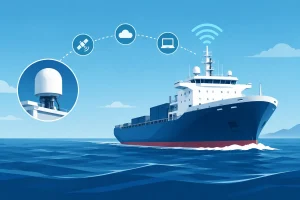
On vessels, movement and changing port conditions make extensive fixed external cabling less attractive. Internal fiber may still be ideal within the vessel, while wireless provides local coverage on deck and satellite or shore connectivity provides the wide-area path. This is an example of a hybrid network producing better results than a single-technology design.
Crossing water or inaccessible routes
A point-to-point microwave link can connect two facilities when subsea or over-water cable installation is commercially difficult. It can also create a secondary path for a critical platform network. Where line of sight is clear and the antenna system is engineered for the environment, microwave can provide high capacity with far less civil or marine installation work.
The limitations must be acknowledged upfront. Structures can obstruct the path. Vessel traffic can affect lower routes. Salt spray, vibration, corrosion, and wind loading demand marine-grade mounting hardware and enclosures. Higher-frequency links can be more susceptible to rain fade. A link that performs well during a short acceptance test may fail to meet expectations across a full seasonal weather cycle if the design margin is weak.
Managing wireless capacity honestly
Wireless bandwidth is shared and finite. Industrial Wi-Fi should not be designed as an afterthought after cameras, crew devices, scanners, and contractor equipment have already crowded the available radio channels. Segmenting operational devices from guest or crew access is essential, both for performance and cybersecurity.
For surveillance, calculate the actual bitrate of every stream, the required frame rate, codec, recording schedule, and peak-event behavior. Then account for retransmissions, protocol overhead, future camera additions, and a meaningful capacity margin. A wireless network that looks adequate at average load may become unreliable when multiple alarms trigger simultaneous live viewing and recording.
Build around criticality, not technology preference
The strongest offshore designs separate traffic by consequence. Life-safety alarms, process control, emergency communications, and critical detection systems require defined availability and should not compete casually with general internet access. Surveillance video can be mission-critical in restricted zones, transfer points, and perimeter approaches, but it should still be designed with sensible priorities and bandwidth controls.
A common architecture uses fiber as the core within a platform or facility. Managed industrial switches distribute service to camera clusters, detection devices, and recording equipment. Wireless then extends coverage to locations where cabling is difficult, including remote structures, temporary zones, and mobile assets. A second independent path, which may be microwave, satellite, or another approved service, can maintain essential monitoring when the primary route is unavailable.
Redundancy is not simply installing two links. The paths must avoid the same failure point. Two cables in the same unprotected tray are not truly diverse. Nor are two wireless radios on the same mast with the same power source and backhaul. Review power, routes, switching, antenna locations, and upstream connections as one resilience plan.
Security and maintainability belong in the purchase decision
Every offshore network carrying surveillance equipment needs controlled access, encrypted management, network segmentation, and disciplined credential management. Wireless requires particular attention because radio signals extend beyond physical walls. Use strong authentication, disable unnecessary services, keep firmware current, and monitor for unauthorized devices and unusual traffic patterns.
Maintainability has a direct effect on operating cost. Fiber systems need clear labeling, tested documentation, spare transceivers, protected patching, and technicians who can diagnose optical faults. Wireless systems need routine inspection of antennas, connectors, grounding, alignment, signal levels, interference, and weather sealing. Both need power protection and backup arrangements sized for the required outage period.
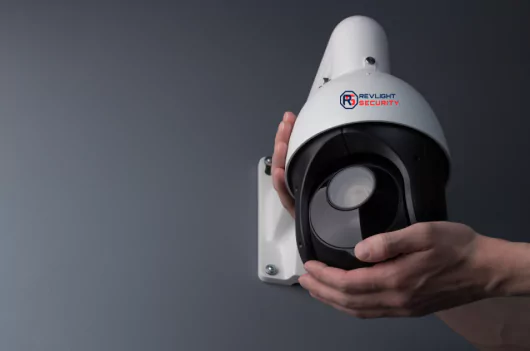
Revlight Security approaches offshore network planning as part of the surveillance outcome, not as a separate connectivity purchase. The goal is clear video, dependable detection, usable remote access, and recording that remains available when an incident requires evidence.
Specify the network from the mission backward
Start with the locations that cannot lose visibility. Define what must be monitored, who needs access, how long footage must be retained, and whether operators need real-time control or only recorded review. Then measure the true route conditions: distance, line of sight, hazardous-area requirements, available power, environmental exposure, physical access, and expected changes to the asset.
Fiber is the right investment when permanence, high capacity, low latency, and growth headroom lead the requirement. Wireless is the right tool when fast deployment, mobility, or hard-to-reach areas lead the requirement. A hybrid design is often the best service provider for offshore operations because it puts each technology where it performs at its best.
Choose the network that keeps the right eyes on the right risk, even when weather, workload, and operating conditions are working against it.
🛡️ Secure Your Home or Business Today
Protect your home, office, shop, or business with reliable CCTV security cameras. Explore our range of CCTV cameras and find the right security solution for your needs.
Explore CCTV Cameras ✉️ Email Us


 Singapore :
+65-6708-9302