
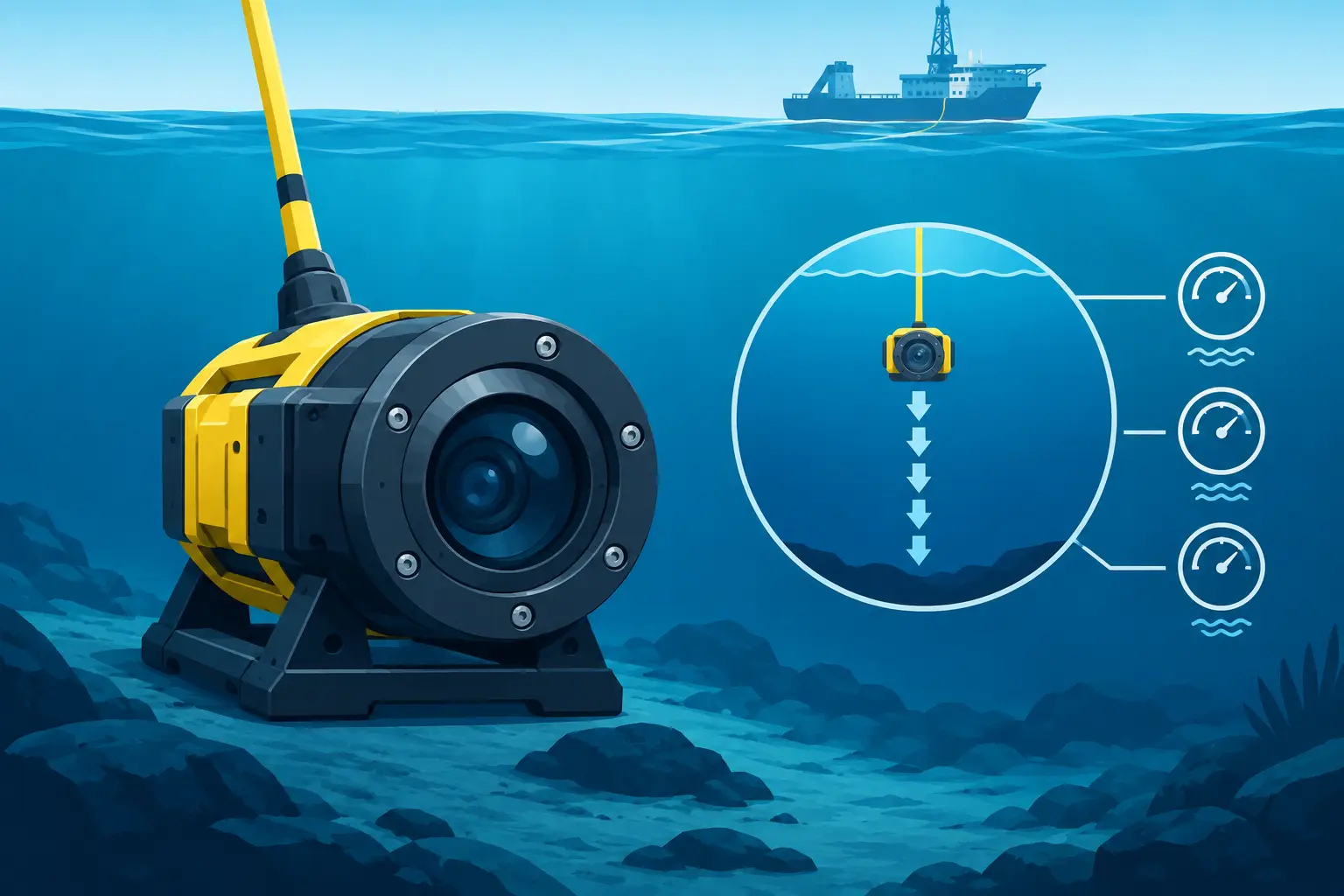
A camera may deliver excellent image quality in a workshop and fail before it reaches the asset. That is why subsea camera pressure ratings are a procurement and engineering decision, not a specification to skim past. For offshore platforms, vessels, pipelines, intake structures, and energy infrastructure, the rating determines whether the camera housing can protect its optics, electronics, seals, and cable entry points at the actual operating depth.
A pressure-rated subsea system supports safer inspection, clearer operational decisions, and fewer costly recoveries. The correct rating is not simply the deepest number on a data sheet. Buyers must account for water depth, pressure cycles, deployment method, fluid exposure, connectors, temperature, and the margin required by the job.
What subsea camera pressure ratings actually mean
A subsea camera pressure rating states the external hydrostatic pressure the complete unit is designed and tested to withstand. It is often expressed as a depth rating in meters or feet, or as pressure in bar, psi, or MPa. At sea level, equipment already experiences about 1 atmosphere of pressure. Roughly every 33 feet of seawater adds another atmosphere.
As a practical estimate, seawater pressure rises by approximately 0.445 psi per foot of depth, or about 14.5 psi for every 33 feet. A camera intended for 1,000 feet therefore encounters roughly 445 psi of additional external pressure. Exact pressure varies with salinity, temperature, and location, but the engineering requirement is clear: the housing must resist an enormous and sustained compressive load.
The rating applies to pressure outside the enclosure, not internal electronics alone. A proper subsea camera assembly includes the pressure housing, viewing port, end caps, sealing system, cable penetrator or wet-mate connector, and any integrated lighting. The lowest-rated part controls the usable depth. A 3,000-meter housing does not create a 3,000-meter system if its connector is only certified to 300 meters.
Depth rating is not the same as deployment depth
A stated depth rating may describe a design limit, a tested limit, or a recommended continuous operating limit. These are materially different claims. Procurement teams should ask the supplier which definition applies and whether the figure relates to the complete assembled system.
For critical offshore work, do not select a camera rated exactly to the anticipated maximum depth. Operating at the limit leaves little room for pressure spikes, uncertain bathymetry, vessel movement, pressure cycling, or future redeployment. A meaningful engineering margin is usually the better commercial choice because recovery, repair, and lost inspection time can exceed the initial difference in equipment cost.
Why pressure ratings matter beyond preventing leaks
Water ingress is the obvious failure mode, but it is not the only concern. Under pressure, a marginal housing can flex. Even slight deformation can affect focus, shift an optical port, compress seals unevenly, or create stress at connectors. The camera may remain dry yet produce compromised footage when operators need clear visual evidence.
Pressure also exposes weak points created by repeated deployment. Each descent and recovery cycle loads and unloads seals, connectors, cable terminations, and threaded interfaces. A system that passes a single pressure test is not automatically suitable for recurring inspection programs. This matters for operators conducting routine hull checks, seabed surveys, riser inspections, or surveillance around offshore assets.
The commercial consequence is straightforward. Selecting an appropriately rated system protects more than the device. It protects vessel time, crew schedules, work permits, inspection windows, and the quality of maintenance decisions made from recorded video.
Selecting the right rating for the mission
Start with the maximum operating depth, then evaluate the complete exposure profile. A shallow harbor inspection and a deepwater infrastructure survey may both require underwater imaging, but the camera selection process should not be the same.
A nearshore installation may require resistance to tidal variation, wave-induced movement, fouling, sediment, and frequent handling. A deeper application shifts the priority toward pressure resistance, reliable subsea connectors, stable imaging, and recovery planning. Cold water can stiffen materials and alter seal behavior, while warm process water or chemical exposure can affect elastomers, coatings, and cable jackets.
Consider these operational factors before specifying the equipment:
- Maximum depth, including clearance for changing tide, vessel motion, and uncertain asset elevation
- Static deployment versus repeated descent, recovery, and pressure cycling
- Water temperature, salinity, suspended solids, and corrosive contaminants
- Required video resolution, low-light performance, illumination range, and viewing angle
- Cable length, connector rating, power requirements, and topside recording or network integration
- Mounting arrangement, impact risk, and the ability to service seals between deployments
The objective is not to buy the highest pressure rating available in every case. Over-specification can add unnecessary size, weight, cost, and handling complexity. A heavy deepwater assembly may be a poor fit for a confined intake inspection or a fast-response vessel deployment. The best selection is the one that meets the true duty cycle with a defensible safety margin.
How housings, ports, and seals handle pressure
The camera housing is the foundation of pressure performance. Materials such as anodized aluminum, stainless steel, titanium, and specialized engineering polymers each present trade-offs in corrosion resistance, weight, machinability, cost, and depth capability. Material selection must match the environment and the service expectations, not just the headline depth.
Optical ports deserve the same scrutiny. The viewing window must remain clear and structurally stable while preserving the camera’s field of view. Port geometry can influence distortion, especially with wide-angle lenses. Acrylic, glass, and sapphire can each be appropriate depending on pressure requirements, optical performance, abrasion resistance, and budget.
Sealing is equally decisive. O-rings and other elastomeric seals require the right material, groove geometry, lubrication, compression, and maintenance discipline. A seal contaminated with grit, cut during assembly, or left beyond its service interval can defeat an otherwise high-quality pressure housing. For operators, this means purchasing decisions should consider access to spares, inspection procedures, and technician training.
Connectors and cable entry points are common limits
The pressure housing often receives the attention, while connectors receive too little. Yet cable penetrators and subsea connectors are frequent sources of failure. Their pressure rating must match or exceed the housing rating, and their electrical configuration must support the camera, lighting, telemetry, and recording requirements without improvised adaptations.
If the camera will connect to a surface monitoring system, confirm the full path: subsea lead, junction points, deck cable, power supply, video transport, recorder, and network interface. A dependable surveillance solution is only as strong as its weakest connection. This is particularly relevant where footage must be monitored live, recorded for review, or shared with control-room teams.
Questions to ask before issuing a purchase order
A serious supplier should be able to answer technical questions directly. Ask whether the rating is based on hydrostatic testing, what safety factor was applied, and whether the published value covers the fully assembled camera rather than an empty housing. Request clarity on the test medium, duration, and acceptance criteria.
Also establish whether the equipment is intended for one-time exposure or repeated pressure cycles. Confirm the rating of every installed component, including connectors, lights, pan-and-tilt units, and cable terminations. If the system will work near hydrocarbons, chemicals, or process infrastructure, verify material compatibility and any required hazardous-area considerations separately. Pressure rating alone does not establish suitability for a hazardous location.
For major projects, specify documentation requirements in the purchase order. Serial-number traceability, pressure-test records, maintenance guidance, and recommended seal replacement intervals give operations teams a clearer basis for acceptance and lifecycle planning.
Avoiding false confidence from a single specification
A high pressure number can be persuasive, but it should not replace application engineering. A camera rated for extreme depth may still be unsuitable if lighting is inadequate, the port is wrong for the required image, the cable is too short, or the topside system cannot provide reliable recording and playback.
Likewise, an apparently modest rating can be the right commercial solution for a controlled shallow-water application when backed by suitable materials, correct installation, and regular maintenance. The right choice depends on the whole inspection task, not a single number.
Revlight Security helps industrial buyers evaluate subsea surveillance systems as working infrastructure, with pressure capability, imaging performance, connectivity, and operating conditions considered together. Before deployment, match the documented pressure rating to the deepest credible exposure and verify every component in the assembly. That discipline turns subsea video from a potential point of failure into dependable evidence for safer, faster operational decisions.
🛡️ Secure Your Home or Business Today
Protect your home, office, shop, or business with reliable CCTV security cameras. Explore our range of CCTV cameras and find the right security solution for your needs.
Explore CCTV Cameras ✉️ Email Us

 Singapore :
+65-6708-9302