
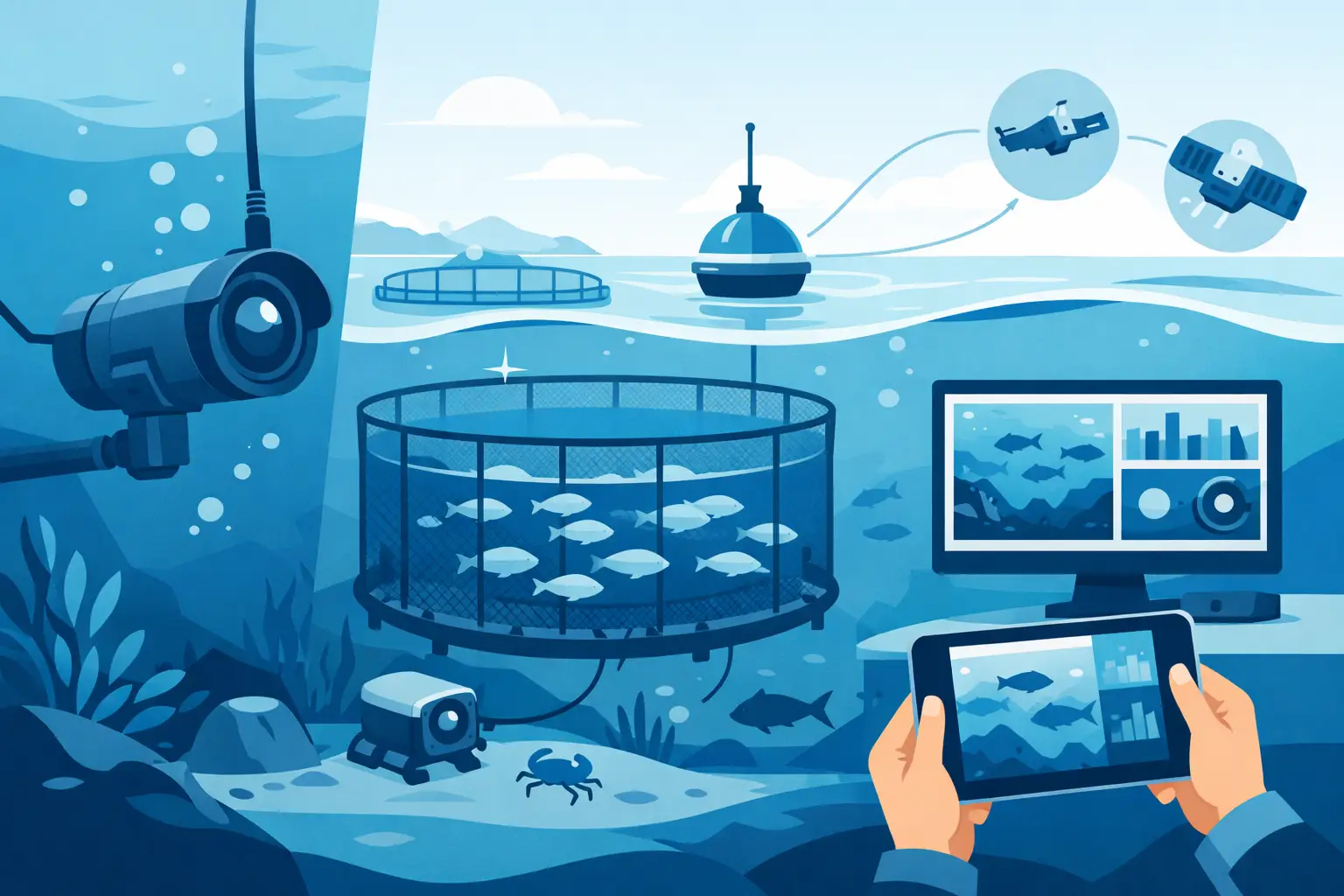
A missed feeding response can waste costly feed in minutes. A fouled lens can hide net damage until it becomes a stock-loss event. This representative aquaculture monitoring camera case study shows how a marine operator can use engineered underwater video to turn uncertain observations into documented operational decisions.
The scenario reflects a commercial offshore fish-farming site with multiple sea cages, demanding weather exposure, limited vessel time, and managers who need visibility without sending personnel into the water for every inspection. It is not a claim about a single named installation. It is a practical deployment model for operators evaluating fixed underwater surveillance as part of a broader farm-control strategy.
The operating problem: visibility was too dependent on vessel visits
The site team had experienced the familiar limits of surface-only observation. Feeding crews could see pellet activity at the surface, but they could not consistently verify behavior through the full water column. Welfare observations depended on scheduled boat rounds and diver inspections. Net condition checks were periodic, often weather-dependent, and records varied by shift.
This created three direct commercial pressures. Feed decisions were based partly on inference rather than visual confirmation. Maintenance teams had less time to plan interventions before biofouling, cage hardware movement, or net wear became more serious. Management also lacked consistent recorded footage when reviewing welfare events, contractor work, or operational disputes.
The goal was not simply to add more cameras. The operator needed a surveillance system that could maintain usable video in a corrosive marine environment, transmit footage to the right decision-makers, and support recording and playback without becoming another high-maintenance asset.
System design for the aquaculture monitoring camera case study
The proposed design used fixed underwater camera positions at selected cages, with viewing angles chosen around feeding zones, net walls, and areas where fish behavior could be assessed without excessive obstruction. Camera placement matters more than camera count. A poorly positioned high-resolution unit will deliver less operational value than a correctly placed unit with stable lighting, a clean viewing path, and reliable network access.
The installation model included pressure-rated underwater camera housings, marine-grade cabling, protected termination points, and network equipment selected for the site’s power and communications conditions. Video was routed to an onshore or vessel-based recording platform, depending on the farm layout and available backhaul. Authorized staff could review live feeds locally and access recorded footage for incident review, welfare checks, and maintenance planning.
Low-light performance was a key procurement requirement. Conditions below the surface change rapidly with depth, weather, turbidity, algae, and seasonal daylight. The system therefore had to be specified around the required inspection task, not just a headline resolution figure. Fish behavior during feeding may require broad scene coverage, while net integrity inspection may need a narrower field of view and higher detail.
Lighting was considered carefully. Supplemental illumination can improve inspection quality, but it must be selected and positioned to limit backscatter in suspended particles. In clear water, lighting may provide strong results. In turbid conditions, the same approach can reduce contrast and create glare. This is why site water conditions should shape the final camera and illumination specification.
Deployment: build around decisions, not equipment labels
Before installation, the operations team defined what each viewing point had to answer. At feeding locations, supervisors needed to see whether fish were actively taking feed, remaining below the feed zone, or showing behavior that suggested a need to change the feeding rate. At net-facing positions, maintenance personnel needed enough detail to identify fouling patterns, tension concerns, and areas requiring closer inspection.
That decision-led approach avoided a common purchasing mistake: buying a general underwater video system with no agreed workflow. A camera feed that nobody owns, reviews, or records against a process will quickly become background noise. At this site, feeding personnel checked designated views during scheduled feed windows, while maintenance staff reviewed net-facing footage on a defined inspection cycle.
The recording policy also mattered. Continuous recording provides the strongest incident trail but consumes more storage and network capacity. Event-based recording can reduce storage demand but may miss the early signs of developing issues. The selected approach combined continuous recording during operational windows with retention settings sized around investigation needs, available bandwidth, and the company’s internal evidence requirements.
Remote access was controlled by user permissions. This gave farm managers and technical support personnel access to relevant feeds without exposing the entire surveillance network. For distributed operations, this is a major advantage. A superintendent can review a concern before authorizing a vessel trip, while an operations director can compare footage and reports across sites without waiting for manually collected media.
What the operator could measure after installation
Within the first operating period, the principal value was not a single dramatic event. It was the steady replacement of guesswork with visible evidence. Feeding teams had a clearer basis for adjusting rates. Supervisors could compare fish behavior between cages and shifts. Maintenance planners could prioritize vessel and labor time toward conditions visible in recorded footage.
The system also improved accountability. When a concern was raised, teams could review the relevant time window rather than rely only on recollection. That matters when assessing irregular feeding activity, confirming contractor work, investigating suspected equipment movement, or documenting conditions before and after maintenance.
The operational gains can be assessed through practical measures rather than vague claims:
- reduced unnecessary vessel or diver callouts for first-stage visual checks;
- more consistent feeding observations documented across shifts;
- faster escalation of visible net, mooring, or cage-condition concerns;
- improved evidence retention for welfare, maintenance, and management review; and
- better use of specialist labor by sending personnel to confirmed priorities.
Actual savings depend on farm size, stocking approach, water clarity, local labor cost, vessel availability, and how actively the video system is used. A camera network will not replace statutory inspections, veterinary assessment, diver work, or physical net repair. It does, however, give those teams better information before they mobilize.
Technical lessons from the installation
The first lesson is that uptime starts with mechanical and environmental engineering. Saltwater exposure, cable strain, pressure, marine growth, impact risk, and connector corrosion must be addressed at the design stage. Selecting a camera solely on image specifications while treating housing, cable routing, power protection, and mounting hardware as secondary items is a costly error.
The second lesson is that lens cleanliness is an operating requirement. Biofouling can degrade an otherwise excellent image quickly. The site should establish a cleaning and inspection schedule based on local growth rates, not a generic calendar. In some conditions, frequent maintenance is necessary; in others, cleaning intervals can be longer. A camera position that is difficult to reach may require a different mounting approach or a more deliberate service plan.
Third, network capacity must match the video plan. Multiple high-quality feeds can create substantial bandwidth and storage demand, particularly where live remote viewing and continuous recording are required. Operators should calculate expected data loads before deployment, then account for peak use, remote connection limits, recording retention, and the reliability of marine wireless or fiber pathways.
Fourth, operators should avoid treating every cage as identical. Water depth, current direction, feed delivery method, cage design, and fish behavior can all alter the useful viewing angle. A pilot installation on a representative cage can validate placement before a full-scale rollout. This reduces rework and gives procurement teams real evidence for the final specification.
Procurement criteria that protect long-term value
For procurement managers, the right question is not, “What is the lowest camera price?” It is, “What will this system cost to keep producing usable evidence over its service life?” The purchase evaluation should include environmental ratings, pressure capability, corrosion resistance, cable and connector quality, mounting options, low-light performance, recording compatibility, remote access controls, warranty support, and the availability of replacement components.
Serviceability deserves equal attention. If a unit fails, can the team isolate the fault quickly? Can a damaged cable section be replaced without taking an entire viewing area offline? Are recordings protected during a network interruption? These details determine whether surveillance remains dependable during the period when it is most needed.
Revlight Security approaches marine and industrial surveillance as operational infrastructure, not a consumer-grade add-on. The right underwater video design gives farm operators a clearer view of feeding, welfare indicators, net condition, and maintenance priorities while supporting the disciplined evidence trail expected in serious commercial operations.
The most useful next step is to map the decisions your team currently makes without enough visibility, then specify each camera position around those decisions. When the footage has a clear operational owner and a clear purpose, underwater surveillance becomes a working asset rather than another screen in the control room.
🛡️ Secure Your Home or Business Today
Protect your home, office, shop, or business with reliable CCTV security cameras. Explore our range of CCTV cameras and find the right security solution for your needs.
Explore CCTV Cameras ✉️ Email Us



 Singapore :
+65-6708-9302
Singapore :
+65-6708-9302