
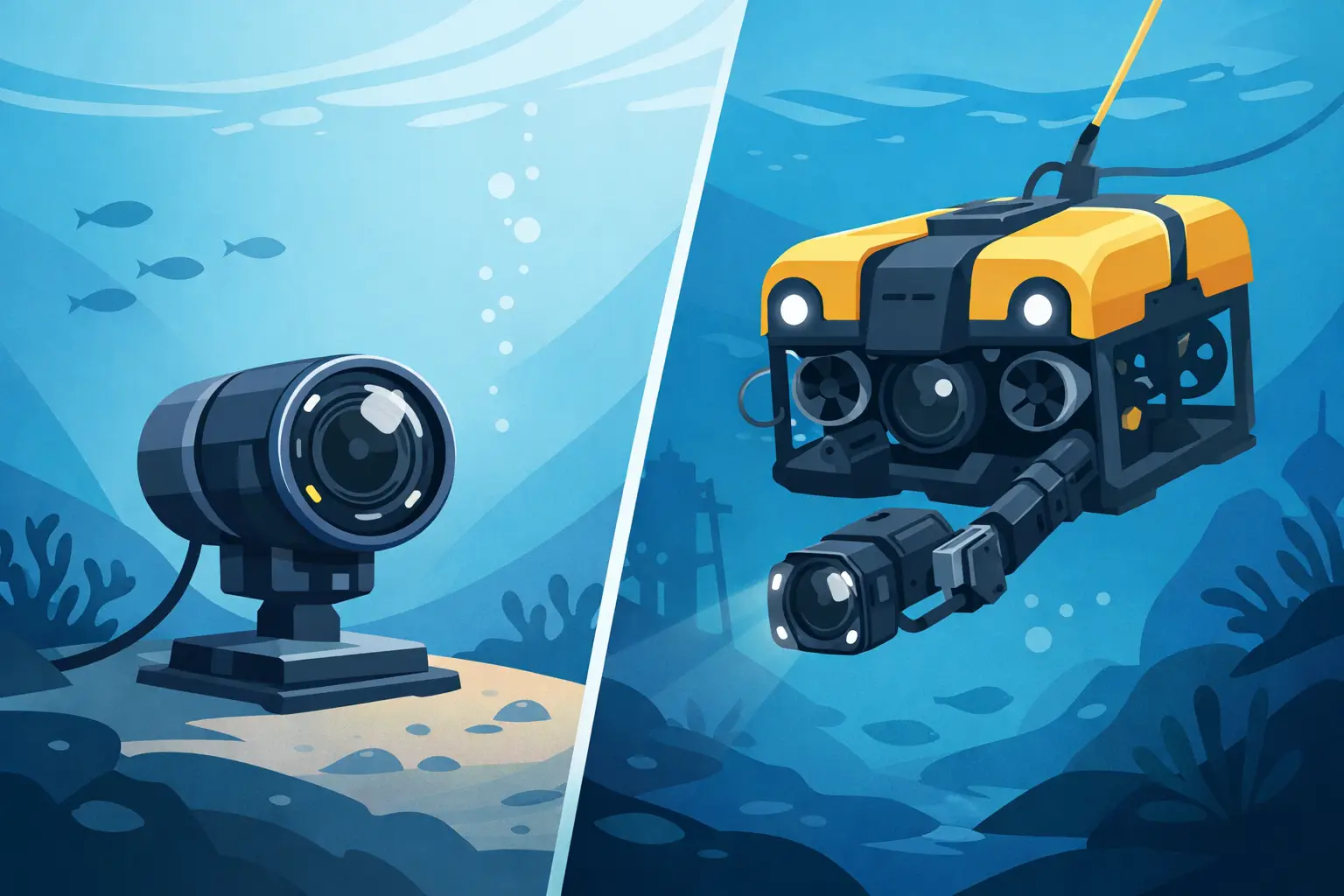
A damaged riser clamp, fouled sea chest, or suspicious hull condition cannot wait for a vessel to return to port. The subsea camera vs rov camera decision determines how quickly your team can see the problem, how much of the asset they can inspect, and what the operation will cost. These systems are often discussed as alternatives, but they solve different surveillance and inspection requirements.
For offshore platforms, vessels, terminals, power stations, and industrial marine facilities, the right choice starts with the task. A fixed or deployable subsea camera provides persistent visibility at a known point. An ROV camera provides mobile visual coverage wherever the remotely operated vehicle can travel. Selecting the wrong format can leave critical areas unobserved or add unnecessary vehicle, crew, and mobilization costs.
Subsea Camera vs ROV Camera: The Real Difference
A subsea camera is a pressure-rated imaging unit designed to operate below the waterline. It may be permanently installed on a structure, mounted in a fixed inspection location, lowered on a cable, or integrated into a specialized monitoring assembly. Its main advantage is dependable observation of a defined area, such as a platform leg, mooring point, intake structure, berth, sea chest, or vessel hull zone.
An ROV camera is also a subsea imaging system, but it is mounted on a remotely operated vehicle. The vehicle supplies mobility, positioning, lighting support, and often multiple viewing angles. Operators use it to inspect long routes, irregular structures, underwater equipment, and locations that cannot be monitored from one fixed camera position.
That distinction matters commercially. If your requirement is continuous monitoring of one high-value location, a subsea camera installation is usually the more efficient security investment. If the inspection area changes from job to job or extends across hundreds of feet of pipe, cable, hull, or seabed infrastructure, an ROV-based system is generally the stronger operational tool.
When a Fixed Subsea Camera Is the Better Investment
A fixed subsea camera is built for repeatable visibility. It gives control rooms, marine crews, and asset managers a stable reference view without launching a vehicle for every check. This is valuable when conditions need to be observed over time rather than documented during a single campaign.
Typical applications include berth and quay wall monitoring, platform splash-zone observation, underwater access points, water intakes, mooring chains, vessel docking areas, and critical zones around offshore infrastructure. A camera can be connected to a local recorder or network architecture for live viewing, recorded playback, alarm investigation, and authorized remote access. For facilities already operating surveillance networks, this can make underwater video part of the same broader security picture.
The limits are straightforward. A fixed camera only sees what it is aimed at. Marine growth, sediment, debris, poor water clarity, and changing lighting conditions can reduce useful image quality. Positioning must be planned carefully, with suitable illumination, cable protection, mounting design, and maintenance access. A camera that is technically rated for depth but poorly located will not deliver reliable evidence or actionable inspection video.
For permanent deployment, buyers should look beyond resolution. Pressure rating, housing material, connector sealing, cable specification, low-light performance, LED lighting output, operating temperature, and compatibility with recording and network equipment all affect service life. In saltwater environments, corrosion resistance and marine-grade engineering are operational requirements, not optional upgrades.
Where an ROV Camera Delivers More Value
An ROV camera earns its cost when the mission requires movement. The vehicle can travel along a hull, inspect propellers and rudders, examine subsea valves, follow pipelines, investigate dropped objects, and reach areas that are unsafe or impractical for divers. It can also approach the subject from different angles, which is essential when confirming cracks, marine growth, obstruction, damage, or tampering.
ROV systems often carry more than one camera. A forward-facing unit helps the pilot navigate, while a higher-resolution inspection camera documents the condition of the asset. Depending on the vehicle and mission profile, additional lighting, sonar, positioning systems, manipulators, and recording equipment may be available. That package delivers a much wider inspection capability than a single stationary unit.
However, mobility introduces dependencies. An ROV requires a suitable vehicle, tether management, power, surface control equipment, trained operators, launch and recovery procedures, and weather planning. Vessel time can become a major part of the total cost. In confined waters, strong currents, poor visibility, or heavy marine traffic can also affect deployment windows and inspection quality.
For scheduled surveys, outage planning, emergency assessment, and route-based inspection work, those requirements are justified. For a daily view of the same underwater gate or mooring point, they are usually excessive.
Image Quality Is Only One Part of the Specification
Procurement teams frequently begin with camera resolution. High-definition video is valuable, but image quality underwater depends on the full system. Suspended particles reflect light back toward the lens, producing glare and reducing contrast. In dark water, poorly positioned lighting can make a high-resolution camera deliver poor usable footage.
A fixed subsea camera should be specified with its field of view, mounting distance, target size, light level, and water conditions in mind. Wide-angle coverage is useful for scene awareness, while a narrower view may be better for identifying a component, reading markings, or examining a defined structural area. The same applies to ROV payloads, where a navigation view and a detailed inspection view often serve separate purposes.
Low-light sensitivity, color performance, white balance, optical distortion, and lighting geometry deserve direct attention during system selection. For evidence-grade incident review or engineering assessment, recording quality and time synchronization are also significant. A clear live picture is not enough if the recorded file is compressed beyond practical use or cannot be matched to the time and location of the event.
Consider Control, Recording, and Network Integration
The most effective underwater surveillance systems do more than display a video feed. They support operational decisions. Fixed systems can be integrated with recording platforms, operator displays, access-controlled remote viewing, and alarm workflows. This is particularly useful where security teams need a documented record of activity around assets below the waterline.
ROV video should be managed with the same discipline. Missions benefit from recorded footage, camera overlays, inspection logs, and clear file retention procedures. If the footage will support maintenance planning, claims, regulatory review, or contractor acceptance, establish image quality standards before the job begins. Repeating a marine inspection because the original video is poorly lit or incorrectly recorded wastes time and budget.
Network design also matters. Long cable runs, power delivery, signal conversion, subsea penetrators, surface enclosures, and cybersecurity controls must be selected as one system. Revlight Security approaches underwater surveillance as infrastructure, not as an isolated camera purchase. That is the level of planning required when video supports critical industrial operations.
Compare Total Cost, Not Purchase Price
A fixed subsea camera can have a higher initial installation requirement when mounting hardware, cabling, civil work, and network integration are involved. Once installed, it can reduce recurring inspection costs by providing immediate visibility without vessel or ROV mobilization. It is particularly attractive for sites where the same condition must be checked frequently.
An ROV camera system can be more economical for occasional, wide-area, or changing inspection requirements. Buying and maintaining a vehicle may not make sense for every operator, while project-based deployment can provide advanced capability when it is needed. The trade-off is that each inspection depends on equipment availability, qualified personnel, and suitable operating conditions.
The correct decision therefore depends on inspection frequency, area coverage, depth, water clarity, risk level, available infrastructure, and the cost of not seeing a developing problem. Many operations benefit from both: fixed subsea surveillance at critical locations, supported by ROV inspections for detailed investigation and broader coverage.
Before requesting pricing, define the target asset, operating depth, required viewing distance, desired recording period, lighting conditions, and how quickly video must reach the decision-maker. A well-defined requirement gives your engineering, security, and procurement teams a system that protects uptime rather than simply adding another camera to the inventory.
🛡️ Secure Your Home or Business Today
Protect your home, office, shop, or business with reliable CCTV security cameras. Explore our range of CCTV cameras and find the right security solution for your needs.
Explore CCTV Cameras ✉️ Email Us

 Singapore :
+65-6708-9302
Singapore :
+65-6708-9302